

226
A. Cole and G. Shiu
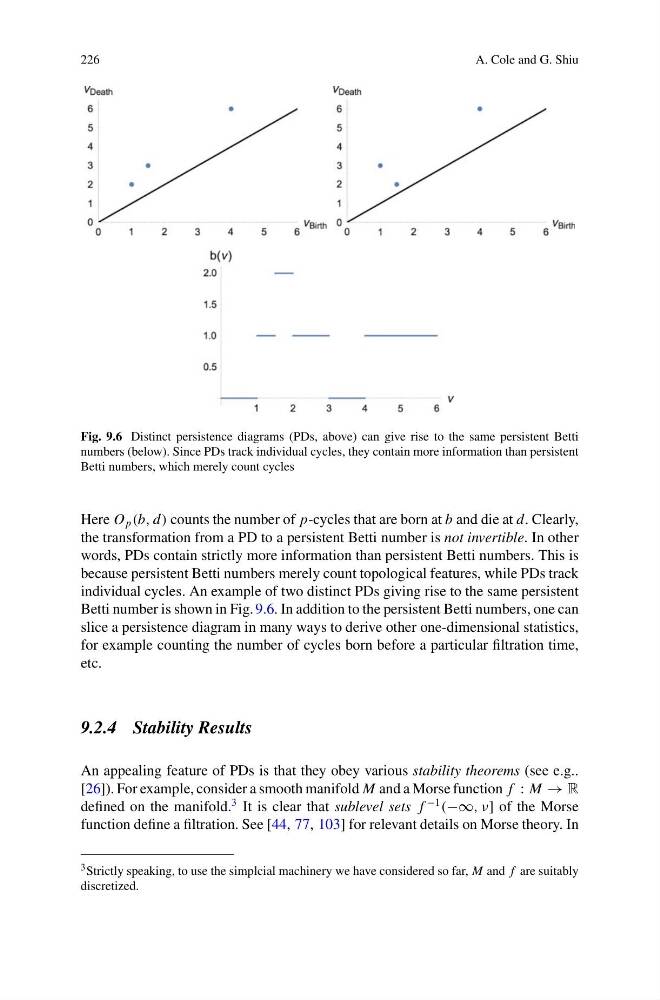
Fig. 9.6 Distinct persistence diagrams (PDs, above) can give rise to the same persistent Betti
numbers (below). Since PDs track individual cycles, they contain more information than persistent
Betti numbers, which merely count cycles
Here O p (b, d) counts the number of p-cycles that are born at b and die at d. Clearly,
the transformation from a PD to a persistent Betti number is not invertible. In other
words, PDs contain strictly more information than persistent Betti numbers. This is
because persistent Betti numbers merely count topological features, while PDs track
individual cycles. An example of two distinct PDs giving rise to the same persistent
Betti number is shown in Fig. 9.6. In addition to the persistent Betti numbers, one can
slice a persistence diagram in many ways to derive other one-dimensional statistics,
for example counting the number of cycles born before a particular filtration time,
etc.
9.2.4 Stability Results
An appealing feature of PDs is that they obey various stability theorems (see e.g..
[26]). For example, consider a smooth manifold M and a Morse function f : M → R
defined on the manifold.
3 It is clear that sublevel sets f
−1
(−∞, ν] of the Morse
function define a filtration. See [44, 77, 103] for relevant details on Morse theory. In
3 Strictly speaking, to use the simplcial machinery we have considered so far, M and f are suitably
discretized.
A. Cole and G. Shiu
Fig. 9.6 Distinct persistence diagrams (PDs, above) can give rise to the same persistent Betti
numbers (below). Since PDs track individual cycles, they contain more information than persistent
Betti numbers, which merely count cycles
Here O p (b, d) counts the number of p-cycles that are born at b and die at d. Clearly,
the transformation from a PD to a persistent Betti number is not invertible. In other
words, PDs contain strictly more information than persistent Betti numbers. This is
because persistent Betti numbers merely count topological features, while PDs track
individual cycles. An example of two distinct PDs giving rise to the same persistent
Betti number is shown in Fig. 9.6. In addition to the persistent Betti numbers, one can
slice a persistence diagram in many ways to derive other one-dimensional statistics,
for example counting the number of cycles born before a particular filtration time,
etc.
9.2.4 Stability Results
An appealing feature of PDs is that they obey various stability theorems (see e.g..
[26]). For example, consider a smooth manifold M and a Morse function f : M → R
defined on the manifold.
3 It is clear that sublevel sets f
−1
(−∞, ν] of the Morse
function define a filtration. See [44, 77, 103] for relevant details on Morse theory. In
3 Strictly speaking, to use the simplcial machinery we have considered so far, M and f are suitably
discretized.