

224
A. Cole and G. Shiu
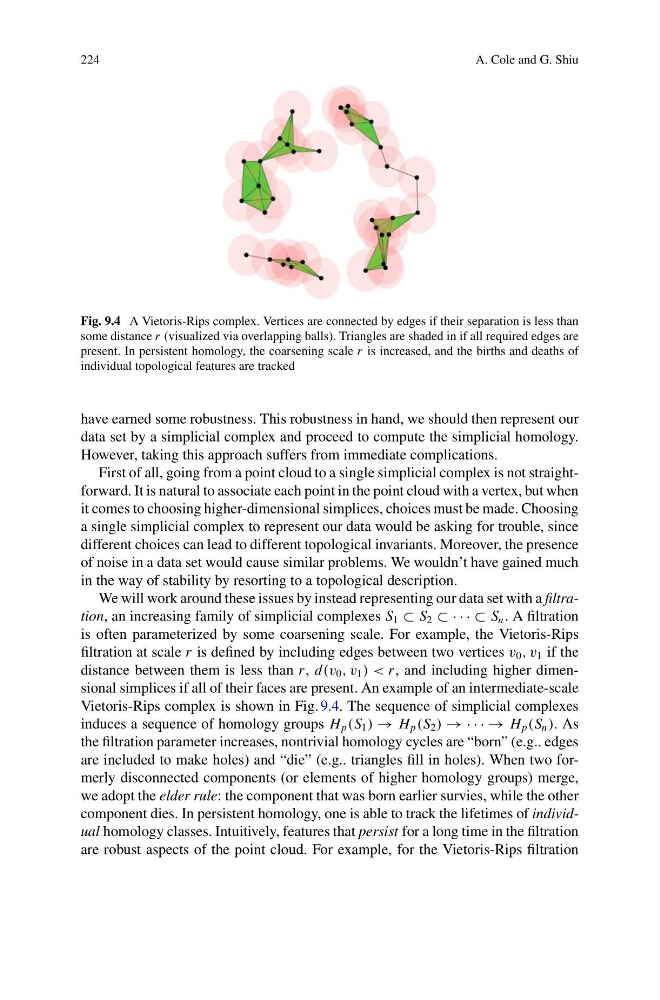
Fig. 9.4 A Vietoris-Rips complex. Vertices are connected by edges if their separation is less than
some distance r (visualized via overlapping balls). Triangles are shaded in if all required edges are
present. In persistent homology, the coarsening scale r is increased, and the births and deaths of
individual topological features are tracked
have earned some robustness. This robustness in hand, we should then represent our
data set by a simplicial complex and proceed to compute the simplicial homology.
However, taking this approach suffers from immediate complications.
First of all, going from a point cloud to a single simplicial complex is not straightforward. It is natural to associate each point in the point cloud with a vertex, but when
it comes to choosing higher-dimensional simplices, choices must be made. Choosing
a single simplicial complex to represent our data would be asking for trouble, since
different choices can lead to different topological invariants. Moreover, the presence
of noise in a data set would cause similar problems. We wouldn’t have gained much
in the way of stability by resorting to a topological description.
We will work around these issues by instead representing our data set with a filtration, an increasing family of simplicial complexes S 1 ⊂ S 2 ⊂ · · · ⊂ S n . A filtration
is often parameterized by some coarsening scale. For example, the Vietoris-Rips
filtration at scale r is defined by including edges between two vertices v 0 , v 1 if the
distance between them is less than r , d(v 0 , v 1 ) < r , and including higher dimensional simplices if all of their faces are present. An example of an intermediate-scale
Vietoris-Rips complex is shown in Fig. 9.4. The sequence of simplicial complexes
induces a sequence of homology groups H p (S 1 ) → H p (S 2 ) → · · · → H p (S n ). As
the filtration parameter increases, nontrivial homology cycles are “born” (e.g.. edges
are included to make holes) and “die” (e.g.. triangles fill in holes). When two formerly disconnected components (or elements of higher homology groups) merge,
we adopt the elder rule: the component that was born earlier survies, while the other
component dies. In persistent homology, one is able to track the lifetimes of individual homology classes. Intuitively, features that persist for a long time in the filtration
are robust aspects of the point cloud. For example, for the Vietoris-Rips filtration
A. Cole and G. Shiu
Fig. 9.4 A Vietoris-Rips complex. Vertices are connected by edges if their separation is less than
some distance r (visualized via overlapping balls). Triangles are shaded in if all required edges are
present. In persistent homology, the coarsening scale r is increased, and the births and deaths of
individual topological features are tracked
have earned some robustness. This robustness in hand, we should then represent our
data set by a simplicial complex and proceed to compute the simplicial homology.
However, taking this approach suffers from immediate complications.
First of all, going from a point cloud to a single simplicial complex is not straightforward. It is natural to associate each point in the point cloud with a vertex, but when
it comes to choosing higher-dimensional simplices, choices must be made. Choosing
a single simplicial complex to represent our data would be asking for trouble, since
different choices can lead to different topological invariants. Moreover, the presence
of noise in a data set would cause similar problems. We wouldn’t have gained much
in the way of stability by resorting to a topological description.
We will work around these issues by instead representing our data set with a filtration, an increasing family of simplicial complexes S 1 ⊂ S 2 ⊂ · · · ⊂ S n . A filtration
is often parameterized by some coarsening scale. For example, the Vietoris-Rips
filtration at scale r is defined by including edges between two vertices v 0 , v 1 if the
distance between them is less than r , d(v 0 , v 1 ) < r , and including higher dimensional simplices if all of their faces are present. An example of an intermediate-scale
Vietoris-Rips complex is shown in Fig. 9.4. The sequence of simplicial complexes
induces a sequence of homology groups H p (S 1 ) → H p (S 2 ) → · · · → H p (S n ). As
the filtration parameter increases, nontrivial homology cycles are “born” (e.g.. edges
are included to make holes) and “die” (e.g.. triangles fill in holes). When two formerly disconnected components (or elements of higher homology groups) merge,
we adopt the elder rule: the component that was born earlier survies, while the other
component dies. In persistent homology, one is able to track the lifetimes of individual homology classes. Intuitively, features that persist for a long time in the filtration
are robust aspects of the point cloud. For example, for the Vietoris-Rips filtration