

9 Towards the “Shape” of Cosmological Observables and the String …
221
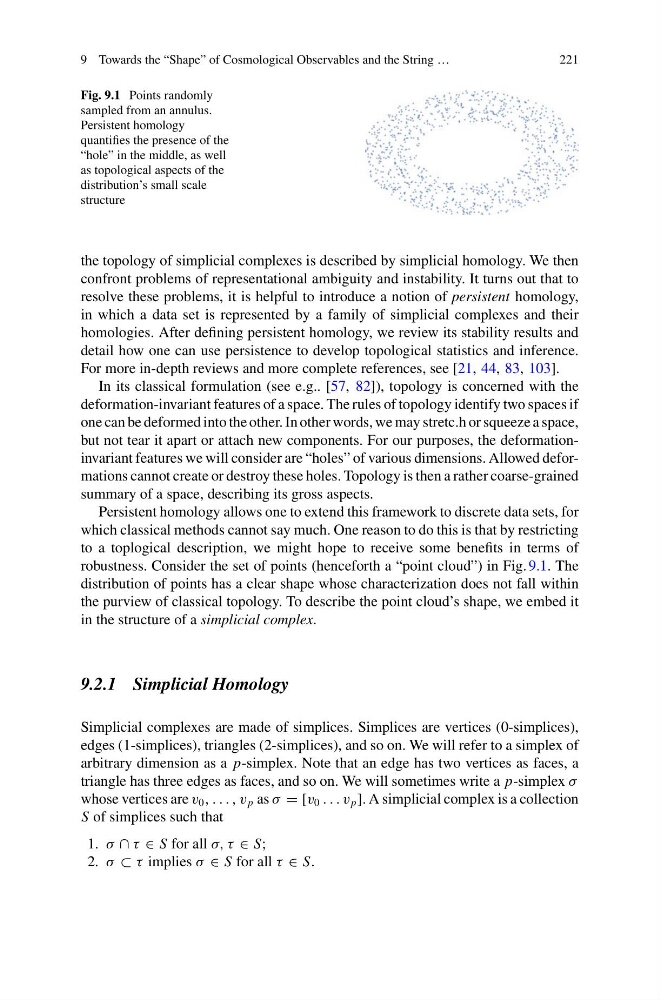
Fig. 9.1 Points randomly
sampled from an annulus.
Persistent homology
quantifies the presence of the
“hole” in the middle, as well
as topological aspects of the
distribution’s small scale
structure
the topology of simplicial complexes is described by simplicial homology. We then
confront problems of representational ambiguity and instability. It turns out that to
resolve these problems, it is helpful to introduce a notion of persistent homology,
in which a data set is represented by a family of simplicial complexes and their
homologies. After defining persistent homology, we review its stability results and
detail how one can use persistence to develop topological statistics and inference.
For more in-depth reviews and more complete references, see [21, 44, 83, 103].
In its classical formulation (see e.g.. [57, 82]), topology is concerned with the
deformation-invariant features of a space. The rules of topology identify two spaces if
one can be deformed into the other. In other words, we may stretc.h or squeeze a space,
but not tear it apart or attach new components. For our purposes, the deformationinvariant features we will consider are “holes” of various dimensions. Allowed deformations cannot create or destroy these holes. Topology is then a rather coarse-grained
summary of a space, describing its gross aspects.
Persistent homology allows one to extend this framework to discrete data sets, for
which classical methods cannot say much. One reason to do this is that by restricting
to a toplogical description, we might hope to receive some benefits in terms of
robustness. Consider the set of points (henceforth a “point cloud”) in Fig. 9.1. The
distribution of points has a clear shape whose characterization does not fall within
the purview of classical topology. To describe the point cloud’s shape, we embed it
in the structure of a simplicial complex.
9.2.1 Simplicial Homology
Simplicial complexes are made of simplices. Simplices are vertices (0-simplices),
edges (1-simplices), triangles (2-simplices), and so on. We will refer to a simplex of
arbitrary dimension as a p-simplex. Note that an edge has two vertices as faces, a
triangle has three edges as faces, and so on. We will sometimes write a p-simplex σ
whose vertices are v 0 , . . . , v p as σ = [v 0 . . . v p ]. A simplicial complex is a collection
S of simplices such that
1. σ ∩ τ ∈ S for all σ, τ ∈ S;
2. σ ⊂ τ implies σ ∈ S for all τ ∈ S.
221
Fig. 9.1 Points randomly
sampled from an annulus.
Persistent homology
quantifies the presence of the
“hole” in the middle, as well
as topological aspects of the
distribution’s small scale
structure
the topology of simplicial complexes is described by simplicial homology. We then
confront problems of representational ambiguity and instability. It turns out that to
resolve these problems, it is helpful to introduce a notion of persistent homology,
in which a data set is represented by a family of simplicial complexes and their
homologies. After defining persistent homology, we review its stability results and
detail how one can use persistence to develop topological statistics and inference.
For more in-depth reviews and more complete references, see [21, 44, 83, 103].
In its classical formulation (see e.g.. [57, 82]), topology is concerned with the
deformation-invariant features of a space. The rules of topology identify two spaces if
one can be deformed into the other. In other words, we may stretc.h or squeeze a space,
but not tear it apart or attach new components. For our purposes, the deformationinvariant features we will consider are “holes” of various dimensions. Allowed deformations cannot create or destroy these holes. Topology is then a rather coarse-grained
summary of a space, describing its gross aspects.
Persistent homology allows one to extend this framework to discrete data sets, for
which classical methods cannot say much. One reason to do this is that by restricting
to a toplogical description, we might hope to receive some benefits in terms of
robustness. Consider the set of points (henceforth a “point cloud”) in Fig. 9.1. The
distribution of points has a clear shape whose characterization does not fall within
the purview of classical topology. To describe the point cloud’s shape, we embed it
in the structure of a simplicial complex.
9.2.1 Simplicial Homology
Simplicial complexes are made of simplices. Simplices are vertices (0-simplices),
edges (1-simplices), triangles (2-simplices), and so on. We will refer to a simplex of
arbitrary dimension as a p-simplex. Note that an edge has two vertices as faces, a
triangle has three edges as faces, and so on. We will sometimes write a p-simplex σ
whose vertices are v 0 , . . . , v p as σ = [v 0 . . . v p ]. A simplicial complex is a collection
S of simplices such that
1. σ ∩ τ ∈ S for all σ, τ ∈ S;
2. σ ⊂ τ implies σ ∈ S for all τ ∈ S.