

1 IG of Poincaré inequalities …
11
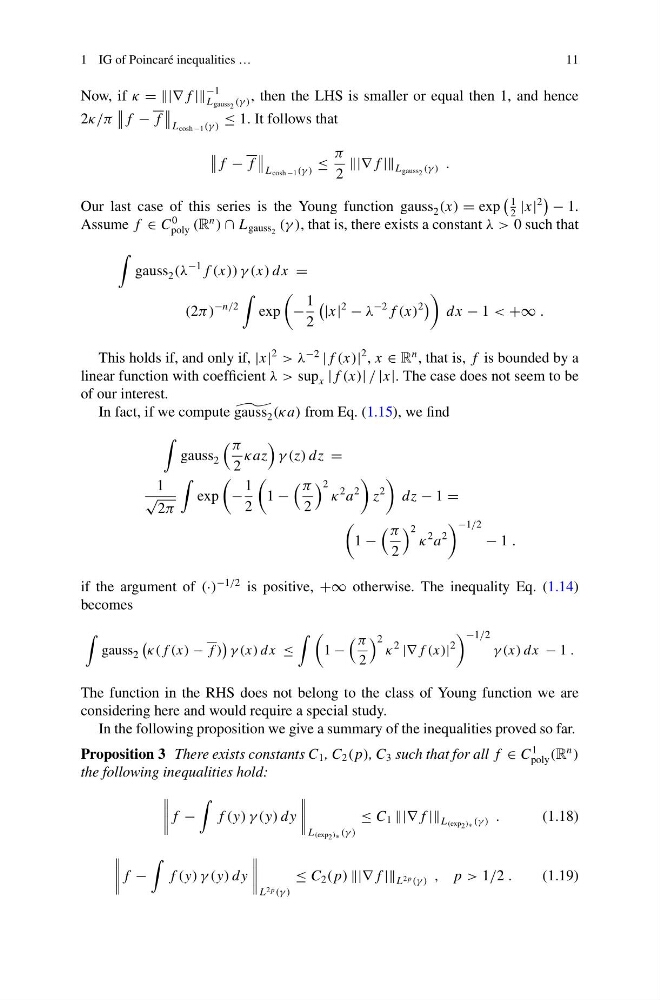
Now, if κ = |∇ f ||
−1
L gauss 2 (γ ) , then the LHS is smaller or equal then 1, and hence
2κ/π
f − f
L cosh −1( γ )
≤ 1. It follows that
f − f
L cosh −1( γ )
≤
π
2
|∇ f || L gauss 2 (γ ) .
Our last case of this series is the Young function gauss 2 (x) = exp
1
2
|x|
2
− 1.
Assume f ∈ C
0
poly (R
n
) ∩ L gauss 2 (γ ), that is, there exists a constant λ > 0 such that
gauss 2 (λ
−1 f (x)) γ (x) dx =
(2π)
−n/2
exp
−
1
2
|x|
2
− λ
−2 f (x)
2
dx − 1 < +∞ .
This holds if, and only if, |x|
2
> λ
−2
| f (x)|
2 , x ∈ R
n , that is, f is bounded by a
linear function with coefficient λ > sup x | f (x)| / |x|. The case does not seem to be
of our interest.
In fact, if we compute
gauss 2 (κa) from Eq. (1.15), we find
gauss 2
π
2
κaz
γ (z) dz =
1
√
2π
exp
−
1
2
1 −
π
2
2 κ
2 a
2
z
2
dz − 1 =
1 −
π
2
2 κ
2 a
2
−1/2
− 1 .
if the argument of (·)
−1/2 is positive, +∞ otherwise. The inequality Eq. (1.14)
becomes
gauss 2
κ( f (x) − f )
γ (x) dx ≤
1 −
π
2
2 κ
2
|∇ f (x)|
2
−1/2
γ (x) dx − 1 .
The function in the RHS does not belong to the class of Young function we are
considering here and would require a special study.
In the following proposition we give a summary of the inequalities proved so far.
Proposition 3 There exists constants C 1 , C 2 ( p), C 3 such that for all f ∈ C
1
poly (R
n
)
the following inequalities hold:
f −
f (y) γ (y) dy
L (exp 2 )∗ (γ )
≤ C 1 |∇ f || L (exp 2 )∗ (γ ) .
(1.18)
f −
f (y) γ (y) dy
L 2 p (γ )
≤ C 2 ( p) |∇ f || L 2 p (γ ) , p > 1/2 .
(1.19)
11
Now, if κ = |∇ f ||
−1
L gauss 2 (γ ) , then the LHS is smaller or equal then 1, and hence
2κ/π
f − f
L cosh −1( γ )
≤ 1. It follows that
f − f
L cosh −1( γ )
≤
π
2
|∇ f || L gauss 2 (γ ) .
Our last case of this series is the Young function gauss 2 (x) = exp
1
2
|x|
2
− 1.
Assume f ∈ C
0
poly (R
n
) ∩ L gauss 2 (γ ), that is, there exists a constant λ > 0 such that
gauss 2 (λ
−1 f (x)) γ (x) dx =
(2π)
−n/2
exp
−
1
2
|x|
2
− λ
−2 f (x)
2
dx − 1 < +∞ .
This holds if, and only if, |x|
2
> λ
−2
| f (x)|
2 , x ∈ R
n , that is, f is bounded by a
linear function with coefficient λ > sup x | f (x)| / |x|. The case does not seem to be
of our interest.
In fact, if we compute
gauss 2 (κa) from Eq. (1.15), we find
gauss 2
π
2
κaz
γ (z) dz =
1
√
2π
exp
−
1
2
1 −
π
2
2 κ
2 a
2
z
2
dz − 1 =
1 −
π
2
2 κ
2 a
2
−1/2
− 1 .
if the argument of (·)
−1/2 is positive, +∞ otherwise. The inequality Eq. (1.14)
becomes
gauss 2
κ( f (x) − f )
γ (x) dx ≤
1 −
π
2
2 κ
2
|∇ f (x)|
2
−1/2
γ (x) dx − 1 .
The function in the RHS does not belong to the class of Young function we are
considering here and would require a special study.
In the following proposition we give a summary of the inequalities proved so far.
Proposition 3 There exists constants C 1 , C 2 ( p), C 3 such that for all f ∈ C
1
poly (R
n
)
the following inequalities hold:
f −
f (y) γ (y) dy
L (exp 2 )∗ (γ )
≤ C 1 |∇ f || L (exp 2 )∗ (γ ) .
(1.18)
f −
f (y) γ (y) dy
L 2 p (γ )
≤ C 2 ( p) |∇ f || L 2 p (γ ) , p > 1/2 .
(1.19)