

10
G. Pistone
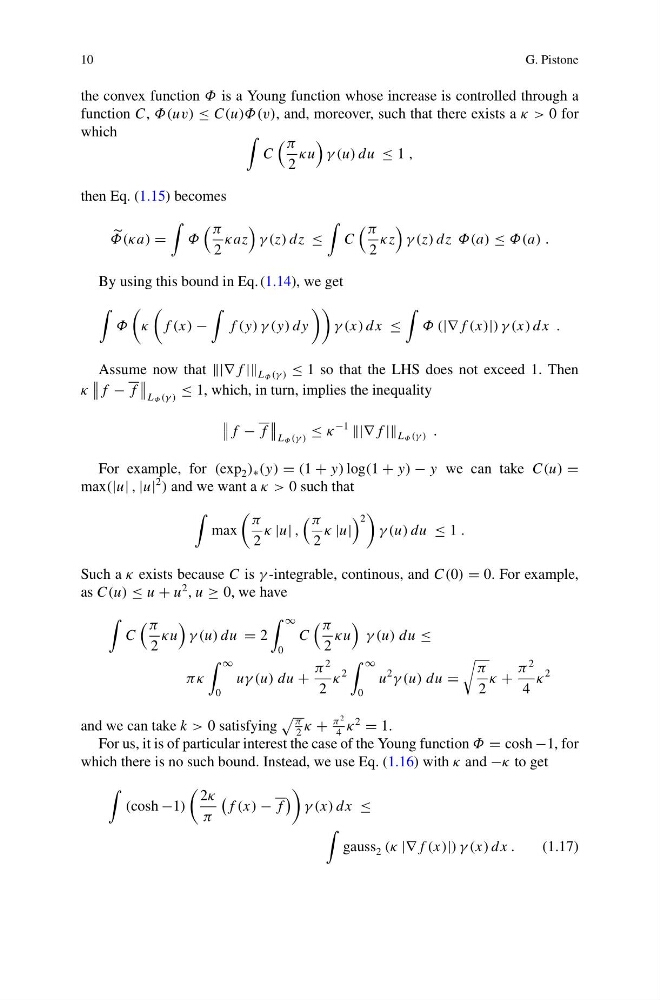
the convex function Φ is a Young function whose increase is controlled through a
function C, Φ(uv) ≤ C(u)Φ(v), and, moreover, such that there exists a κ > 0 for
which
C
π
2
κu
γ (u) du ≤ 1 ,
then Eq. (1.15) becomes
Φ(κa) =
Φ
π
2
κaz
γ (z) dz ≤
C
π
2
κz
γ (z) dz Φ(a) ≤ Φ(a) .
By using this bound in Eq. (1.14), we get
Φ
κ
f (x) −
f (y) γ (y) dy
γ (x) dx ≤
Φ (|∇ f (x)|) γ (x) dx .
Assume now that |∇ f || L Φ (γ ) ≤ 1 so that the LHS does not exceed 1. Then
κ
f − f
L Φ (γ )
≤ 1, which, in turn, implies the inequality
f − f
L Φ (γ )
≤ κ
−1
|∇ f || L Φ (γ ) .
For example, for (exp 2 ) ∗ (y) = (1 + y) log(1 + y) − y we can take C(u) =
max(|u| , |u|
2
) and we want a κ > 0 such that
max
π
2
κ |u| ,
π
2
κ |u|
2
γ (u) du ≤ 1 .
Such a κ exists because C is γ -integrable, continous, and C(0) = 0. For example,
as C(u) ≤ u + u
2 , u ≥ 0, we have
C
π
2
κu
γ (u) du = 2
∞
0
C
π
2
κu
γ (u) du ≤
πκ
∞
0
uγ (u) du +
π
2
2
κ
2
∞
0
u
2
γ (u) du =
π
2
κ +
π
2
4
κ
2
and we can take k > 0 satisfying
π
2
κ +
π
2
4
κ
2
= 1.
For us, it is of particular interest the case of the Young function Φ = cosh −1, for
which there is no such bound. Instead, we use Eq. (1.16) with κ and −κ to get
(cosh −1)
2κ
π
f (x) − f
γ (x) dx ≤
gauss 2 (κ |∇ f (x)|) γ (x) dx .
(1.17)
G. Pistone
the convex function Φ is a Young function whose increase is controlled through a
function C, Φ(uv) ≤ C(u)Φ(v), and, moreover, such that there exists a κ > 0 for
which
C
π
2
κu
γ (u) du ≤ 1 ,
then Eq. (1.15) becomes
Φ(κa) =
Φ
π
2
κaz
γ (z) dz ≤
C
π
2
κz
γ (z) dz Φ(a) ≤ Φ(a) .
By using this bound in Eq. (1.14), we get
Φ
κ
f (x) −
f (y) γ (y) dy
γ (x) dx ≤
Φ (|∇ f (x)|) γ (x) dx .
Assume now that |∇ f || L Φ (γ ) ≤ 1 so that the LHS does not exceed 1. Then
κ
f − f
L Φ (γ )
≤ 1, which, in turn, implies the inequality
f − f
L Φ (γ )
≤ κ
−1
|∇ f || L Φ (γ ) .
For example, for (exp 2 ) ∗ (y) = (1 + y) log(1 + y) − y we can take C(u) =
max(|u| , |u|
2
) and we want a κ > 0 such that
max
π
2
κ |u| ,
π
2
κ |u|
2
γ (u) du ≤ 1 .
Such a κ exists because C is γ -integrable, continous, and C(0) = 0. For example,
as C(u) ≤ u + u
2 , u ≥ 0, we have
C
π
2
κu
γ (u) du = 2
∞
0
C
π
2
κu
γ (u) du ≤
πκ
∞
0
uγ (u) du +
π
2
2
κ
2
∞
0
u
2
γ (u) du =
π
2
κ +
π
2
4
κ
2
and we can take k > 0 satisfying
π
2
κ +
π
2
4
κ
2
= 1.
For us, it is of particular interest the case of the Young function Φ = cosh −1, for
which there is no such bound. Instead, we use Eq. (1.16) with κ and −κ to get
(cosh −1)
2κ
π
f (x) − f
γ (x) dx ≤
gauss 2 (κ |∇ f (x)|) γ (x) dx .
(1.17)