

7 On Geodesic Triangles with Right Angles in a Dually Flat Space
179
η
θ
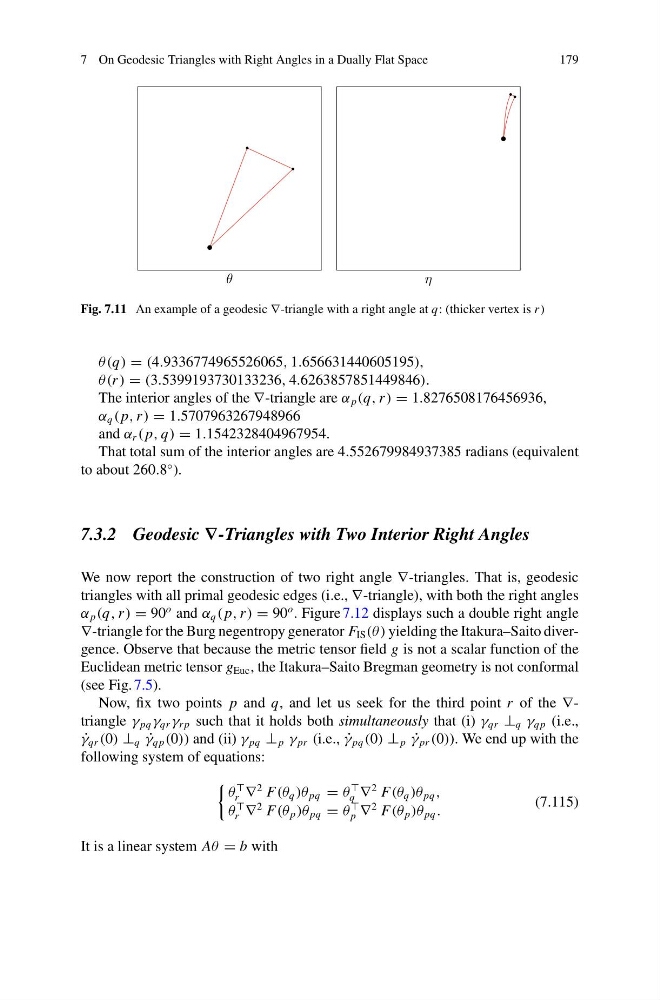
Fig. 7.11 An example of a geodesic ∇-triangle with a right angle at q: (thicker vertex is r )
θ(q) = (4.9336774965526065, 1.656631440605195),
θ(r ) = (3.5399193730133236, 4.6263857851449846).
The interior angles of the ∇-triangle are α p (q, r ) = 1.8276508176456936,
α q ( p, r ) = 1.5707963267948966
and α r ( p, q) = 1.1542328404967954.
That total sum of the interior angles are 4.552679984937385 radians (equivalent
to about 260.8
◦ ).
7.3.2 Geodesic ∇-Triangles with Two Interior Right Angles
We now report the construction of two right angle ∇-triangles. That is, geodesic
triangles with all primal geodesic edges (i.e., ∇-triangle), with both the right angles
α p (q, r ) = 90
o and α q ( p, r ) = 90
o . Figure 7.12 displays such a double right angle
∇-triangle for the Burg negentropy generator F IS (θ ) yielding the Itakura–Saito divergence. Observe that because the metric tensor field g is not a scalar function of the
Euclidean metric tensor g Euc , the Itakura–Saito Bregman geometry is not conformal
(see Fig. 7.5).
Now, fix two points p and q, and let us seek for the third point r of the ∇triangle γ pq γ qr γ r p such that it holds both simultaneously that (i) γ qr ⊥ q γ qp (i.e.,
˙
γ qr (0) ⊥ q ˙
γ qp (0)) and (ii) γ pq ⊥ p γ pr (i.e., ˙
γ pq (0) ⊥ p ˙
γ pr (0)). We end up with the
following system of equations:
θ
r ∇
2 F(θ q )θ pq = θ
q ∇
2 F(θ q )θ pq ,
θ
r ∇
2 F(θ p )θ pq = θ
p ∇
2 F(θ p )θ pq .
(7.115)
It is a linear system Aθ = b with
179
η
θ
Fig. 7.11 An example of a geodesic ∇-triangle with a right angle at q: (thicker vertex is r )
θ(q) = (4.9336774965526065, 1.656631440605195),
θ(r ) = (3.5399193730133236, 4.6263857851449846).
The interior angles of the ∇-triangle are α p (q, r ) = 1.8276508176456936,
α q ( p, r ) = 1.5707963267948966
and α r ( p, q) = 1.1542328404967954.
That total sum of the interior angles are 4.552679984937385 radians (equivalent
to about 260.8
◦ ).
7.3.2 Geodesic ∇-Triangles with Two Interior Right Angles
We now report the construction of two right angle ∇-triangles. That is, geodesic
triangles with all primal geodesic edges (i.e., ∇-triangle), with both the right angles
α p (q, r ) = 90
o and α q ( p, r ) = 90
o . Figure 7.12 displays such a double right angle
∇-triangle for the Burg negentropy generator F IS (θ ) yielding the Itakura–Saito divergence. Observe that because the metric tensor field g is not a scalar function of the
Euclidean metric tensor g Euc , the Itakura–Saito Bregman geometry is not conformal
(see Fig. 7.5).
Now, fix two points p and q, and let us seek for the third point r of the ∇triangle γ pq γ qr γ r p such that it holds both simultaneously that (i) γ qr ⊥ q γ qp (i.e.,
˙
γ qr (0) ⊥ q ˙
γ qp (0)) and (ii) γ pq ⊥ p γ pr (i.e., ˙
γ pq (0) ⊥ p ˙
γ pr (0)). We end up with the
following system of equations:
θ
r ∇
2 F(θ q )θ pq = θ
q ∇
2 F(θ q )θ pq ,
θ
r ∇
2 F(θ p )θ pq = θ
p ∇
2 F(θ p )θ pq .
(7.115)
It is a linear system Aθ = b with