

7 On Geodesic Triangles with Right Angles in a Dually Flat Space
175
is a strictly convex and C
3 function on = R
D
++ , i.e., a separable Bregman generator.
Here, we consider the positive orthant domain instead of the probability simplex
hence the name extended Shannon negentropy. We have the following conversion
formula between the primal and dual coordinates:
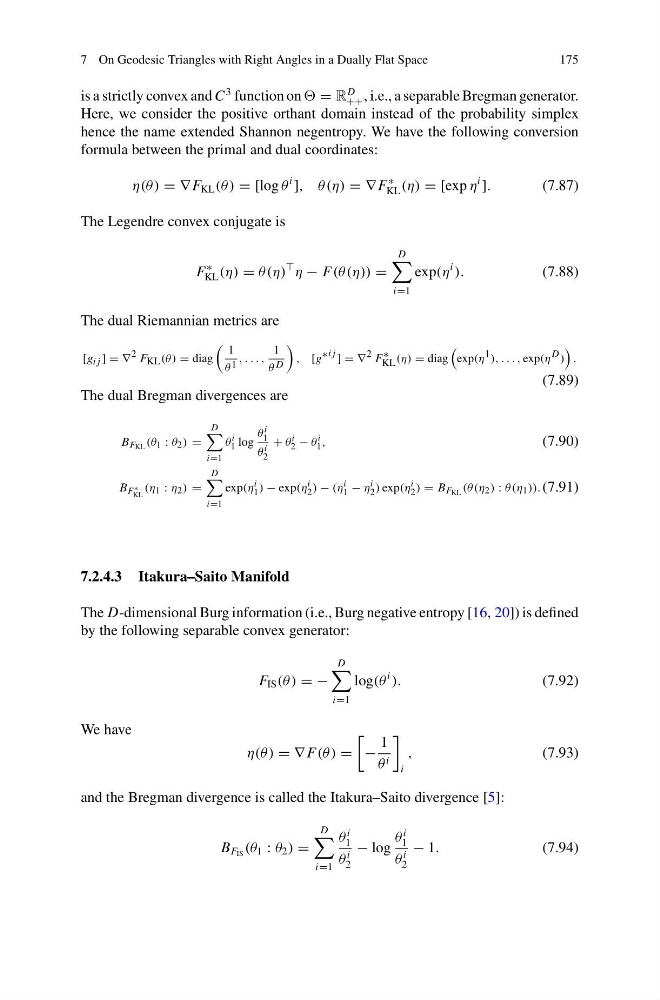
η(θ) = ∇ F KL (θ ) = [log θ
i
], θ(η) = ∇ F
∗
KL (η) = [exp η
i
].
(7.87)
The Legendre convex conjugate is
F
∗
KL (η) = θ(η)
η − F(θ (η)) =
D
i=1
exp(η
i
).
(7.88)
The dual Riemannian metrics are
[g i j ] = ∇ 2 F KL (θ ) = diag
1
θ 1 , . . . ,
1
θ D
, [g ∗i j ] = ∇ 2 F ∗
KL (η) = diag
exp(η 1 ), . . . , exp(η D )
.
(7.89)
The dual Bregman divergences are
B FKL (θ 1 : θ 2 ) =
D
i=1
θ
i
1 log
θ
i
1
θ i
2
+ θ
i
2 − θ
i
1 ,
(7.90)
B F ∗
KL
(η 1 : η 2 ) =
D
i=1
exp(η
i
1 ) − exp(η
i
2 ) − (η
i
1 − η
i
2 ) exp(η
i
2 ) = B FKL (θ(η 2 ) : θ(η 1 )). (7.91)
7.2.4.3 Itakura–Saito Manifold
The D-dimensional Burg information (i.e., Burg negative entropy [16, 20]) is defined
by the following separable convex generator:
F IS (θ ) = −
D
i=1
log(θ
i
).
(7.92)
We have
η(θ) = ∇ F(θ ) =
−
1
θ i
i
,
(7.93)
and the Bregman divergence is called the Itakura–Saito divergence [5]:
B F IS (θ 1 : θ 2 ) =
D
i=1
θ
i
1
θ
i
2
− log
θ
i
1
θ
i
2
− 1.
(7.94)
175
is a strictly convex and C
3 function on = R
D
++ , i.e., a separable Bregman generator.
Here, we consider the positive orthant domain instead of the probability simplex
hence the name extended Shannon negentropy. We have the following conversion
formula between the primal and dual coordinates:
η(θ) = ∇ F KL (θ ) = [log θ
i
], θ(η) = ∇ F
∗
KL (η) = [exp η
i
].
(7.87)
The Legendre convex conjugate is
F
∗
KL (η) = θ(η)
η − F(θ (η)) =
D
i=1
exp(η
i
).
(7.88)
The dual Riemannian metrics are
[g i j ] = ∇ 2 F KL (θ ) = diag
1
θ 1 , . . . ,
1
θ D
, [g ∗i j ] = ∇ 2 F ∗
KL (η) = diag
exp(η 1 ), . . . , exp(η D )
.
(7.89)
The dual Bregman divergences are
B FKL (θ 1 : θ 2 ) =
D
i=1
θ
i
1 log
θ
i
1
θ i
2
+ θ
i
2 − θ
i
1 ,
(7.90)
B F ∗
KL
(η 1 : η 2 ) =
D
i=1
exp(η
i
1 ) − exp(η
i
2 ) − (η
i
1 − η
i
2 ) exp(η
i
2 ) = B FKL (θ(η 2 ) : θ(η 1 )). (7.91)
7.2.4.3 Itakura–Saito Manifold
The D-dimensional Burg information (i.e., Burg negative entropy [16, 20]) is defined
by the following separable convex generator:
F IS (θ ) = −
D
i=1
log(θ
i
).
(7.92)
We have
η(θ) = ∇ F(θ ) =
−
1
θ i
i
,
(7.93)
and the Bregman divergence is called the Itakura–Saito divergence [5]:
B F IS (θ 1 : θ 2 ) =
D
i=1
θ
i
1
θ
i
2
− log
θ
i
1
θ
i
2
− 1.
(7.94)