

164
F. Nielsen
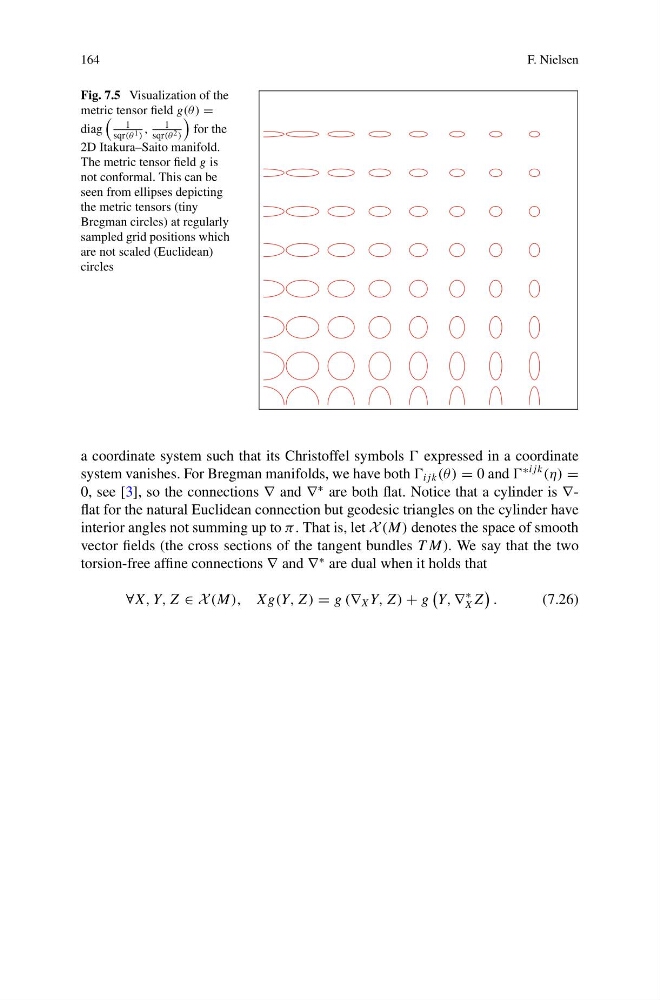
Fig. 7.5 Visualization of the
metric tensor field g(θ) =
diag
1
sqr(θ 1 )
,
1
sqr(θ 2 )
for the
2D Itakura–Saito manifold.
The metric tensor field g is
not conformal. This can be
seen from ellipses depicting
the metric tensors (tiny
Bregman circles) at regularly
sampled grid positions which
are not scaled (Euclidean)
circles
a coordinate system such that its Christoffel symbols expressed in a coordinate
system vanishes. For Bregman manifolds, we have both i jk (θ ) = 0 and
∗i jk
(η) =
0, see [3], so the connections ∇ and ∇
∗ are both flat. Notice that a cylinder is ∇flat for the natural Euclidean connection but geodesic triangles on the cylinder have
interior angles not summing up to π . That is, let X (M) denotes the space of smooth
vector fields (the cross sections of the tangent bundles T M). We say that the two
torsion-free affine connections ∇ and ∇
∗ are dual when it holds that
∀X, Y, Z ∈ X (M), Xg(Y, Z ) = g (∇ X Y, Z ) + g
Y, ∇
∗
X Z
.
(7.26)
F. Nielsen
Fig. 7.5 Visualization of the
metric tensor field g(θ) =
diag
1
sqr(θ 1 )
,
1
sqr(θ 2 )
for the
2D Itakura–Saito manifold.
The metric tensor field g is
not conformal. This can be
seen from ellipses depicting
the metric tensors (tiny
Bregman circles) at regularly
sampled grid positions which
are not scaled (Euclidean)
circles
a coordinate system such that its Christoffel symbols expressed in a coordinate
system vanishes. For Bregman manifolds, we have both i jk (θ ) = 0 and
∗i jk
(η) =
0, see [3], so the connections ∇ and ∇
∗ are both flat. Notice that a cylinder is ∇flat for the natural Euclidean connection but geodesic triangles on the cylinder have
interior angles not summing up to π . That is, let X (M) denotes the space of smooth
vector fields (the cross sections of the tangent bundles T M). We say that the two
torsion-free affine connections ∇ and ∇
∗ are dual when it holds that
∀X, Y, Z ∈ X (M), Xg(Y, Z ) = g (∇ X Y, Z ) + g
Y, ∇
∗
X Z
.
(7.26)