

7 On Geodesic Triangles with Right Angles in a Dually Flat Space
155
(a)
(b)
(c)
(d)
(e)
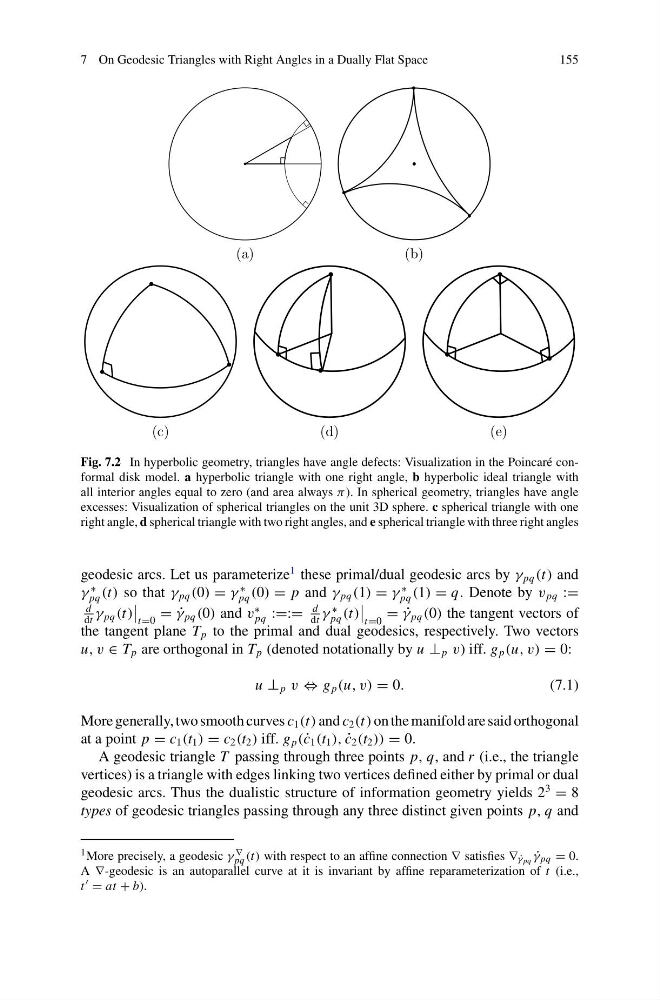
Fig. 7.2 In hyperbolic geometry, triangles have angle defects: Visualization in the Poincaré conformal disk model. a hyperbolic triangle with one right angle, b hyperbolic ideal triangle with
all interior angles equal to zero (and area always π ). In spherical geometry, triangles have angle
excesses: Visualization of spherical triangles on the unit 3D sphere. c spherical triangle with one
right angle, d spherical triangle with two right angles, and e spherical triangle with three right angles
geodesic arcs. Let us parameterize
1 these primal/dual geodesic arcs by γ pq (t) and
γ
∗
pq (t) so that γ pq (0) = γ
∗
pq (0) = p and γ pq (1) = γ
∗
pq (1) = q. Denote by v pq :=
d
dt
γ pq (t)
t=0
= ˙
γ pq (0) and v
∗
pq :=:=
d
dt
γ
∗
pq (t)
t=0
= ˙
γ pq (0) the tangent vectors of
the tangent plane T p to the primal and dual geodesics, respectively. Two vectors
u, v ∈ T p are orthogonal in T p (denoted notationally by u ⊥ p v) iff. g p (u, v) = 0:
u ⊥ p v ⇔ g p (u, v) = 0.
(7.1)
More generally, two smooth curves c 1 (t) and c 2 (t) on the manifold are said orthogonal
at a point p = c 1 (t 1 ) = c 2 (t 2 ) iff. g p ( ˙
c 1 (t 1 ), ˙
c 2 (t 2 )) = 0.
A geodesic triangle T passing through three points p, q, and r (i.e., the triangle
vertices) is a triangle with edges linking two vertices defined either by primal or dual
geodesic arcs. Thus the dualistic structure of information geometry yields 2
3
= 8
types of geodesic triangles passing through any three distinct given points p, q and
1 More precisely, a geodesic γ ∇
pq (t) with respect to an affine connection ∇ satisfies ∇ ˙
γpq ˙
γ pq = 0.
A ∇-geodesic is an autoparallel curve at it is invariant by affine reparameterization of t (i.e.,
t = at + b).
155
(a)
(b)
(c)
(d)
(e)
Fig. 7.2 In hyperbolic geometry, triangles have angle defects: Visualization in the Poincaré conformal disk model. a hyperbolic triangle with one right angle, b hyperbolic ideal triangle with
all interior angles equal to zero (and area always π ). In spherical geometry, triangles have angle
excesses: Visualization of spherical triangles on the unit 3D sphere. c spherical triangle with one
right angle, d spherical triangle with two right angles, and e spherical triangle with three right angles
geodesic arcs. Let us parameterize
1 these primal/dual geodesic arcs by γ pq (t) and
γ
∗
pq (t) so that γ pq (0) = γ
∗
pq (0) = p and γ pq (1) = γ
∗
pq (1) = q. Denote by v pq :=
d
dt
γ pq (t)
t=0
= ˙
γ pq (0) and v
∗
pq :=:=
d
dt
γ
∗
pq (t)
t=0
= ˙
γ pq (0) the tangent vectors of
the tangent plane T p to the primal and dual geodesics, respectively. Two vectors
u, v ∈ T p are orthogonal in T p (denoted notationally by u ⊥ p v) iff. g p (u, v) = 0:
u ⊥ p v ⇔ g p (u, v) = 0.
(7.1)
More generally, two smooth curves c 1 (t) and c 2 (t) on the manifold are said orthogonal
at a point p = c 1 (t 1 ) = c 2 (t 2 ) iff. g p ( ˙
c 1 (t 1 ), ˙
c 2 (t 2 )) = 0.
A geodesic triangle T passing through three points p, q, and r (i.e., the triangle
vertices) is a triangle with edges linking two vertices defined either by primal or dual
geodesic arcs. Thus the dualistic structure of information geometry yields 2
3
= 8
types of geodesic triangles passing through any three distinct given points p, q and
1 More precisely, a geodesic γ ∇
pq (t) with respect to an affine connection ∇ satisfies ∇ ˙
γpq ˙
γ pq = 0.
A ∇-geodesic is an autoparallel curve at it is invariant by affine reparameterization of t (i.e.,
t = at + b).