

154
F. Nielsen
p
q
r
180
◦
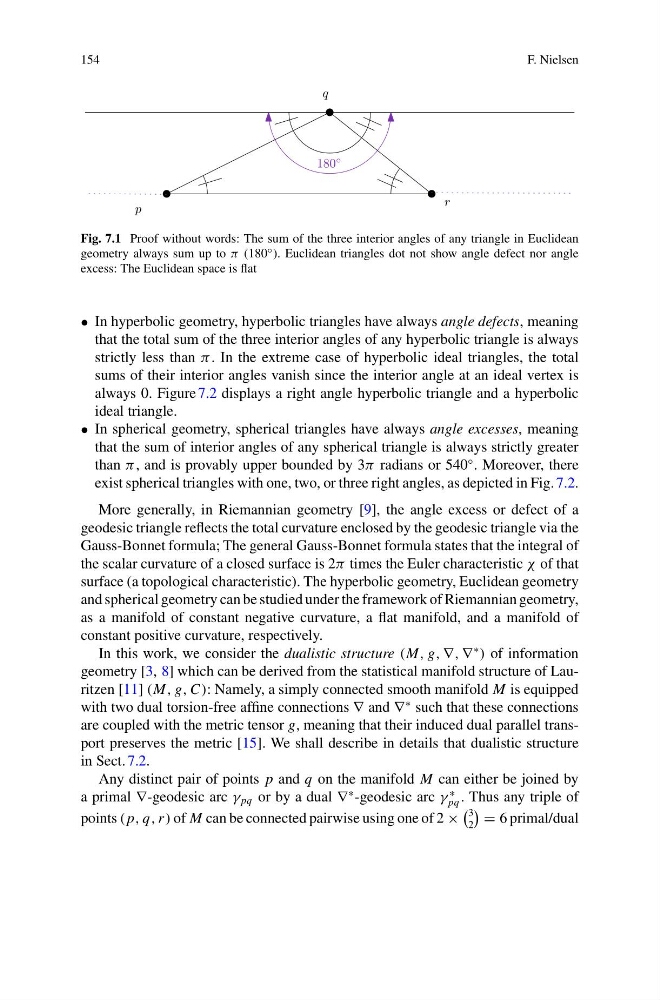
Fig. 7.1 Proof without words: The sum of the three interior angles of any triangle in Euclidean
geometry always sum up to π (180 ◦ ). Euclidean triangles dot not show angle defect nor angle
excess: The Euclidean space is flat
• In hyperbolic geometry, hyperbolic triangles have always angle defects, meaning
that the total sum of the three interior angles of any hyperbolic triangle is always
strictly less than π . In the extreme case of hyperbolic ideal triangles, the total
sums of their interior angles vanish since the interior angle at an ideal vertex is
always 0. Figure 7.2 displays a right angle hyperbolic triangle and a hyperbolic
ideal triangle.
• In spherical geometry, spherical triangles have always angle excesses, meaning
that the sum of interior angles of any spherical triangle is always strictly greater
than π , and is provably upper bounded by 3π radians or 540
◦ . Moreover, there
exist spherical triangles with one, two, or three right angles, as depicted in Fig. 7.2.
More generally, in Riemannian geometry [9], the angle excess or defect of a
geodesic triangle reflects the total curvature enclosed by the geodesic triangle via the
Gauss-Bonnet formula; The general Gauss-Bonnet formula states that the integral of
the scalar curvature of a closed surface is 2π times the Euler characteristic χ of that
surface (a topological characteristic). The hyperbolic geometry, Euclidean geometry
and spherical geometry can be studied under the framework of Riemannian geometry,
as a manifold of constant negative curvature, a flat manifold, and a manifold of
constant positive curvature, respectively.
In this work, we consider the dualistic structure (M, g, ∇, ∇
∗
) of information
geometry [3, 8] which can be derived from the statistical manifold structure of Lauritzen [11] (M, g, C): Namely, a simply connected smooth manifold M is equipped
with two dual torsion-free affine connections ∇ and ∇
∗ such that these connections
are coupled with the metric tensor g, meaning that their induced dual parallel transport preserves the metric [15]. We shall describe in details that dualistic structure
in Sect. 7.2.
Any distinct pair of points p and q on the manifold M can either be joined by
a primal ∇-geodesic arc γ pq or by a dual ∇
∗ -geodesic arc γ
∗
pq . Thus any triple of
points ( p, q, r ) of M can be connected pairwise using one of 2 ×
3
2
= 6 primal/dual
F. Nielsen
p
q
r
180
◦
Fig. 7.1 Proof without words: The sum of the three interior angles of any triangle in Euclidean
geometry always sum up to π (180 ◦ ). Euclidean triangles dot not show angle defect nor angle
excess: The Euclidean space is flat
• In hyperbolic geometry, hyperbolic triangles have always angle defects, meaning
that the total sum of the three interior angles of any hyperbolic triangle is always
strictly less than π . In the extreme case of hyperbolic ideal triangles, the total
sums of their interior angles vanish since the interior angle at an ideal vertex is
always 0. Figure 7.2 displays a right angle hyperbolic triangle and a hyperbolic
ideal triangle.
• In spherical geometry, spherical triangles have always angle excesses, meaning
that the sum of interior angles of any spherical triangle is always strictly greater
than π , and is provably upper bounded by 3π radians or 540
◦ . Moreover, there
exist spherical triangles with one, two, or three right angles, as depicted in Fig. 7.2.
More generally, in Riemannian geometry [9], the angle excess or defect of a
geodesic triangle reflects the total curvature enclosed by the geodesic triangle via the
Gauss-Bonnet formula; The general Gauss-Bonnet formula states that the integral of
the scalar curvature of a closed surface is 2π times the Euler characteristic χ of that
surface (a topological characteristic). The hyperbolic geometry, Euclidean geometry
and spherical geometry can be studied under the framework of Riemannian geometry,
as a manifold of constant negative curvature, a flat manifold, and a manifold of
constant positive curvature, respectively.
In this work, we consider the dualistic structure (M, g, ∇, ∇
∗
) of information
geometry [3, 8] which can be derived from the statistical manifold structure of Lauritzen [11] (M, g, C): Namely, a simply connected smooth manifold M is equipped
with two dual torsion-free affine connections ∇ and ∇
∗ such that these connections
are coupled with the metric tensor g, meaning that their induced dual parallel transport preserves the metric [15]. We shall describe in details that dualistic structure
in Sect. 7.2.
Any distinct pair of points p and q on the manifold M can either be joined by
a primal ∇-geodesic arc γ pq or by a dual ∇
∗ -geodesic arc γ
∗
pq . Thus any triple of
points ( p, q, r ) of M can be connected pairwise using one of 2 ×
3
2
= 6 primal/dual