

6 Gauge Freedom of Entropies on q-Gaussian Measures
151
(q, n, k, 1; ξ)
= 2π i · Res(φ q,n,k,1;σ , ir (q, σ ))
= 2π i lim
z→ir (q,σ )
(z − ir (q, σ )) · φ q,n,k, j;σ (z)
= 2π i lim
z→ir (q,σ )
z
σ
2k
p q (z; 0, σ )
(n−1)(q−1)+q
z + ir (q, σ )
(Z q σ ) 1−q (3 − q)σ 2
−1
= 2π i ·
ir (q, σ )
σ
2k (Z q σ )
1−q
(3 − q)σ
2
2ir (q, σ )
= (−1)
k π(Z q σ )
1−q
(3 − q)
σ 2(k−1)
r (q, σ )
2k−1
,
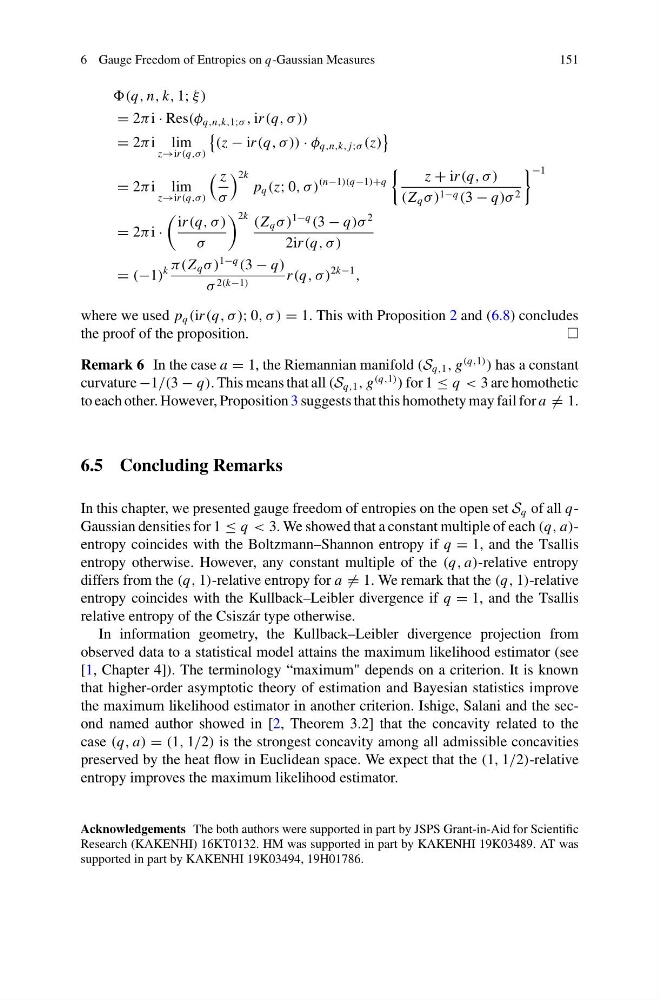
where we used p q (ir (q, σ ); 0, σ ) = 1. This with Proposition 2 and (6.8) concludes
the proof of the proposition.
Remark 6 In the case a = 1, the Riemannian manifold (S q,1 , g
(q,1)
) has a constant
curvature −1/(3 − q). This means that all (S q,1 , g
(q,1)
) for 1 ≤ q < 3 are homothetic
to each other. However, Proposition 3 suggests that this homothety may fail for a = 1.
6.5 Concluding Remarks
In this chapter, we presented gauge freedom of entropies on the open set S q of all qGaussian densities for 1 ≤ q < 3. We showed that a constant multiple of each (q, a)entropy coincides with the Boltzmann–Shannon entropy if q = 1, and the Tsallis
entropy otherwise. However, any constant multiple of the (q, a)-relative entropy
differs from the (q, 1)-relative entropy for a = 1. We remark that the (q, 1)-relative
entropy coincides with the Kullback–Leibler divergence if q = 1, and the Tsallis
relative entropy of the Csiszár type otherwise.
In information geometry, the Kullback–Leibler divergence projection from
observed data to a statistical model attains the maximum likelihood estimator (see
[1, Chapter 4]). The terminology “maximum" depends on a criterion. It is known
that higher-order asymptotic theory of estimation and Bayesian statistics improve
the maximum likelihood estimator in another criterion. Ishige, Salani and the second named author showed in [2, Theorem 3.2] that the concavity related to the
case (q, a) = (1, 1/2) is the strongest concavity among all admissible concavities
preserved by the heat flow in Euclidean space. We expect that the (1, 1/2)-relative
entropy improves the maximum likelihood estimator.
Acknowledgements The both authors were supported in part by JSPS Grant-in-Aid for Scientific
Research (KAKENHI) 16KT0132. HM was supported in part by KAKENHI 19K03489. AT was
supported in part by KAKENHI 19K03494, 19H01786.
151
(q, n, k, 1; ξ)
= 2π i · Res(φ q,n,k,1;σ , ir (q, σ ))
= 2π i lim
z→ir (q,σ )
(z − ir (q, σ )) · φ q,n,k, j;σ (z)
= 2π i lim
z→ir (q,σ )
z
σ
2k
p q (z; 0, σ )
(n−1)(q−1)+q
z + ir (q, σ )
(Z q σ ) 1−q (3 − q)σ 2
−1
= 2π i ·
ir (q, σ )
σ
2k (Z q σ )
1−q
(3 − q)σ
2
2ir (q, σ )
= (−1)
k π(Z q σ )
1−q
(3 − q)
σ 2(k−1)
r (q, σ )
2k−1
,
where we used p q (ir (q, σ ); 0, σ ) = 1. This with Proposition 2 and (6.8) concludes
the proof of the proposition.
Remark 6 In the case a = 1, the Riemannian manifold (S q,1 , g
(q,1)
) has a constant
curvature −1/(3 − q). This means that all (S q,1 , g
(q,1)
) for 1 ≤ q < 3 are homothetic
to each other. However, Proposition 3 suggests that this homothety may fail for a = 1.
6.5 Concluding Remarks
In this chapter, we presented gauge freedom of entropies on the open set S q of all qGaussian densities for 1 ≤ q < 3. We showed that a constant multiple of each (q, a)entropy coincides with the Boltzmann–Shannon entropy if q = 1, and the Tsallis
entropy otherwise. However, any constant multiple of the (q, a)-relative entropy
differs from the (q, 1)-relative entropy for a = 1. We remark that the (q, 1)-relative
entropy coincides with the Kullback–Leibler divergence if q = 1, and the Tsallis
relative entropy of the Csiszár type otherwise.
In information geometry, the Kullback–Leibler divergence projection from
observed data to a statistical model attains the maximum likelihood estimator (see
[1, Chapter 4]). The terminology “maximum" depends on a criterion. It is known
that higher-order asymptotic theory of estimation and Bayesian statistics improve
the maximum likelihood estimator in another criterion. Ishige, Salani and the second named author showed in [2, Theorem 3.2] that the concavity related to the
case (q, a) = (1, 1/2) is the strongest concavity among all admissible concavities
preserved by the heat flow in Euclidean space. We expect that the (1, 1/2)-relative
entropy improves the maximum likelihood estimator.
Acknowledgements The both authors were supported in part by JSPS Grant-in-Aid for Scientific
Research (KAKENHI) 16KT0132. HM was supported in part by KAKENHI 19K03489. AT was
supported in part by KAKENHI 19K03494, 19H01786.