

150
H. Matsuzoe and A. Takatsu
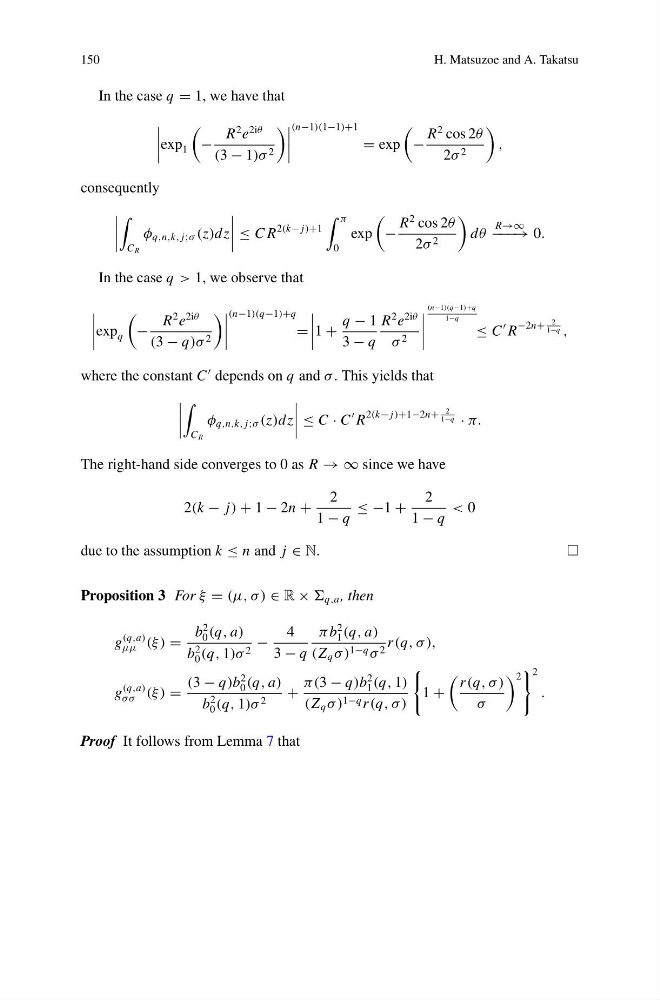
In the case q = 1, we have that
exp 1
−
R
2 e
2iθ
(3 − 1)σ 2
(n−1)(1−1)+1
= exp
−
R
2 cos 2θ
2σ 2
,
consequently
C R
φ q,n,k, j;σ (z)dz
≤ C R
2(k− j)+1
π
0
exp
−
R
2 cos 2θ
2σ 2
dθ
R→∞
− −− → 0.
In the case q > 1, we observe that
exp q
−
R
2 e
2iθ
(3 − q)σ 2
(n−1)(q−1)+q
=
1 +
q − 1
3 − q
R
2 e
2iθ
σ 2
(n−1)(q−1)+q
1−q
≤ C
R
−2n+
2
1−q ,
where the constant C
depends on q and σ . This yields that
C R
φ q,n,k, j;σ (z)dz
≤ C · C
R
2(k− j)+1−2n+
2
1−q · π.
The right-hand side converges to 0 as R → ∞ since we have
2(k − j) + 1 − 2n +
2
1 − q
≤ −1 +
2
1 − q
< 0
due to the assumption k ≤ n and j ∈ N.
Proposition 3 For ξ = (μ, σ ) ∈ R × q,a , then
g
(q,a)
μμ (ξ ) =
b
2
0 (q, a)
b
2
0 (q, 1)σ 2 −
4
3 − q
π b
2
1 (q, a)
(Z q σ ) 1−q σ 2 r (q, σ ),
g
(q,a)
σ σ (ξ ) =
(3 − q)b
2
0 (q, a)
b
2
0 (q, 1)σ 2 +
π(3 − q)b
2
1 (q, 1)
(Z q σ ) 1−q r (q, σ )
1 +
r (q, σ )
σ
2
2
.
Proof It follows from Lemma 7 that
H. Matsuzoe and A. Takatsu
In the case q = 1, we have that
exp 1
−
R
2 e
2iθ
(3 − 1)σ 2
(n−1)(1−1)+1
= exp
−
R
2 cos 2θ
2σ 2
,
consequently
C R
φ q,n,k, j;σ (z)dz
≤ C R
2(k− j)+1
π
0
exp
−
R
2 cos 2θ
2σ 2
dθ
R→∞
− −− → 0.
In the case q > 1, we observe that
exp q
−
R
2 e
2iθ
(3 − q)σ 2
(n−1)(q−1)+q
=
1 +
q − 1
3 − q
R
2 e
2iθ
σ 2
(n−1)(q−1)+q
1−q
≤ C
R
−2n+
2
1−q ,
where the constant C
depends on q and σ . This yields that
C R
φ q,n,k, j;σ (z)dz
≤ C · C
R
2(k− j)+1−2n+
2
1−q · π.
The right-hand side converges to 0 as R → ∞ since we have
2(k − j) + 1 − 2n +
2
1 − q
≤ −1 +
2
1 − q
< 0
due to the assumption k ≤ n and j ∈ N.
Proposition 3 For ξ = (μ, σ ) ∈ R × q,a , then
g
(q,a)
μμ (ξ ) =
b
2
0 (q, a)
b
2
0 (q, 1)σ 2 −
4
3 − q
π b
2
1 (q, a)
(Z q σ ) 1−q σ 2 r (q, σ ),
g
(q,a)
σ σ (ξ ) =
(3 − q)b
2
0 (q, a)
b
2
0 (q, 1)σ 2 +
π(3 − q)b
2
1 (q, 1)
(Z q σ ) 1−q r (q, σ )
1 +
r (q, σ )
σ
2
2
.
Proof It follows from Lemma 7 that