

132
H. Matsuzoe and A. Takatsu
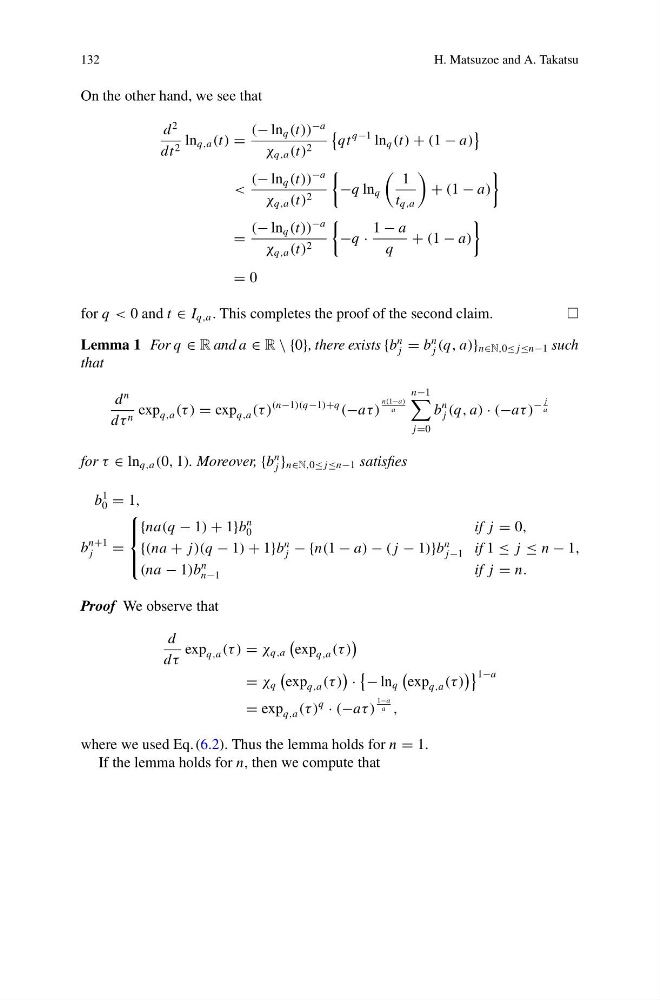
On the other hand, we see that
d
2
dt 2 ln q,a (t) =
(− ln q (t))
−a
χ q,a (t) 2
qt
q−1 ln q (t) + (1 − a)
<
(− ln q (t))
−a
χ q,a (t) 2
−q ln q
1
t q,a
+ (1 − a)
=
(− ln q (t))
−a
χ q,a (t) 2
−q ·
1 − a
q
+ (1 − a)
= 0
for q < 0 and t ∈ I q,a . This completes the proof of the second claim.
Lemma 1 For q ∈ R and a ∈ R \ {0}, there exists {b
n
j = b
n
j (q, a)} n∈N,0≤ j≤n−1 such
that
d
n
dτ n exp q,a (τ ) = exp q,a (τ )
(n−1)(q−1)+q
(−aτ )
n(1−a)
a
n−1
j=0
b
n
j (q, a) · (−aτ )
−
j
a
for τ ∈ ln q,a (0, 1). Moreover, {b
n
j } n∈N,0≤ j≤n−1 satisfies
b
1
0 = 1,
b
n+1
j
=
⎧
⎪ ⎨
⎪ ⎩
{na(q − 1) + 1}b
n
0
if j = 0,
{(na + j)(q − 1) + 1}b
n
j − {n(1 − a) − ( j − 1)}b
n
j−1 if 1 ≤ j ≤ n − 1,
(na − 1)b
n
n−1
if j = n.
Proof We observe that
d
dτ
exp q,a (τ ) = χ q,a
exp q,a (τ )
= χ q
exp q,a (τ )
·
− ln q
exp q,a (τ )
1−a
= exp q,a (τ )
q
· (−aτ )
1−a
a ,
where we used Eq. (6.2). Thus the lemma holds for n = 1.
If the lemma holds for n, then we compute that
H. Matsuzoe and A. Takatsu
On the other hand, we see that
d
2
dt 2 ln q,a (t) =
(− ln q (t))
−a
χ q,a (t) 2
qt
q−1 ln q (t) + (1 − a)
<
(− ln q (t))
−a
χ q,a (t) 2
−q ln q
1
t q,a
+ (1 − a)
=
(− ln q (t))
−a
χ q,a (t) 2
−q ·
1 − a
q
+ (1 − a)
= 0
for q < 0 and t ∈ I q,a . This completes the proof of the second claim.
Lemma 1 For q ∈ R and a ∈ R \ {0}, there exists {b
n
j = b
n
j (q, a)} n∈N,0≤ j≤n−1 such
that
d
n
dτ n exp q,a (τ ) = exp q,a (τ )
(n−1)(q−1)+q
(−aτ )
n(1−a)
a
n−1
j=0
b
n
j (q, a) · (−aτ )
−
j
a
for τ ∈ ln q,a (0, 1). Moreover, {b
n
j } n∈N,0≤ j≤n−1 satisfies
b
1
0 = 1,
b
n+1
j
=
⎧
⎪ ⎨
⎪ ⎩
{na(q − 1) + 1}b
n
0
if j = 0,
{(na + j)(q − 1) + 1}b
n
j − {n(1 − a) − ( j − 1)}b
n
j−1 if 1 ≤ j ≤ n − 1,
(na − 1)b
n
n−1
if j = n.
Proof We observe that
d
dτ
exp q,a (τ ) = χ q,a
exp q,a (τ )
= χ q
exp q,a (τ )
·
− ln q
exp q,a (τ )
1−a
= exp q,a (τ )
q
· (−aτ )
1−a
a ,
where we used Eq. (6.2). Thus the lemma holds for n = 1.
If the lemma holds for n, then we compute that