

6 Gauge Freedom of Entropies on q-Gaussian Measures
131
ln q,a
(1 − λ)t 0 + λt 1
> (1 − λ) ln q,a (t 0 ) + λ ln q,a (t 1 )
⇔ ln q,a
(1 − λ)t 0 + λt 1
> (1 − λ)τ 0 + λτ 1
⇔ exp q,a
ln q,a
(1 − λ)t 0 + λt 1
> exp q,a ((1 − λ)τ 0 + λτ 1 )
⇔ (1 − λ)t 0 + λt 1 > exp q,a ((1 − λ)τ 0 + λτ 1 )
⇔ (1 − λ) exp q,a (τ 0 ) + λ exp q,a (τ 1 ) > exp q,a ((1 − λ)τ 0 + λτ 1 ) ,
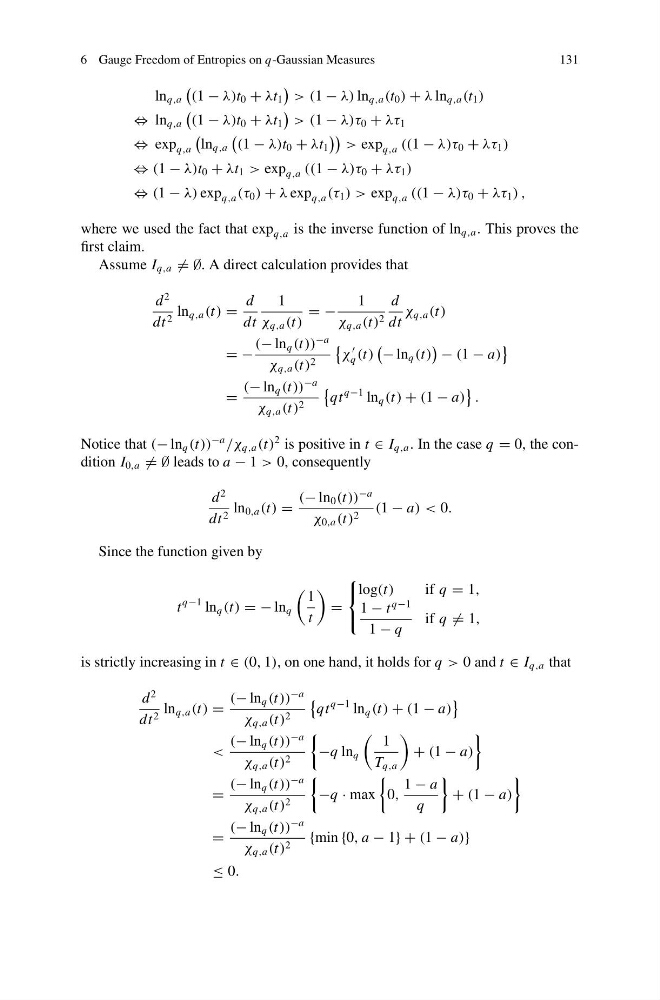
where we used the fact that exp q,a is the inverse function of ln q,a . This proves the
first claim.
Assume I q,a = ∅. A direct calculation provides that
d
2
dt 2 ln q,a (t) =
d
dt
1
χ q,a (t)
= −
1
χ q,a (t) 2
d
dt
χ q,a (t)
= −
(− ln q (t))
−a
χ q,a (t) 2
χ
q (t)
− ln q (t)
− (1 − a)
=
(− ln q (t))
−a
χ q,a (t) 2
qt
q−1 ln q (t) + (1 − a)
.
Notice that (− ln q (t))
−a
/χ q,a (t)
2 is positive in t ∈ I q,a . In the case q = 0, the condition I 0,a = ∅ leads to a − 1 > 0, consequently
d
2
dt 2 ln 0,a (t) =
(− ln 0 (t))
−a
χ 0,a (t) 2 (1 − a) < 0.
Since the function given by
t
q−1 ln q (t) = − ln q
1
t
=
⎧
⎨
⎩
log(t)
if q = 1,
1 − t
q−1
1 − q
if q = 1,
is strictly increasing in t ∈ (0, 1), on one hand, it holds for q > 0 and t ∈ I q,a that
d
2
dt 2 ln q,a (t) =
(− ln q (t))
−a
χ q,a (t) 2
qt
q−1 ln q (t) + (1 − a)
<
(− ln q (t))
−a
χ q,a (t) 2
−q ln q
1
T q,a
+ (1 − a)
=
(− ln q (t))
−a
χ q,a (t) 2
−q · max
0,
1 − a
q
+ (1 − a)
=
(− ln q (t))
−a
χ q,a (t) 2 {min {0, a − 1} + (1 − a)}
≤ 0.
131
ln q,a
(1 − λ)t 0 + λt 1
> (1 − λ) ln q,a (t 0 ) + λ ln q,a (t 1 )
⇔ ln q,a
(1 − λ)t 0 + λt 1
> (1 − λ)τ 0 + λτ 1
⇔ exp q,a
ln q,a
(1 − λ)t 0 + λt 1
> exp q,a ((1 − λ)τ 0 + λτ 1 )
⇔ (1 − λ)t 0 + λt 1 > exp q,a ((1 − λ)τ 0 + λτ 1 )
⇔ (1 − λ) exp q,a (τ 0 ) + λ exp q,a (τ 1 ) > exp q,a ((1 − λ)τ 0 + λτ 1 ) ,
where we used the fact that exp q,a is the inverse function of ln q,a . This proves the
first claim.
Assume I q,a = ∅. A direct calculation provides that
d
2
dt 2 ln q,a (t) =
d
dt
1
χ q,a (t)
= −
1
χ q,a (t) 2
d
dt
χ q,a (t)
= −
(− ln q (t))
−a
χ q,a (t) 2
χ
q (t)
− ln q (t)
− (1 − a)
=
(− ln q (t))
−a
χ q,a (t) 2
qt
q−1 ln q (t) + (1 − a)
.
Notice that (− ln q (t))
−a
/χ q,a (t)
2 is positive in t ∈ I q,a . In the case q = 0, the condition I 0,a = ∅ leads to a − 1 > 0, consequently
d
2
dt 2 ln 0,a (t) =
(− ln 0 (t))
−a
χ 0,a (t) 2 (1 − a) < 0.
Since the function given by
t
q−1 ln q (t) = − ln q
1
t
=
⎧
⎨
⎩
log(t)
if q = 1,
1 − t
q−1
1 − q
if q = 1,
is strictly increasing in t ∈ (0, 1), on one hand, it holds for q > 0 and t ∈ I q,a that
d
2
dt 2 ln q,a (t) =
(− ln q (t))
−a
χ q,a (t) 2
qt
q−1 ln q (t) + (1 − a)
<
(− ln q (t))
−a
χ q,a (t) 2
−q ln q
1
T q,a
+ (1 − a)
=
(− ln q (t))
−a
χ q,a (t) 2
−q · max
0,
1 − a
q
+ (1 − a)
=
(− ln q (t))
−a
χ q,a (t) 2 {min {0, a − 1} + (1 − a)}
≤ 0.