

3 Structural Peculiarities and Properties of Silver-Containing Polymer. . .
57
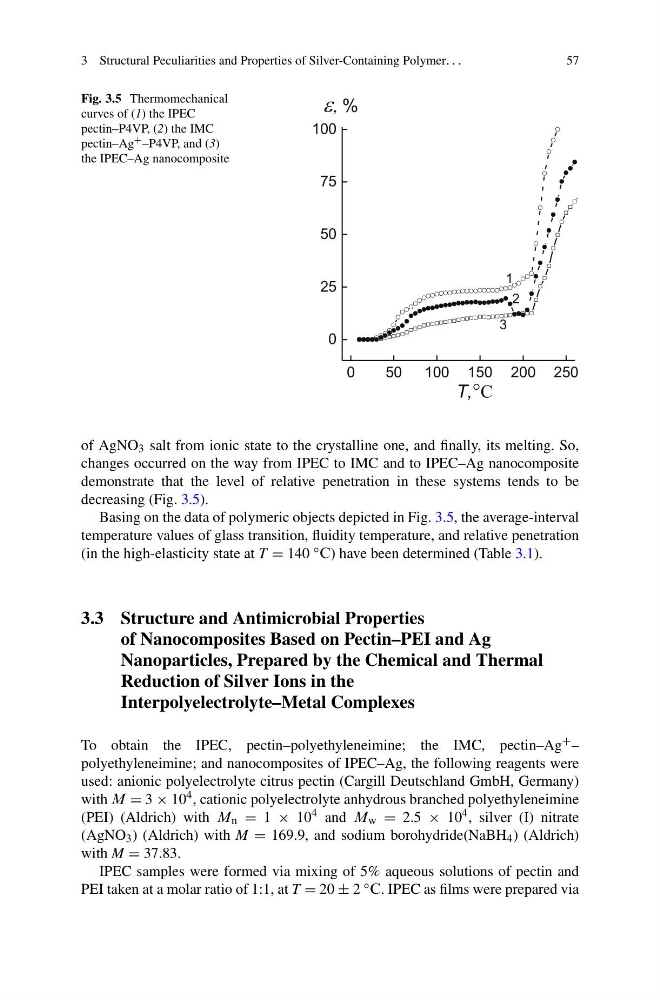
Fig. 3.5 Thermomechanical
curves of (1) the IPEC
pectin–P4VP, (2) the IMC
pectin–Ag + –P4VP, and (3)
the IPEC–Ag nanocomposite
0
50 100 150 200 250
0
25
50
75
100
3
e, %
T,°С
2
1
of AgNO 3 salt from ionic state to the crystalline one, and finally, its melting. So,
changes occurred on the way from IPEC to IMC and to IPEC–Ag nanocomposite
demonstrate that the level of relative penetration in these systems tends to be
decreasing (Fig. 3.5).
Basing on the data of polymeric objects depicted in Fig. 3.5, the average-interval
temperature values of glass transition, fluidity temperature, and relative penetration
(in the high-elasticity state at T = 140 ◦ ´) have been determined (Table 3.1).
3.3 Structure and Antimicrobial Properties
of Nanocomposites Based on Pectin–PEI and Ag
Nanoparticles, Prepared by the Chemical and Thermal
Reduction of Silver Ions in the
Interpolyelectrolyte–Metal Complexes
To obtain the IPEC, pectin–polyethyleneimine; the IMC, pectin–Ag + –
polyethyleneimine; and nanocomposites of IPEC–Ag, the following reagents were
used: anionic polyelectrolyte citrus pectin (Cargill Deutschland GmbH, Germany)
with ¯ = 3 × 10 4 , cationic polyelectrolyte anhydrous branched polyethyleneimine
(PEI) (Aldrich) with ¯ n = 1 × 10 4 and ¯ w = 2.5 × 10 4 , silver (I) nitrate
(AgNO 3 ) (Aldrich) with M = 169.9, and sodium borohydride(NaBH 4 ) (Aldrich)
with M = 37.83.
IPEC samples were formed via mixing of 5% aqueous solutions of pectin and
PEI taken at a molar ratio of 1:1, at T = 20 ± 2 ◦ ´. IPEC as films were prepared via
57
Fig. 3.5 Thermomechanical
curves of (1) the IPEC
pectin–P4VP, (2) the IMC
pectin–Ag + –P4VP, and (3)
the IPEC–Ag nanocomposite
0
50 100 150 200 250
0
25
50
75
100
3
e, %
T,°С
2
1
of AgNO 3 salt from ionic state to the crystalline one, and finally, its melting. So,
changes occurred on the way from IPEC to IMC and to IPEC–Ag nanocomposite
demonstrate that the level of relative penetration in these systems tends to be
decreasing (Fig. 3.5).
Basing on the data of polymeric objects depicted in Fig. 3.5, the average-interval
temperature values of glass transition, fluidity temperature, and relative penetration
(in the high-elasticity state at T = 140 ◦ ´) have been determined (Table 3.1).
3.3 Structure and Antimicrobial Properties
of Nanocomposites Based on Pectin–PEI and Ag
Nanoparticles, Prepared by the Chemical and Thermal
Reduction of Silver Ions in the
Interpolyelectrolyte–Metal Complexes
To obtain the IPEC, pectin–polyethyleneimine; the IMC, pectin–Ag + –
polyethyleneimine; and nanocomposites of IPEC–Ag, the following reagents were
used: anionic polyelectrolyte citrus pectin (Cargill Deutschland GmbH, Germany)
with ¯ = 3 × 10 4 , cationic polyelectrolyte anhydrous branched polyethyleneimine
(PEI) (Aldrich) with ¯ n = 1 × 10 4 and ¯ w = 2.5 × 10 4 , silver (I) nitrate
(AgNO 3 ) (Aldrich) with M = 169.9, and sodium borohydride(NaBH 4 ) (Aldrich)
with M = 37.83.
IPEC samples were formed via mixing of 5% aqueous solutions of pectin and
PEI taken at a molar ratio of 1:1, at T = 20 ± 2 ◦ ´. IPEC as films were prepared via