

3 Structural Peculiarities and Properties of Silver-Containing Polymer. . .
55
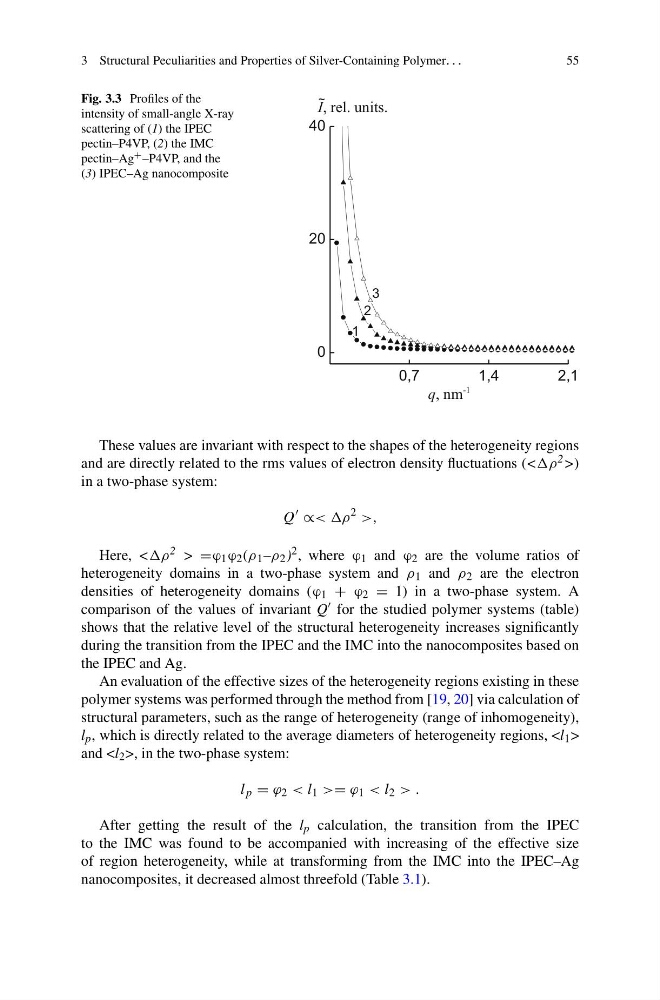
Fig. 3.3 Profiles of the
intensity of small-angle X-ray
scattering of (1) the IPEC
pectin–P4VP, (2) the IMC
pectin–Ag + –P4VP, and the
(3) IPEC–Ag nanocomposite
0,7
1,4
2,1
0
20
40
3
2
1
~
q, nm
-1
I, rel. units.
These values are invariant with respect to the shapes of the heterogeneity regions
and are directly related to the rms values of electron density fluctuations (<ρ 2 >)
in a two-phase system:
Q
∝< <ρ
2 >,
Here, <ρ 2 > =ϕ 1 ϕ 2 (ρ 1 –ρ 2 ) 2 , where ϕ 1 and ϕ 2 are the volume ratios of
heterogeneity domains in a two-phase system and ρ 1 and ρ 2 are the electron
densities of heterogeneity domains (ϕ 1 + ϕ 2 = 1) in a two-phase system. A
comparison of the values of invariant Q for the studied polymer systems (table)
shows that the relative level of the structural heterogeneity increases significantly
during the transition from the IPEC and the IMC into the nanocomposites based on
the IPEC and Ag.
An evaluation of the effective sizes of the heterogeneity regions existing in these
polymer systems was performed through the method from [19, 20] via calculation of
structural parameters, such as the range of heterogeneity (range of inhomogeneity),
l p , which is directly related to the average diameters of heterogeneity regions,
and, in the two-phase system:
l p = ϕ 2 < l 1 >= ϕ 1 < l 2 > .
After getting the result of the l p calculation, the transition from the IPEC
to the IMC was found to be accompanied with increasing of the effective size
of region heterogeneity, while at transforming from the IMC into the IPEC–Ag
nanocomposites, it decreased almost threefold (Table 3.1).
55
Fig. 3.3 Profiles of the
intensity of small-angle X-ray
scattering of (1) the IPEC
pectin–P4VP, (2) the IMC
pectin–Ag + –P4VP, and the
(3) IPEC–Ag nanocomposite
0,7
1,4
2,1
0
20
40
3
2
1
~
q, nm
-1
I, rel. units.
These values are invariant with respect to the shapes of the heterogeneity regions
and are directly related to the rms values of electron density fluctuations (<ρ 2 >)
in a two-phase system:
Q
∝< <ρ
2 >,
Here, <ρ 2 > =ϕ 1 ϕ 2 (ρ 1 –ρ 2 ) 2 , where ϕ 1 and ϕ 2 are the volume ratios of
heterogeneity domains in a two-phase system and ρ 1 and ρ 2 are the electron
densities of heterogeneity domains (ϕ 1 + ϕ 2 = 1) in a two-phase system. A
comparison of the values of invariant Q for the studied polymer systems (table)
shows that the relative level of the structural heterogeneity increases significantly
during the transition from the IPEC and the IMC into the nanocomposites based on
the IPEC and Ag.
An evaluation of the effective sizes of the heterogeneity regions existing in these
polymer systems was performed through the method from [19, 20] via calculation of
structural parameters, such as the range of heterogeneity (range of inhomogeneity),
l p , which is directly related to the average diameters of heterogeneity regions,
and
l p = ϕ 2 < l 1 >= ϕ 1 < l 2 > .
After getting the result of the l p calculation, the transition from the IPEC
to the IMC was found to be accompanied with increasing of the effective size
of region heterogeneity, while at transforming from the IMC into the IPEC–Ag
nanocomposites, it decreased almost threefold (Table 3.1).