

1 Nanostructured Functional Coatings of Iron Family Metals with Refractory. . .
31
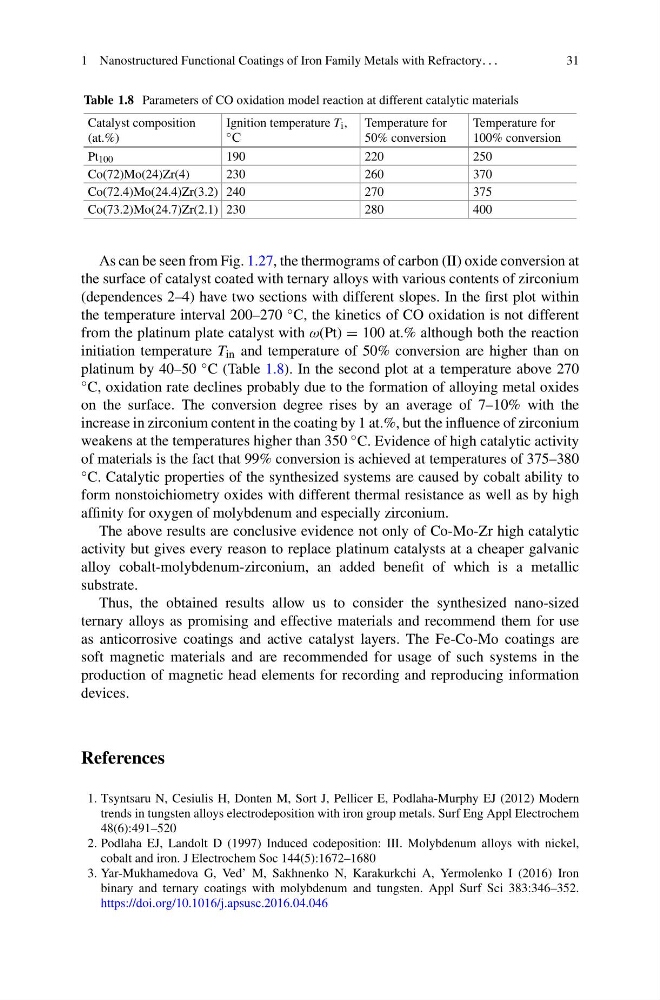
Table 1.8 Parameters of CO oxidation model reaction at different catalytic materials
Catalyst composition
(at.%)
Ignition temperature T i ,
◦ ´
Temperature for
50% conversion
Temperature for
100% conversion
Pt 100
190
220
250
Co(72)Mo(24)Zr(4)
230
260
370
Co(72.4)Mo(24.4)Zr(3.2) 240
270
375
Co(73.2)Mo(24.7)Zr(2.1) 230
280
400
As can be seen from Fig. 1.27, the thermograms of carbon (II) oxide conversion at
the surface of catalyst coated with ternary alloys with various contents of zirconium
(dependences 2–4) have two sections with different slopes. In the first plot within
the temperature interval 200–270 ◦ C, the kinetics of CO oxidation is not different
from the platinum plate catalyst with ω(Pt) = 100 at.% although both the reaction
initiation temperature T in and temperature of 50% conversion are higher than on
platinum by 40–50 ◦ C (Table 1.8). In the second plot at a temperature above 270
◦ C, oxidation rate declines probably due to the formation of alloying metal oxides
on the surface. The conversion degree rises by an average of 7–10% with the
increase in zirconium content in the coating by 1 at.%, but the influence of zirconium
weakens at the temperatures higher than 350 ◦ C. Evidence of high catalytic activity
of materials is the fact that 99% conversion is achieved at temperatures of 375–380
◦ C. Catalytic properties of the synthesized systems are caused by cobalt ability to
form nonstoichiometry oxides with different thermal resistance as well as by high
affinity for oxygen of molybdenum and especially zirconium.
The above results are conclusive evidence not only of Co-Mo-Zr high catalytic
activity but gives every reason to replace platinum catalysts at a cheaper galvanic
alloy cobalt-molybdenum-zirconium, an added benefit of which is a metallic
substrate.
Thus, the obtained results allow us to consider the synthesized nano-sized
ternary alloys as promising and effective materials and recommend them for use
as anticorrosive coatings and active catalyst layers. The Fe-Co-Mo coatings are
soft magnetic materials and are recommended for usage of such systems in the
production of magnetic head elements for recording and reproducing information
devices.
References
1. Tsyntsaru N, Cesiulis H, Donten M, Sort J, Pellicer E, Podlaha-Murphy EJ (2012) Modern
trends in tungsten alloys electrodeposition with iron group metals. Surf Eng Appl Electrochem
48(6):491–520
2. Podlaha EJ, Landolt D (1997) Induced codeposition: III. Molybdenum alloys with nickel,
cobalt and iron. J Electrochem Soc 144(5):1672–1680
3. Yar-Mukhamedova G, Ved’ M, Sakhnenko N, Karakurkchi A, Yermolenko I (2016) Iron
binary and ternary coatings with molybdenum and tungsten. Appl Surf Sci 383:346–352.
https://doi.org/10.1016/j.apsusc.2016.04.046
31
Table 1.8 Parameters of CO oxidation model reaction at different catalytic materials
Catalyst composition
(at.%)
Ignition temperature T i ,
◦ ´
Temperature for
50% conversion
Temperature for
100% conversion
Pt 100
190
220
250
Co(72)Mo(24)Zr(4)
230
260
370
Co(72.4)Mo(24.4)Zr(3.2) 240
270
375
Co(73.2)Mo(24.7)Zr(2.1) 230
280
400
As can be seen from Fig. 1.27, the thermograms of carbon (II) oxide conversion at
the surface of catalyst coated with ternary alloys with various contents of zirconium
(dependences 2–4) have two sections with different slopes. In the first plot within
the temperature interval 200–270 ◦ C, the kinetics of CO oxidation is not different
from the platinum plate catalyst with ω(Pt) = 100 at.% although both the reaction
initiation temperature T in and temperature of 50% conversion are higher than on
platinum by 40–50 ◦ C (Table 1.8). In the second plot at a temperature above 270
◦ C, oxidation rate declines probably due to the formation of alloying metal oxides
on the surface. The conversion degree rises by an average of 7–10% with the
increase in zirconium content in the coating by 1 at.%, but the influence of zirconium
weakens at the temperatures higher than 350 ◦ C. Evidence of high catalytic activity
of materials is the fact that 99% conversion is achieved at temperatures of 375–380
◦ C. Catalytic properties of the synthesized systems are caused by cobalt ability to
form nonstoichiometry oxides with different thermal resistance as well as by high
affinity for oxygen of molybdenum and especially zirconium.
The above results are conclusive evidence not only of Co-Mo-Zr high catalytic
activity but gives every reason to replace platinum catalysts at a cheaper galvanic
alloy cobalt-molybdenum-zirconium, an added benefit of which is a metallic
substrate.
Thus, the obtained results allow us to consider the synthesized nano-sized
ternary alloys as promising and effective materials and recommend them for use
as anticorrosive coatings and active catalyst layers. The Fe-Co-Mo coatings are
soft magnetic materials and are recommended for usage of such systems in the
production of magnetic head elements for recording and reproducing information
devices.
References
1. Tsyntsaru N, Cesiulis H, Donten M, Sort J, Pellicer E, Podlaha-Murphy EJ (2012) Modern
trends in tungsten alloys electrodeposition with iron group metals. Surf Eng Appl Electrochem
48(6):491–520
2. Podlaha EJ, Landolt D (1997) Induced codeposition: III. Molybdenum alloys with nickel,
cobalt and iron. J Electrochem Soc 144(5):1672–1680
3. Yar-Mukhamedova G, Ved’ M, Sakhnenko N, Karakurkchi A, Yermolenko I (2016) Iron
binary and ternary coatings with molybdenum and tungsten. Appl Surf Sci 383:346–352.
https://doi.org/10.1016/j.apsusc.2016.04.046