

30
M. V. Ved’ et al.
Table 1.7 Exchange current density of hydrogen evolution log i 0
H and coefficient b lgi 0 ° for
different materials in acidic and alkali media
Material composition, at. %
Medium
acidic
Alkaline
–logi 0
H [£·Ôm −2 ]
–b, V
–logi 0
H [£·Ôm −2 ]
–b, V
Pt100
3.30
0.03
3.10
00.100
Co100
4.35
0.14
4.30
0.14
Mo100
8.25
0.08
4.80
0.14
Co76-Mo24
4.1
0.03
4.2
0.10
Co72-Mo-24-Zr4
4.0
0.1
3.9
0.03
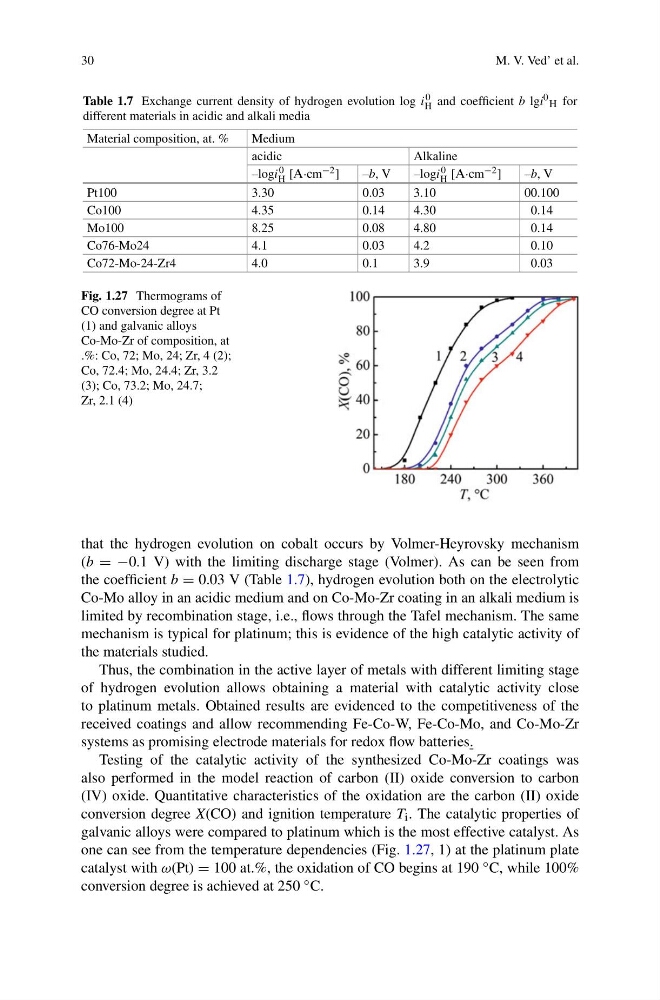
Fig. 1.27 Thermograms of
CO conversion degree at Pt
(1) and galvanic alloys
Co-Mo-Zr of composition, at
.%: Co, 72; Mo, 24; Zr, 4 (2);
Co, 72.4; Mo, 24.4; Zr, 3.2
(3); Co, 73.2; Mo, 24.7;
Zr, 2.1 (4)
that the hydrogen evolution on cobalt occurs by Volmer-Heyrovsky mechanism
(b = −0.1 V) with the limiting discharge stage (Volmer). As can be seen from
the coefficient b = 0.03 V (Table 1.7), hydrogen evolution both on the electrolytic
Co-Mo alloy in an acidic medium and on Co-Mo-Zr coating in an alkali medium is
limited by recombination stage, i.e., flows through the Tafel mechanism. The same
mechanism is typical for platinum; this is evidence of the high catalytic activity of
the materials studied.
Thus, the combination in the active layer of metals with different limiting stage
of hydrogen evolution allows obtaining a material with catalytic activity close
to platinum metals. Obtained results are evidenced to the competitiveness of the
received coatings and allow recommending Fe-Co-W, Fe-Co-Mo, and Co-Mo-Zr
systems as promising electrode materials for redox flow batteries.
Testing of the catalytic activity of the synthesized Co-Mo-Zr coatings was
also performed in the model reaction of carbon (II) oxide conversion to carbon
(IV) oxide. Quantitative characteristics of the oxidation are the carbon (II) oxide
conversion degree X(CO) and ignition temperature T i . The catalytic properties of
galvanic alloys were compared to platinum which is the most effective catalyst. As
one can see from the temperature dependencies (Fig. 1.27, 1) at the platinum plate
catalyst with ω(Pt) = 100 at.%, the oxidation of CO begins at 190 ◦ C, while 100%
conversion degree is achieved at 250 ◦ C.
M. V. Ved’ et al.
Table 1.7 Exchange current density of hydrogen evolution log i 0
H and coefficient b lgi 0 ° for
different materials in acidic and alkali media
Material composition, at. %
Medium
acidic
Alkaline
–logi 0
H [£·Ôm −2 ]
–b, V
–logi 0
H [£·Ôm −2 ]
–b, V
Pt100
3.30
0.03
3.10
00.100
Co100
4.35
0.14
4.30
0.14
Mo100
8.25
0.08
4.80
0.14
Co76-Mo24
4.1
0.03
4.2
0.10
Co72-Mo-24-Zr4
4.0
0.1
3.9
0.03
Fig. 1.27 Thermograms of
CO conversion degree at Pt
(1) and galvanic alloys
Co-Mo-Zr of composition, at
.%: Co, 72; Mo, 24; Zr, 4 (2);
Co, 72.4; Mo, 24.4; Zr, 3.2
(3); Co, 73.2; Mo, 24.7;
Zr, 2.1 (4)
that the hydrogen evolution on cobalt occurs by Volmer-Heyrovsky mechanism
(b = −0.1 V) with the limiting discharge stage (Volmer). As can be seen from
the coefficient b = 0.03 V (Table 1.7), hydrogen evolution both on the electrolytic
Co-Mo alloy in an acidic medium and on Co-Mo-Zr coating in an alkali medium is
limited by recombination stage, i.e., flows through the Tafel mechanism. The same
mechanism is typical for platinum; this is evidence of the high catalytic activity of
the materials studied.
Thus, the combination in the active layer of metals with different limiting stage
of hydrogen evolution allows obtaining a material with catalytic activity close
to platinum metals. Obtained results are evidenced to the competitiveness of the
received coatings and allow recommending Fe-Co-W, Fe-Co-Mo, and Co-Mo-Zr
systems as promising electrode materials for redox flow batteries.
Testing of the catalytic activity of the synthesized Co-Mo-Zr coatings was
also performed in the model reaction of carbon (II) oxide conversion to carbon
(IV) oxide. Quantitative characteristics of the oxidation are the carbon (II) oxide
conversion degree X(CO) and ignition temperature T i . The catalytic properties of
galvanic alloys were compared to platinum which is the most effective catalyst. As
one can see from the temperature dependencies (Fig. 1.27, 1) at the platinum plate
catalyst with ω(Pt) = 100 at.%, the oxidation of CO begins at 190 ◦ C, while 100%
conversion degree is achieved at 250 ◦ C.