

28 Copper Nucleation on Nickel from Pyrophosphate-Based Polyligand Electrolyte
453
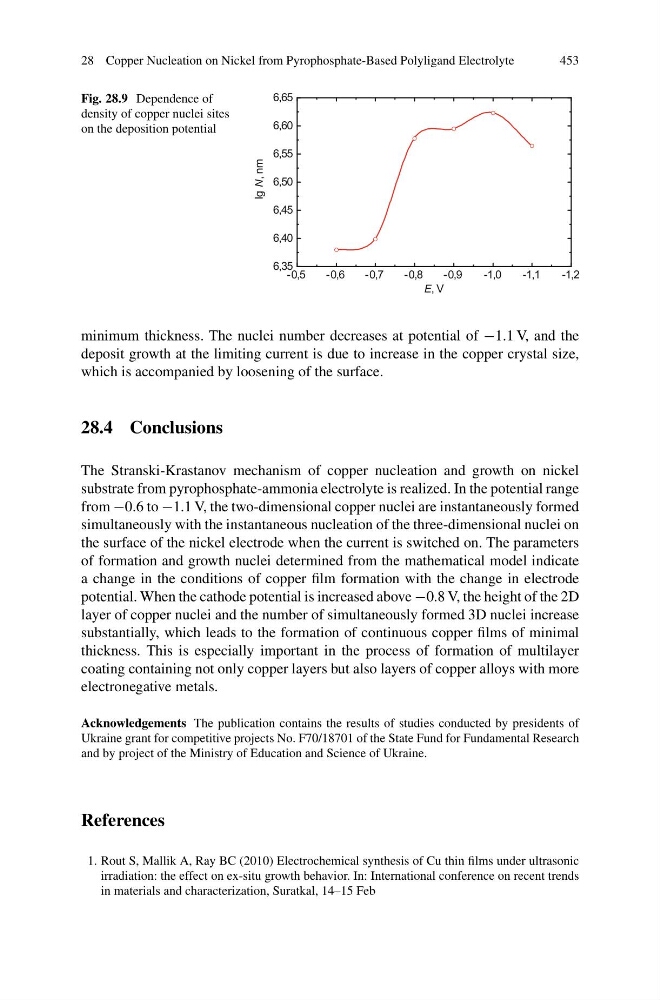
Fig. 28.9 Dependence of
density of copper nuclei sites
on the deposition potential
minimum thickness. The nuclei number decreases at potential of −1.1 V, and the
deposit growth at the limiting current is due to increase in the copper crystal size,
which is accompanied by loosening of the surface.
28.4 Conclusions
The Stranski-Krastanov mechanism of copper nucleation and growth on nickel
substrate from pyrophosphate-ammonia electrolyte is realized. In the potential range
from −0.6 to −1.1 V, the two-dimensional copper nuclei are instantaneously formed
simultaneously with the instantaneous nucleation of the three-dimensional nuclei on
the surface of the nickel electrode when the current is switched on. The parameters
of formation and growth nuclei determined from the mathematical model indicate
a change in the conditions of copper film formation with the change in electrode
potential. When the cathode potential is increased above −0.8 V, the height of the 2D
layer of copper nuclei and the number of simultaneously formed 3D nuclei increase
substantially, which leads to the formation of continuous copper films of minimal
thickness. This is especially important in the process of formation of multilayer
coating containing not only copper layers but also layers of copper alloys with more
electronegative metals.
Acknowledgements The publication contains the results of studies conducted by presidents of
Ukraine grant for competitive projects No. F70/18701 of the State Fund for Fundamental Research
and by project of the Ministry of Education and Science of Ukraine.
References
1. Rout S, Mallik A, Ray BC (2010) Electrochemical synthesis of Cu thin films under ultrasonic
irradiation: the effect on ex-situ growth behavior. In: International conference on recent trends
in materials and characterization, Suratkal, 14–15 Feb
453
Fig. 28.9 Dependence of
density of copper nuclei sites
on the deposition potential
minimum thickness. The nuclei number decreases at potential of −1.1 V, and the
deposit growth at the limiting current is due to increase in the copper crystal size,
which is accompanied by loosening of the surface.
28.4 Conclusions
The Stranski-Krastanov mechanism of copper nucleation and growth on nickel
substrate from pyrophosphate-ammonia electrolyte is realized. In the potential range
from −0.6 to −1.1 V, the two-dimensional copper nuclei are instantaneously formed
simultaneously with the instantaneous nucleation of the three-dimensional nuclei on
the surface of the nickel electrode when the current is switched on. The parameters
of formation and growth nuclei determined from the mathematical model indicate
a change in the conditions of copper film formation with the change in electrode
potential. When the cathode potential is increased above −0.8 V, the height of the 2D
layer of copper nuclei and the number of simultaneously formed 3D nuclei increase
substantially, which leads to the formation of continuous copper films of minimal
thickness. This is especially important in the process of formation of multilayer
coating containing not only copper layers but also layers of copper alloys with more
electronegative metals.
Acknowledgements The publication contains the results of studies conducted by presidents of
Ukraine grant for competitive projects No. F70/18701 of the State Fund for Fundamental Research
and by project of the Ministry of Education and Science of Ukraine.
References
1. Rout S, Mallik A, Ray BC (2010) Electrochemical synthesis of Cu thin films under ultrasonic
irradiation: the effect on ex-situ growth behavior. In: International conference on recent trends
in materials and characterization, Suratkal, 14–15 Feb