

26
M. V. Ved’ et al.
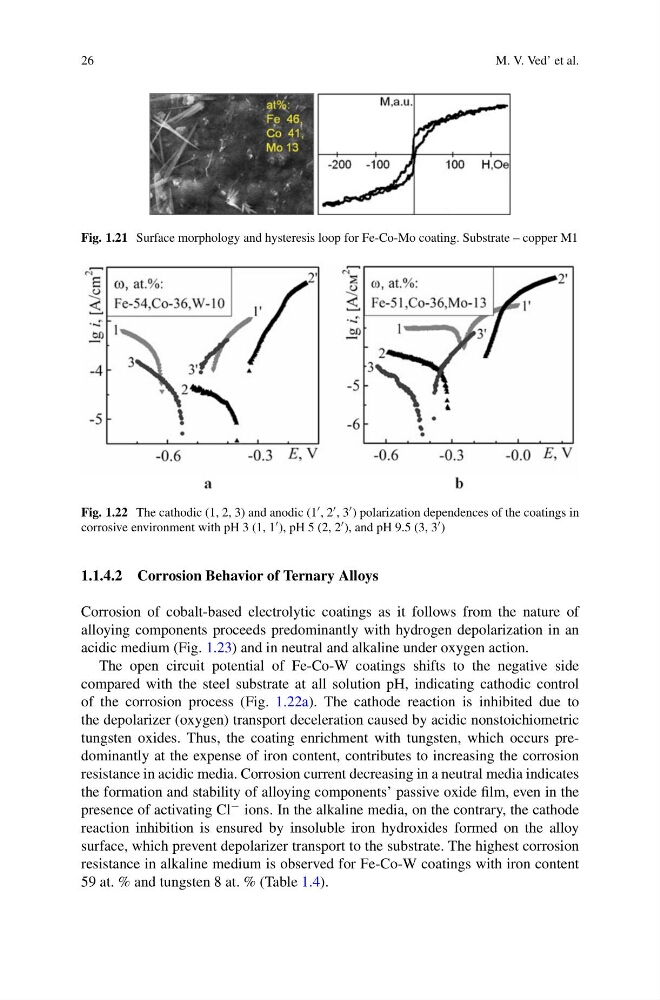
Fig. 1.21 Surface morphology and hysteresis loop for Fe-Co-Mo coating. Substrate – copper M1
Fig. 1.22 The cathodic (1, 2, 3) and anodic (1 , 2 , 3 ) polarization dependences of the coatings in
corrosive environment with pH 3 (1, 1 ), pH 5 (2, 2 ), and pH 9.5 (3, 3 )
1.1.4.2 Corrosion Behavior of Ternary Alloys
Corrosion of cobalt-based electrolytic coatings as it follows from the nature of
alloying components proceeds predominantly with hydrogen depolarization in an
acidic medium (Fig. 1.23) and in neutral and alkaline under oxygen action.
The open circuit potential of Fe-Co-W coatings shifts to the negative side
compared with the steel substrate at all solution pH, indicating cathodic control
of the corrosion process (Fig. 1.22a). The cathode reaction is inhibited due to
the depolarizer (oxygen) transport deceleration caused by acidic nonstoichiometric
tungsten oxides. Thus, the coating enrichment with tungsten, which occurs predominantly at the expense of iron content, contributes to increasing the corrosion
resistance in acidic media. Corrosion current decreasing in a neutral media indicates
the formation and stability of alloying components’ passive oxide film, even in the
presence of activating Cl − ions. In the alkaline media, on the contrary, the cathode
reaction inhibition is ensured by insoluble iron hydroxides formed on the alloy
surface, which prevent depolarizer transport to the substrate. The highest corrosion
resistance in alkaline medium is observed for Fe-Co-W coatings with iron content
59 at. % and tungsten 8 at. % (Table 1.4).
M. V. Ved’ et al.
Fig. 1.21 Surface morphology and hysteresis loop for Fe-Co-Mo coating. Substrate – copper M1
Fig. 1.22 The cathodic (1, 2, 3) and anodic (1 , 2 , 3 ) polarization dependences of the coatings in
corrosive environment with pH 3 (1, 1 ), pH 5 (2, 2 ), and pH 9.5 (3, 3 )
1.1.4.2 Corrosion Behavior of Ternary Alloys
Corrosion of cobalt-based electrolytic coatings as it follows from the nature of
alloying components proceeds predominantly with hydrogen depolarization in an
acidic medium (Fig. 1.23) and in neutral and alkaline under oxygen action.
The open circuit potential of Fe-Co-W coatings shifts to the negative side
compared with the steel substrate at all solution pH, indicating cathodic control
of the corrosion process (Fig. 1.22a). The cathode reaction is inhibited due to
the depolarizer (oxygen) transport deceleration caused by acidic nonstoichiometric
tungsten oxides. Thus, the coating enrichment with tungsten, which occurs predominantly at the expense of iron content, contributes to increasing the corrosion
resistance in acidic media. Corrosion current decreasing in a neutral media indicates
the formation and stability of alloying components’ passive oxide film, even in the
presence of activating Cl − ions. In the alkaline media, on the contrary, the cathode
reaction inhibition is ensured by insoluble iron hydroxides formed on the alloy
surface, which prevent depolarizer transport to the substrate. The highest corrosion
resistance in alkaline medium is observed for Fe-Co-W coatings with iron content
59 at. % and tungsten 8 at. % (Table 1.4).