

1 Nanostructured Functional Coatings of Iron Family Metals with Refractory. . .
25
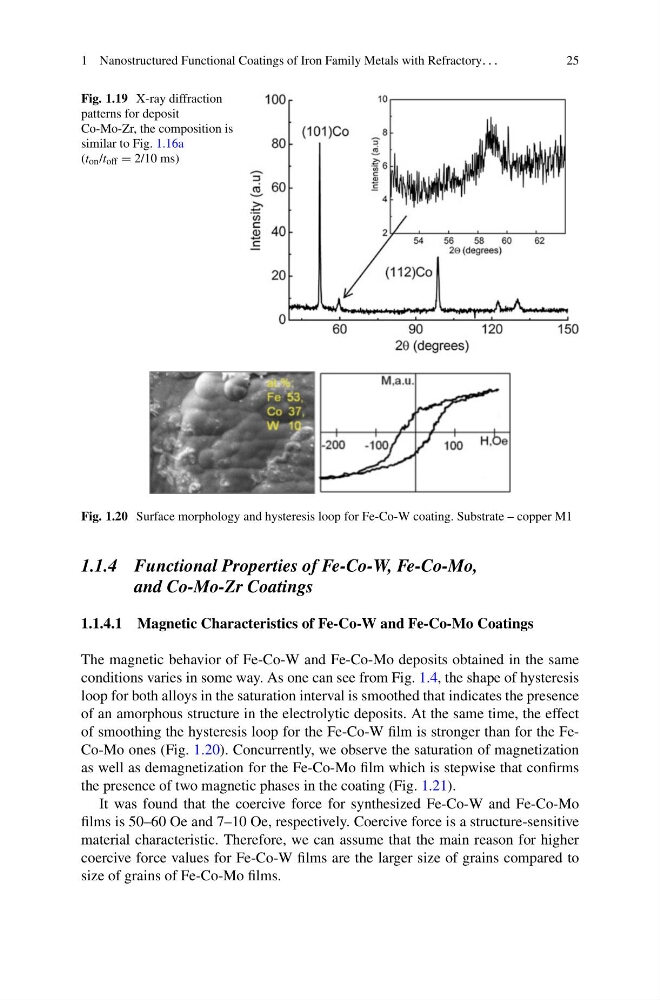
Fig. 1.19 X-ray diffraction
patterns for deposit
Co-Mo-Zr, the composition is
similar to Fig. 1.16a
(t on /t off = 2/10 ms)
Fig. 1.20 Surface morphology and hysteresis loop for Fe-Co-W coating. Substrate – copper M1
1.1.4 Functional Properties of Fe-Co-W, Fe-Co-Mo,
and Co-Mo-Zr Coatings
1.1.4.1 Magnetic Characteristics of Fe-Co-W and Fe-Co-Mo Coatings
The magnetic behavior of Fe-Co-W and Fe-Co-Mo deposits obtained in the same
conditions varies in some way. As one can see from Fig. 1.4, the shape of hysteresis
loop for both alloys in the saturation interval is smoothed that indicates the presence
of an amorphous structure in the electrolytic deposits. At the same time, the effect
of smoothing the hysteresis loop for the Fe-Co-W film is stronger than for the FeCo-Mo ones (Fig. 1.20). Concurrently, we observe the saturation of magnetization
as well as demagnetization for the Fe-Co-Mo film which is stepwise that confirms
the presence of two magnetic phases in the coating (Fig. 1.21).
It was found that the coercive force for synthesized Fe-Co-W and Fe-Co-Mo
films is 50–60 Oe and 7–10 Oe, respectively. Coercive force is a structure-sensitive
material characteristic. Therefore, we can assume that the main reason for higher
coercive force values for Fe-Co-W films are the larger size of grains compared to
size of grains of Fe-Co-Mo films.
25
Fig. 1.19 X-ray diffraction
patterns for deposit
Co-Mo-Zr, the composition is
similar to Fig. 1.16a
(t on /t off = 2/10 ms)
Fig. 1.20 Surface morphology and hysteresis loop for Fe-Co-W coating. Substrate – copper M1
1.1.4 Functional Properties of Fe-Co-W, Fe-Co-Mo,
and Co-Mo-Zr Coatings
1.1.4.1 Magnetic Characteristics of Fe-Co-W and Fe-Co-Mo Coatings
The magnetic behavior of Fe-Co-W and Fe-Co-Mo deposits obtained in the same
conditions varies in some way. As one can see from Fig. 1.4, the shape of hysteresis
loop for both alloys in the saturation interval is smoothed that indicates the presence
of an amorphous structure in the electrolytic deposits. At the same time, the effect
of smoothing the hysteresis loop for the Fe-Co-W film is stronger than for the FeCo-Mo ones (Fig. 1.20). Concurrently, we observe the saturation of magnetization
as well as demagnetization for the Fe-Co-Mo film which is stepwise that confirms
the presence of two magnetic phases in the coating (Fig. 1.21).
It was found that the coercive force for synthesized Fe-Co-W and Fe-Co-Mo
films is 50–60 Oe and 7–10 Oe, respectively. Coercive force is a structure-sensitive
material characteristic. Therefore, we can assume that the main reason for higher
coercive force values for Fe-Co-W films are the larger size of grains compared to
size of grains of Fe-Co-Mo films.