

432
Iu. Gudyma et al.
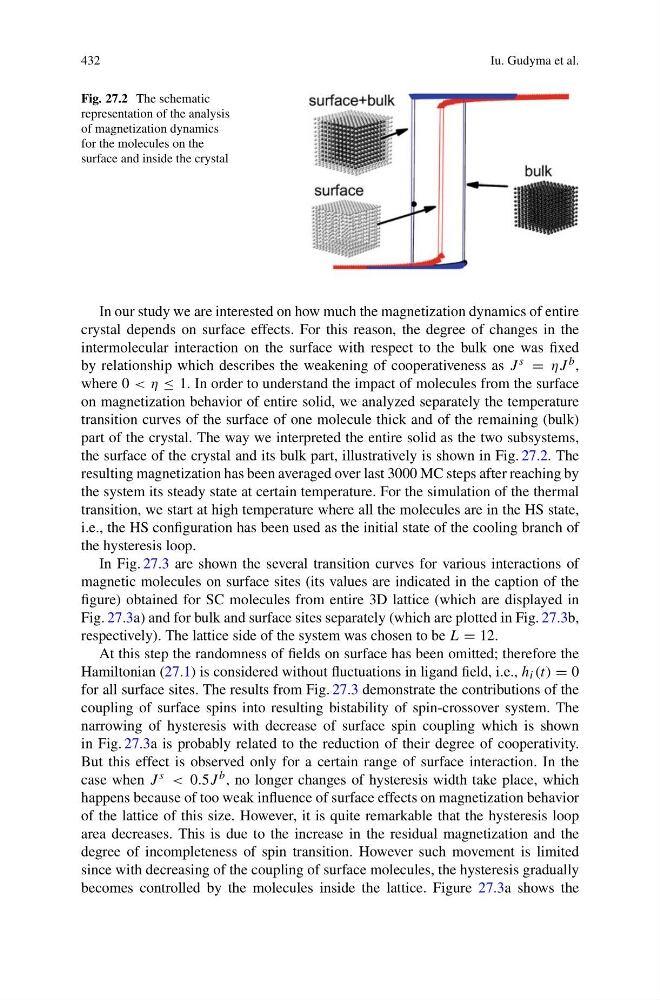
Fig. 27.2 The schematic
representation of the analysis
of magnetization dynamics
for the molecules on the
surface and inside the crystal
In our study we are interested on how much the magnetization dynamics of entire
crystal depends on surface effects. For this reason, the degree of changes in the
intermolecular interaction on the surface with respect to the bulk one was fixed
by relationship which describes the weakening of cooperativeness as J s = ηJ b ,
where 0 < η ≤ 1. In order to understand the impact of molecules from the surface
on magnetization behavior of entire solid, we analyzed separately the temperature
transition curves of the surface of one molecule thick and of the remaining (bulk)
part of the crystal. The way we interpreted the entire solid as the two subsystems,
the surface of the crystal and its bulk part, illustratively is shown in Fig. 27.2. The
resulting magnetization has been averaged over last 3000 MC steps after reaching by
the system its steady state at certain temperature. For the simulation of the thermal
transition, we start at high temperature where all the molecules are in the HS state,
i.e., the HS configuration has been used as the initial state of the cooling branch of
the hysteresis loop.
In Fig. 27.3 are shown the several transition curves for various interactions of
magnetic molecules on surface sites (its values are indicated in the caption of the
figure) obtained for SC molecules from entire 3D lattice (which are displayed in
Fig. 27.3a) and for bulk and surface sites separately (which are plotted in Fig. 27.3b,
respectively). The lattice side of the system was chosen to be L = 12.
At this step the randomness of fields on surface has been omitted; therefore the
Hamiltonian (27.1) is considered without fluctuations in ligand field, i.e., h i (t) = 0
for all surface sites. The results from Fig. 27.3 demonstrate the contributions of the
coupling of surface spins into resulting bistability of spin-crossover system. The
narrowing of hysteresis with decrease of surface spin coupling which is shown
in Fig. 27.3a is probably related to the reduction of their degree of cooperativity.
But this effect is observed only for a certain range of surface interaction. In the
case when J s < 0.5J b , no longer changes of hysteresis width take place, which
happens because of too weak influence of surface effects on magnetization behavior
of the lattice of this size. However, it is quite remarkable that the hysteresis loop
area decreases. This is due to the increase in the residual magnetization and the
degree of incompleteness of spin transition. However such movement is limited
since with decreasing of the coupling of surface molecules, the hysteresis gradually
becomes controlled by the molecules inside the lattice. Figure 27.3a shows the
Iu. Gudyma et al.
Fig. 27.2 The schematic
representation of the analysis
of magnetization dynamics
for the molecules on the
surface and inside the crystal
In our study we are interested on how much the magnetization dynamics of entire
crystal depends on surface effects. For this reason, the degree of changes in the
intermolecular interaction on the surface with respect to the bulk one was fixed
by relationship which describes the weakening of cooperativeness as J s = ηJ b ,
where 0 < η ≤ 1. In order to understand the impact of molecules from the surface
on magnetization behavior of entire solid, we analyzed separately the temperature
transition curves of the surface of one molecule thick and of the remaining (bulk)
part of the crystal. The way we interpreted the entire solid as the two subsystems,
the surface of the crystal and its bulk part, illustratively is shown in Fig. 27.2. The
resulting magnetization has been averaged over last 3000 MC steps after reaching by
the system its steady state at certain temperature. For the simulation of the thermal
transition, we start at high temperature where all the molecules are in the HS state,
i.e., the HS configuration has been used as the initial state of the cooling branch of
the hysteresis loop.
In Fig. 27.3 are shown the several transition curves for various interactions of
magnetic molecules on surface sites (its values are indicated in the caption of the
figure) obtained for SC molecules from entire 3D lattice (which are displayed in
Fig. 27.3a) and for bulk and surface sites separately (which are plotted in Fig. 27.3b,
respectively). The lattice side of the system was chosen to be L = 12.
At this step the randomness of fields on surface has been omitted; therefore the
Hamiltonian (27.1) is considered without fluctuations in ligand field, i.e., h i (t) = 0
for all surface sites. The results from Fig. 27.3 demonstrate the contributions of the
coupling of surface spins into resulting bistability of spin-crossover system. The
narrowing of hysteresis with decrease of surface spin coupling which is shown
in Fig. 27.3a is probably related to the reduction of their degree of cooperativity.
But this effect is observed only for a certain range of surface interaction. In the
case when J s < 0.5J b , no longer changes of hysteresis width take place, which
happens because of too weak influence of surface effects on magnetization behavior
of the lattice of this size. However, it is quite remarkable that the hysteresis loop
area decreases. This is due to the increase in the residual magnetization and the
degree of incompleteness of spin transition. However such movement is limited
since with decreasing of the coupling of surface molecules, the hysteresis gradually
becomes controlled by the molecules inside the lattice. Figure 27.3a shows the