

1 Nanostructured Functional Coatings of Iron Family Metals with Refractory. . .
21
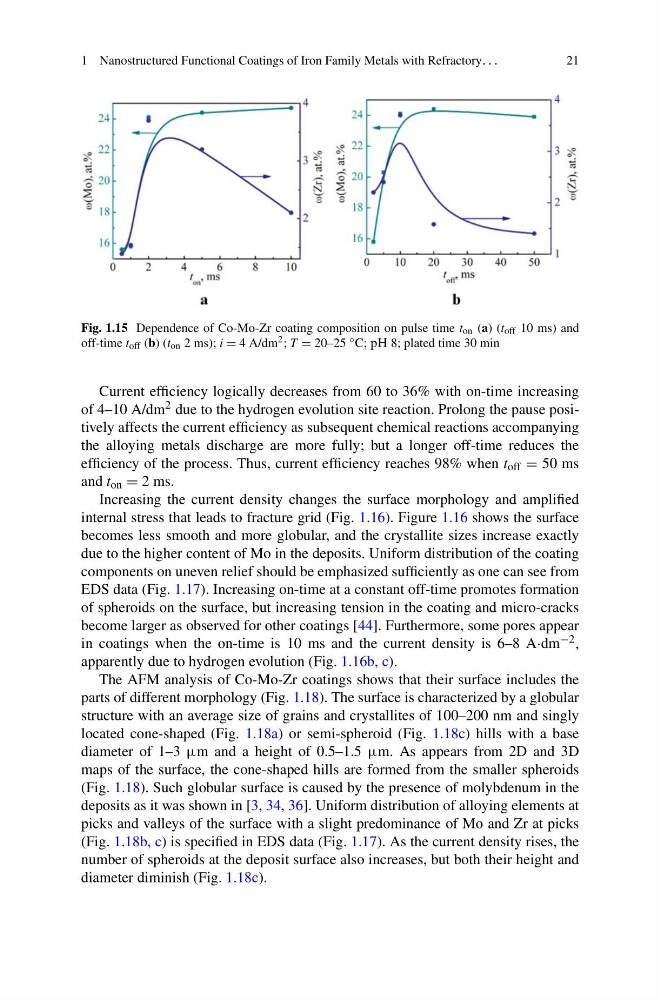
Fig. 1.15 Dependence of Co-Mo-Zr coating composition on pulse time t on (a) (t off 10 ms) and
off-time t off (b) (t on 2 ms); i = 4 A/dm 2 ; T = 20–25 ◦ C; Ó° 8; plated time 30 min
Current efficiency logically decreases from 60 to 36% with on-time increasing
of 4–10 A/dm 2 due to the hydrogen evolution site reaction. Prolong the pause positively affects the current efficiency as subsequent chemical reactions accompanying
the alloying metals discharge are more fully; but a longer off-time reduces the
efficiency of the process. Thus, current efficiency reaches 98% when t off = 50 ms
and t on = 2 ms.
Increasing the current density changes the surface morphology and amplified
internal stress that leads to fracture grid (Fig. 1.16). Figure 1.16 shows the surface
becomes less smooth and more globular, and the crystallite sizes increase exactly
due to the higher content of Mo in the deposits. Uniform distribution of the coating
components on uneven relief should be emphasized sufficiently as one can see from
EDS data (Fig. 1.17). Increasing on-time at a constant off-time promotes formation
of spheroids on the surface, but increasing tension in the coating and micro-cracks
become larger as observed for other coatings [44]. Furthermore, some pores appear
in coatings when the on-time is 10 ms and the current density is 6–8 A·dm −2 ,
apparently due to hydrogen evolution (Fig. 1.16b, c).
The AFM analysis of Co-Mo-Zr coatings shows that their surface includes the
parts of different morphology (Fig. 1.18). The surface is characterized by a globular
structure with an average size of grains and crystallites of 100–200 nm and singly
located cone-shaped (Fig. 1.18a) or semi-spheroid (Fig. 1.18c) hills with a base
diameter of 1–3 μm and a height of 0.5–1.5 μm. As appears from 2D and 3D
maps of the surface, the cone-shaped hills are formed from the smaller spheroids
(Fig. 1.18). Such globular surface is caused by the presence of molybdenum in the
deposits as it was shown in [3, 34, 36]. Uniform distribution of alloying elements at
picks and valleys of the surface with a slight predominance of Mo and Zr at picks
(Fig. 1.18b, c) is specified in EDS data (Fig. 1.17). As the current density rises, the
number of spheroids at the deposit surface also increases, but both their height and
diameter diminish (Fig. 1.18c).
21
Fig. 1.15 Dependence of Co-Mo-Zr coating composition on pulse time t on (a) (t off 10 ms) and
off-time t off (b) (t on 2 ms); i = 4 A/dm 2 ; T = 20–25 ◦ C; Ó° 8; plated time 30 min
Current efficiency logically decreases from 60 to 36% with on-time increasing
of 4–10 A/dm 2 due to the hydrogen evolution site reaction. Prolong the pause positively affects the current efficiency as subsequent chemical reactions accompanying
the alloying metals discharge are more fully; but a longer off-time reduces the
efficiency of the process. Thus, current efficiency reaches 98% when t off = 50 ms
and t on = 2 ms.
Increasing the current density changes the surface morphology and amplified
internal stress that leads to fracture grid (Fig. 1.16). Figure 1.16 shows the surface
becomes less smooth and more globular, and the crystallite sizes increase exactly
due to the higher content of Mo in the deposits. Uniform distribution of the coating
components on uneven relief should be emphasized sufficiently as one can see from
EDS data (Fig. 1.17). Increasing on-time at a constant off-time promotes formation
of spheroids on the surface, but increasing tension in the coating and micro-cracks
become larger as observed for other coatings [44]. Furthermore, some pores appear
in coatings when the on-time is 10 ms and the current density is 6–8 A·dm −2 ,
apparently due to hydrogen evolution (Fig. 1.16b, c).
The AFM analysis of Co-Mo-Zr coatings shows that their surface includes the
parts of different morphology (Fig. 1.18). The surface is characterized by a globular
structure with an average size of grains and crystallites of 100–200 nm and singly
located cone-shaped (Fig. 1.18a) or semi-spheroid (Fig. 1.18c) hills with a base
diameter of 1–3 μm and a height of 0.5–1.5 μm. As appears from 2D and 3D
maps of the surface, the cone-shaped hills are formed from the smaller spheroids
(Fig. 1.18). Such globular surface is caused by the presence of molybdenum in the
deposits as it was shown in [3, 34, 36]. Uniform distribution of alloying elements at
picks and valleys of the surface with a slight predominance of Mo and Zr at picks
(Fig. 1.18b, c) is specified in EDS data (Fig. 1.17). As the current density rises, the
number of spheroids at the deposit surface also increases, but both their height and
diameter diminish (Fig. 1.18c).