

20
M. V. Ved’ et al.
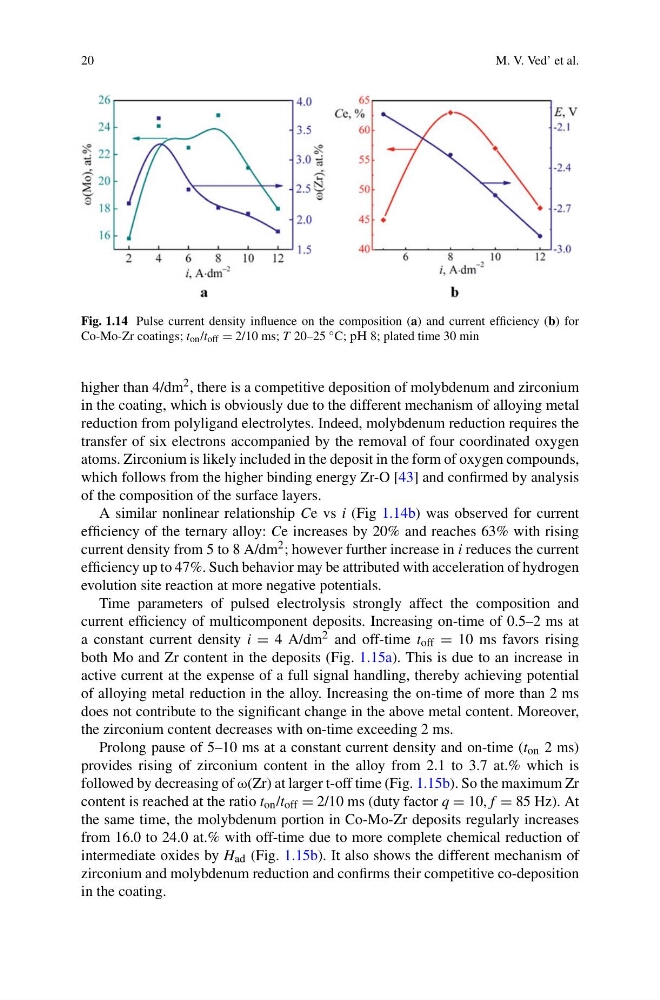
Fig. 1.14 Pulse current density influence on the composition (a) and current efficiency (b) for
Co-Mo-Zr coatings; t on /t off = 2/10 ms; T 20–25 ◦ C; Ó° 8; plated time 30 min
higher than 4/dm 2 , there is a competitive deposition of molybdenum and zirconium
in the coating, which is obviously due to the different mechanism of alloying metal
reduction from polyligand electrolytes. Indeed, molybdenum reduction requires the
transfer of six electrons accompanied by the removal of four coordinated oxygen
atoms. Zirconium is likely included in the deposit in the form of oxygen compounds,
which follows from the higher binding energy Zr-O [43] and confirmed by analysis
of the composition of the surface layers.
A similar nonlinear relationship Ce vs i (Fig 1.14b) was observed for current
efficiency of the ternary alloy: Ce increases by 20% and reaches 63% with rising
current density from 5 to 8 A/dm 2 ; however further increase in i reduces the current
efficiency up to 47%. Such behavior may be attributed with acceleration of hydrogen
evolution site reaction at more negative potentials.
Time parameters of pulsed electrolysis strongly affect the composition and
current efficiency of multicomponent deposits. Increasing on-time of 0.5–2 ms at
a constant current density i = 4 A/dm 2 and off-time t off = 10 ms favors rising
both Mo and Zr content in the deposits (Fig. 1.15a). This is due to an increase in
active current at the expense of a full signal handling, thereby achieving potential
of alloying metal reduction in the alloy. Increasing the on-time of more than 2 ms
does not contribute to the significant change in the above metal content. Moreover,
the zirconium content decreases with on-time exceeding 2 ms.
Prolong pause of 5–10 ms at a constant current density and on-time (t on 2 ms)
provides rising of zirconium content in the alloy from 2.1 to 3.7 at.% which is
followed by decreasing of ω(Zr) at larger t-off time (Fig. 1.15b). So the maximum Zr
content is reached at the ratio t on /t off = 2/10 ms (duty factor q = 10, f = 85 Hz). At
the same time, the molybdenum portion in Co-Mo-Zr deposits regularly increases
from 16.0 to 24.0 at.% with off-time due to more complete chemical reduction of
intermediate oxides by H ad (Fig. 1.15b). It also shows the different mechanism of
zirconium and molybdenum reduction and confirms their competitive co-deposition
in the coating.
M. V. Ved’ et al.
Fig. 1.14 Pulse current density influence on the composition (a) and current efficiency (b) for
Co-Mo-Zr coatings; t on /t off = 2/10 ms; T 20–25 ◦ C; Ó° 8; plated time 30 min
higher than 4/dm 2 , there is a competitive deposition of molybdenum and zirconium
in the coating, which is obviously due to the different mechanism of alloying metal
reduction from polyligand electrolytes. Indeed, molybdenum reduction requires the
transfer of six electrons accompanied by the removal of four coordinated oxygen
atoms. Zirconium is likely included in the deposit in the form of oxygen compounds,
which follows from the higher binding energy Zr-O [43] and confirmed by analysis
of the composition of the surface layers.
A similar nonlinear relationship Ce vs i (Fig 1.14b) was observed for current
efficiency of the ternary alloy: Ce increases by 20% and reaches 63% with rising
current density from 5 to 8 A/dm 2 ; however further increase in i reduces the current
efficiency up to 47%. Such behavior may be attributed with acceleration of hydrogen
evolution site reaction at more negative potentials.
Time parameters of pulsed electrolysis strongly affect the composition and
current efficiency of multicomponent deposits. Increasing on-time of 0.5–2 ms at
a constant current density i = 4 A/dm 2 and off-time t off = 10 ms favors rising
both Mo and Zr content in the deposits (Fig. 1.15a). This is due to an increase in
active current at the expense of a full signal handling, thereby achieving potential
of alloying metal reduction in the alloy. Increasing the on-time of more than 2 ms
does not contribute to the significant change in the above metal content. Moreover,
the zirconium content decreases with on-time exceeding 2 ms.
Prolong pause of 5–10 ms at a constant current density and on-time (t on 2 ms)
provides rising of zirconium content in the alloy from 2.1 to 3.7 at.% which is
followed by decreasing of ω(Zr) at larger t-off time (Fig. 1.15b). So the maximum Zr
content is reached at the ratio t on /t off = 2/10 ms (duty factor q = 10, f = 85 Hz). At
the same time, the molybdenum portion in Co-Mo-Zr deposits regularly increases
from 16.0 to 24.0 at.% with off-time due to more complete chemical reduction of
intermediate oxides by H ad (Fig. 1.15b). It also shows the different mechanism of
zirconium and molybdenum reduction and confirms their competitive co-deposition
in the coating.