

366
M. Satalkar et al.
Table 23.4 Weight %,
atomic %, experimental
Me/Fe molar ratio
(Me/Fe) exp , and theoretical
Me/Fe molar ratio (Me/Fe) th.
of the elements Zn, Ni, Mg,
Cu, Fe, and O present in
Zn 0.75−x Ni x Mg 0.15 Cu 0.1 Fe 2 O 4
(x = 0.00, 0.45) system
obtained from EDS analysis
Element Weight % Atomic % (Me/Fe) exp. (Me/Fe) th.
x = 0.0
O
27.90
56.64
–
–
Mg
1.54
2.43
0.08
0.08
Fe
47.52
28.94
1
1
Zn
20.28
10.60
0.37
0.38
Cu
2.76
1.39
0.05
0.05
Total
100.00
100.00
x = 0.45
O
28.61
57.13
–
–
Mg
1.56
2.03
0.07
0.08
Fe
48.12
28.70
1
1
Ni
11.18
6.25
0.22
0.23
Cu
2.26
1.54
0.05
0.05
Zn
8.27
4.35
0.15
0.15
Total
100.00
100.00
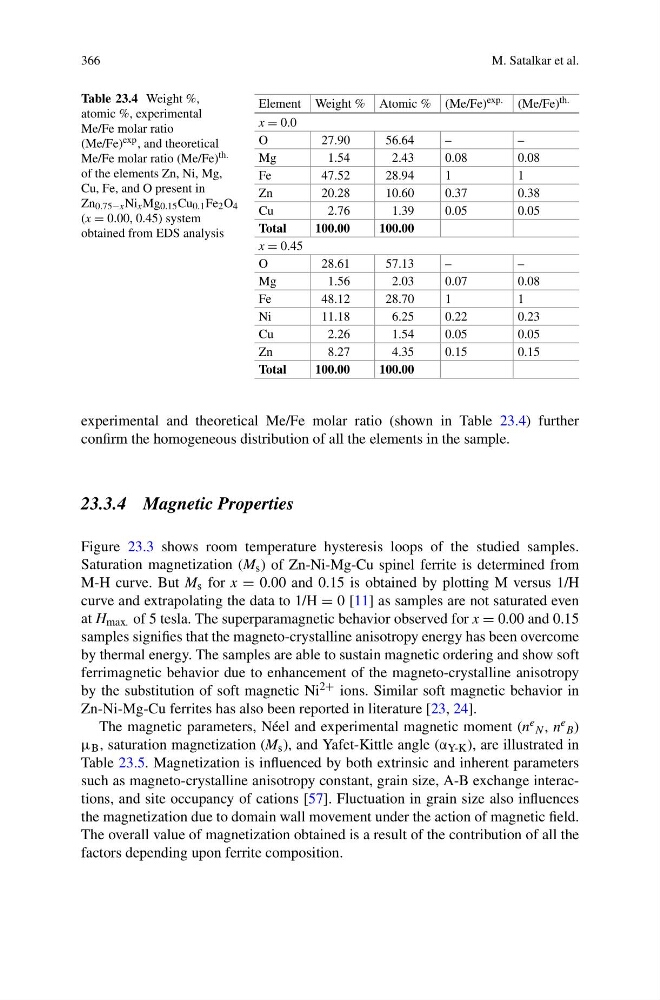
experimental and theoretical Me/Fe molar ratio (shown in Table 23.4) further
confirm the homogeneous distribution of all the elements in the sample.
23.3.4 Magnetic Properties
Figure 23.3 shows room temperature hysteresis loops of the studied samples.
Saturation magnetization (M s ) of Zn-Ni-Mg-Cu spinel ferrite is determined from
M-H curve. But M s for x = 0.00 and 0.15 is obtained by plotting M versus 1/H
curve and extrapolating the data to 1/H = 0 [11] as samples are not saturated even
at H max. of 5 tesla. The superparamagnetic behavior observed for x = 0.00 and 0.15
samples signifies that the magneto-crystalline anisotropy energy has been overcome
by thermal energy. The samples are able to sustain magnetic ordering and show soft
ferrimagnetic behavior due to enhancement of the magneto-crystalline anisotropy
by the substitution of soft magnetic Ni 2+ ions. Similar soft magnetic behavior in
Zn-Ni-Mg-Cu ferrites has also been reported in literature [23, 24].
The magnetic parameters, Néel and experimental magnetic moment (n e N , n e B )
μ B , saturation magnetization (M s ), and Yafet-Kittle angle (α Y-K ), are illustrated in
Table 23.5. Magnetization is influenced by both extrinsic and inherent parameters
such as magneto-crystalline anisotropy constant, grain size, A-B exchange interactions, and site occupancy of cations [57]. Fluctuation in grain size also influences
the magnetization due to domain wall movement under the action of magnetic field.
The overall value of magnetization obtained is a result of the contribution of all the
factors depending upon ferrite composition.
M. Satalkar et al.
Table 23.4 Weight %,
atomic %, experimental
Me/Fe molar ratio
(Me/Fe) exp , and theoretical
Me/Fe molar ratio (Me/Fe) th.
of the elements Zn, Ni, Mg,
Cu, Fe, and O present in
Zn 0.75−x Ni x Mg 0.15 Cu 0.1 Fe 2 O 4
(x = 0.00, 0.45) system
obtained from EDS analysis
Element Weight % Atomic % (Me/Fe) exp. (Me/Fe) th.
x = 0.0
O
27.90
56.64
–
–
Mg
1.54
2.43
0.08
0.08
Fe
47.52
28.94
1
1
Zn
20.28
10.60
0.37
0.38
Cu
2.76
1.39
0.05
0.05
Total
100.00
100.00
x = 0.45
O
28.61
57.13
–
–
Mg
1.56
2.03
0.07
0.08
Fe
48.12
28.70
1
1
Ni
11.18
6.25
0.22
0.23
Cu
2.26
1.54
0.05
0.05
Zn
8.27
4.35
0.15
0.15
Total
100.00
100.00
experimental and theoretical Me/Fe molar ratio (shown in Table 23.4) further
confirm the homogeneous distribution of all the elements in the sample.
23.3.4 Magnetic Properties
Figure 23.3 shows room temperature hysteresis loops of the studied samples.
Saturation magnetization (M s ) of Zn-Ni-Mg-Cu spinel ferrite is determined from
M-H curve. But M s for x = 0.00 and 0.15 is obtained by plotting M versus 1/H
curve and extrapolating the data to 1/H = 0 [11] as samples are not saturated even
at H max. of 5 tesla. The superparamagnetic behavior observed for x = 0.00 and 0.15
samples signifies that the magneto-crystalline anisotropy energy has been overcome
by thermal energy. The samples are able to sustain magnetic ordering and show soft
ferrimagnetic behavior due to enhancement of the magneto-crystalline anisotropy
by the substitution of soft magnetic Ni 2+ ions. Similar soft magnetic behavior in
Zn-Ni-Mg-Cu ferrites has also been reported in literature [23, 24].
The magnetic parameters, Néel and experimental magnetic moment (n e N , n e B )
μ B , saturation magnetization (M s ), and Yafet-Kittle angle (α Y-K ), are illustrated in
Table 23.5. Magnetization is influenced by both extrinsic and inherent parameters
such as magneto-crystalline anisotropy constant, grain size, A-B exchange interactions, and site occupancy of cations [57]. Fluctuation in grain size also influences
the magnetization due to domain wall movement under the action of magnetic field.
The overall value of magnetization obtained is a result of the contribution of all the
factors depending upon ferrite composition.