

22 The Nanocomposite Diffusion Coating of Details Prepared of Boriding
349
In the study [11], AISI 8620 steel was plasma paste borided by using various
B 2 O 3 paste mixture. The plasma paste boriding process was carried out in a dc
plasma system at temperatures of 973, 1023, and 1073 K for 2, 5, and 7 h in a gas
mixture of 70% H 2 –30% Ar under a constant pressure of 10 mbar. The properties
of the boride layer were evaluated by optical microscopy, X-ray diffraction, Vickers
microhardness tester, and the growth kinetics of the boride layers. X-ray diffraction
analysis of boride layers on the surface of the steel revealed FeB and Fe 2 B phases.
Depending on temperature and layer thickness, the activation energies of boron in
steel were found to be 124.7 kJ/mol for 100% B 2 O 3 .
In the study [12], AISI 8620 steel was plasma paste boronized by using various
borax paste mixtures. The plasma paste boronizing process was carried out in a
dc plasma system at a temperature of 973, 1023, and 1073 K for 2, 5, and 7 h,
respectively, in a gas mixture of 70% H 2 –30% Ar under a constant pressure of
10 mbar. The properties of the boride layer were evaluated by optical microscopy,
X-ray diffraction, the microhardness Vickers tester, and the growth kinetics of the
boride layers. The thickness of the boride layers varied from 14 to 91 μm depending
on the boronizing time and temperature. X-ray diffraction analysis of boride layers
on the surface of the steel revealed the formation of FeB and Fe 2 B phases.
Technology hardening of paste (coating) involves the following operations:
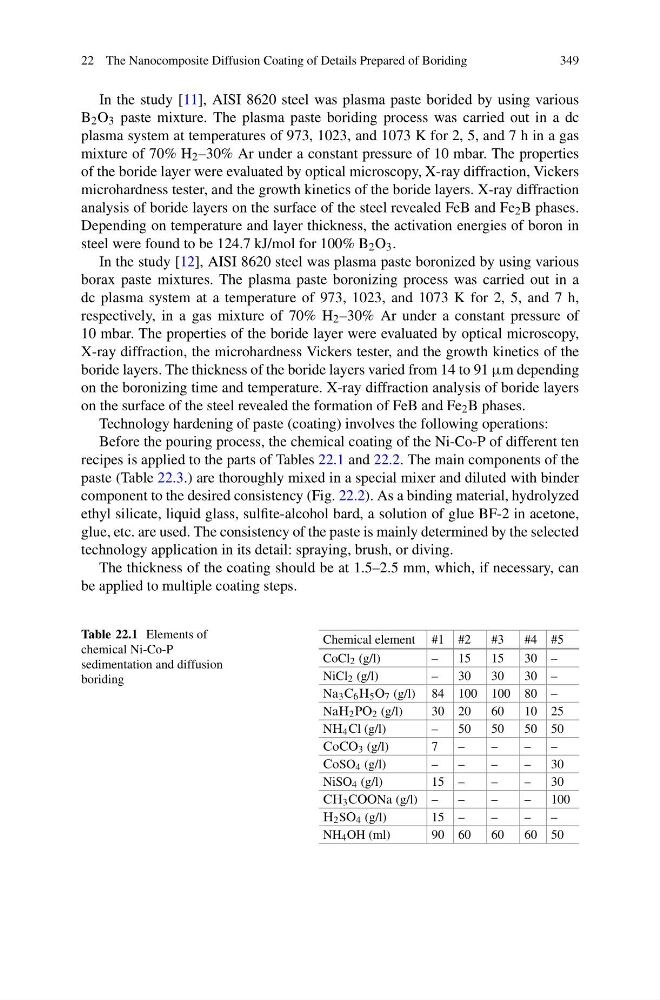
Before the pouring process, the chemical coating of the Ni-Co-P of different ten
recipes is applied to the parts of Tables 22.1 and 22.2. The main components of the
paste (Table 22.3.) are thoroughly mixed in a special mixer and diluted with binder
component to the desired consistency (Fig. 22.2). As a binding material, hydrolyzed
ethyl silicate, liquid glass, sulfite-alcohol bard, a solution of glue BF-2 in acetone,
glue, etc. are used. The consistency of the paste is mainly determined by the selected
technology application in its detail: spraying, brush, or diving.
The thickness of the coating should be at 1.5–2.5 mm, which, if necessary, can
be applied to multiple coating steps.
Table 22.1 Elements of
chemical Ni-Co-P
sedimentation and diffusion
boriding
Chemical element #1 #2
#3
#4 #5
CoCl 2 (g/l)
–
15
15
30 –
NiCl 2 (g/l)
–
30
30
30 –
NÃ 3 ´ 6 ° 5 ± 7 (g/l) 84 100 100 80 –
Nð 2 P± 2 (g/l)
30 20
60
10 25
N° 4 ´l (g/l)
–
50
50
50 50
´Ñ´± 3 (g/l)
7
–
–
–
–
´ÑSO 4 (g/l)
–
–
–
–
30
NiSO 4 (g/l)
15 –
–
–
30
´° 3 ´±±NÃ (g/l) –
–
–
–
100
° 2 S± 4 (g/l)
15 –
–
–
–
NH 4 OH (ml)
90 60
60
60 50
349
In the study [11], AISI 8620 steel was plasma paste borided by using various
B 2 O 3 paste mixture. The plasma paste boriding process was carried out in a dc
plasma system at temperatures of 973, 1023, and 1073 K for 2, 5, and 7 h in a gas
mixture of 70% H 2 –30% Ar under a constant pressure of 10 mbar. The properties
of the boride layer were evaluated by optical microscopy, X-ray diffraction, Vickers
microhardness tester, and the growth kinetics of the boride layers. X-ray diffraction
analysis of boride layers on the surface of the steel revealed FeB and Fe 2 B phases.
Depending on temperature and layer thickness, the activation energies of boron in
steel were found to be 124.7 kJ/mol for 100% B 2 O 3 .
In the study [12], AISI 8620 steel was plasma paste boronized by using various
borax paste mixtures. The plasma paste boronizing process was carried out in a
dc plasma system at a temperature of 973, 1023, and 1073 K for 2, 5, and 7 h,
respectively, in a gas mixture of 70% H 2 –30% Ar under a constant pressure of
10 mbar. The properties of the boride layer were evaluated by optical microscopy,
X-ray diffraction, the microhardness Vickers tester, and the growth kinetics of the
boride layers. The thickness of the boride layers varied from 14 to 91 μm depending
on the boronizing time and temperature. X-ray diffraction analysis of boride layers
on the surface of the steel revealed the formation of FeB and Fe 2 B phases.
Technology hardening of paste (coating) involves the following operations:
Before the pouring process, the chemical coating of the Ni-Co-P of different ten
recipes is applied to the parts of Tables 22.1 and 22.2. The main components of the
paste (Table 22.3.) are thoroughly mixed in a special mixer and diluted with binder
component to the desired consistency (Fig. 22.2). As a binding material, hydrolyzed
ethyl silicate, liquid glass, sulfite-alcohol bard, a solution of glue BF-2 in acetone,
glue, etc. are used. The consistency of the paste is mainly determined by the selected
technology application in its detail: spraying, brush, or diving.
The thickness of the coating should be at 1.5–2.5 mm, which, if necessary, can
be applied to multiple coating steps.
Table 22.1 Elements of
chemical Ni-Co-P
sedimentation and diffusion
boriding
Chemical element #1 #2
#3
#4 #5
CoCl 2 (g/l)
–
15
15
30 –
NiCl 2 (g/l)
–
30
30
30 –
NÃ 3 ´ 6 ° 5 ± 7 (g/l) 84 100 100 80 –
Nð 2 P± 2 (g/l)
30 20
60
10 25
N° 4 ´l (g/l)
–
50
50
50 50
´Ñ´± 3 (g/l)
7
–
–
–
–
´ÑSO 4 (g/l)
–
–
–
–
30
NiSO 4 (g/l)
15 –
–
–
30
´° 3 ´±±NÃ (g/l) –
–
–
–
100
° 2 S± 4 (g/l)
15 –
–
–
–
NH 4 OH (ml)
90 60
60
60 50