

21 Nonlinear Optical Properties of Polymer Nanocomposites. . .
341
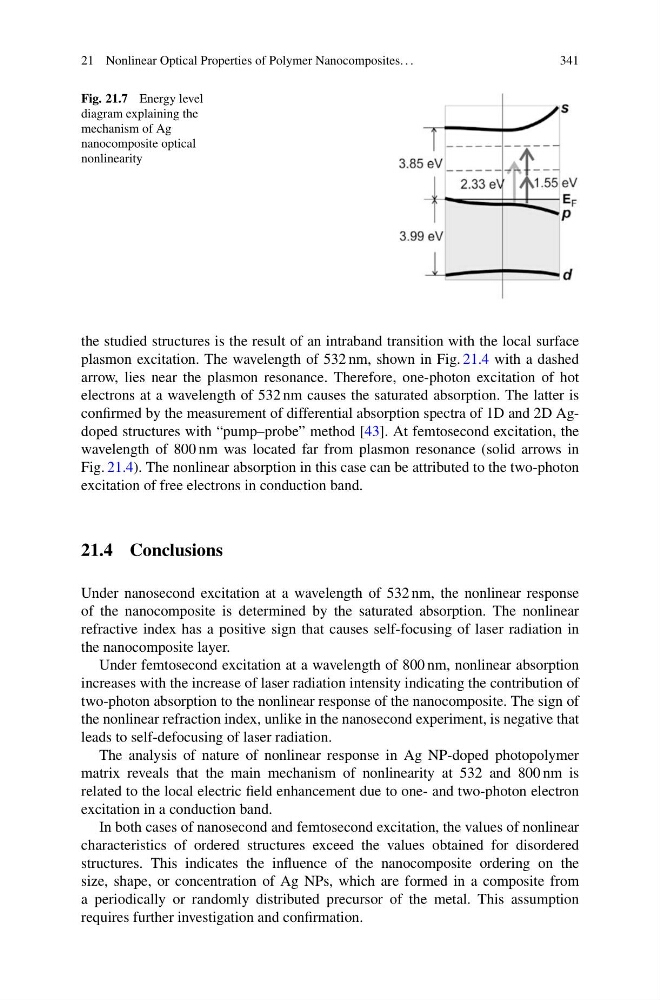
Fig. 21.7 Energy level
diagram explaining the
mechanism of Ag
nanocomposite optical
nonlinearity
the studied structures is the result of an intraband transition with the local surface
plasmon excitation. The wavelength of 532 nm, shown in Fig. 21.4 with a dashed
arrow, lies near the plasmon resonance. Therefore, one-photon excitation of hot
electrons at a wavelength of 532 nm causes the saturated absorption. The latter is
confirmed by the measurement of differential absorption spectra of 1D and 2D Agdoped structures with “pump–probe” method [43]. At femtosecond excitation, the
wavelength of 800 nm was located far from plasmon resonance (solid arrows in
Fig. 21.4). The nonlinear absorption in this case can be attributed to the two-photon
excitation of free electrons in conduction band.
21.4 Conclusions
Under nanosecond excitation at a wavelength of 532 nm, the nonlinear response
of the nanocomposite is determined by the saturated absorption. The nonlinear
refractive index has a positive sign that causes self-focusing of laser radiation in
the nanocomposite layer.
Under femtosecond excitation at a wavelength of 800 nm, nonlinear absorption
increases with the increase of laser radiation intensity indicating the contribution of
two-photon absorption to the nonlinear response of the nanocomposite. The sign of
the nonlinear refraction index, unlike in the nanosecond experiment, is negative that
leads to self-defocusing of laser radiation.
The analysis of nature of nonlinear response in Ag NP-doped photopolymer
matrix reveals that the main mechanism of nonlinearity at 532 and 800 nm is
related to the local electric field enhancement due to one- and two-photon electron
excitation in a conduction band.
In both cases of nanosecond and femtosecond excitation, the values of nonlinear
characteristics of ordered structures exceed the values obtained for disordered
structures. This indicates the influence of the nanocomposite ordering on the
size, shape, or concentration of Ag NPs, which are formed in a composite from
a periodically or randomly distributed precursor of the metal. This assumption
requires further investigation and confirmation.
341
Fig. 21.7 Energy level
diagram explaining the
mechanism of Ag
nanocomposite optical
nonlinearity
the studied structures is the result of an intraband transition with the local surface
plasmon excitation. The wavelength of 532 nm, shown in Fig. 21.4 with a dashed
arrow, lies near the plasmon resonance. Therefore, one-photon excitation of hot
electrons at a wavelength of 532 nm causes the saturated absorption. The latter is
confirmed by the measurement of differential absorption spectra of 1D and 2D Agdoped structures with “pump–probe” method [43]. At femtosecond excitation, the
wavelength of 800 nm was located far from plasmon resonance (solid arrows in
Fig. 21.4). The nonlinear absorption in this case can be attributed to the two-photon
excitation of free electrons in conduction band.
21.4 Conclusions
Under nanosecond excitation at a wavelength of 532 nm, the nonlinear response
of the nanocomposite is determined by the saturated absorption. The nonlinear
refractive index has a positive sign that causes self-focusing of laser radiation in
the nanocomposite layer.
Under femtosecond excitation at a wavelength of 800 nm, nonlinear absorption
increases with the increase of laser radiation intensity indicating the contribution of
two-photon absorption to the nonlinear response of the nanocomposite. The sign of
the nonlinear refraction index, unlike in the nanosecond experiment, is negative that
leads to self-defocusing of laser radiation.
The analysis of nature of nonlinear response in Ag NP-doped photopolymer
matrix reveals that the main mechanism of nonlinearity at 532 and 800 nm is
related to the local electric field enhancement due to one- and two-photon electron
excitation in a conduction band.
In both cases of nanosecond and femtosecond excitation, the values of nonlinear
characteristics of ordered structures exceed the values obtained for disordered
structures. This indicates the influence of the nanocomposite ordering on the
size, shape, or concentration of Ag NPs, which are formed in a composite from
a periodically or randomly distributed precursor of the metal. This assumption
requires further investigation and confirmation.