

340
T. N. Smirnova et al.
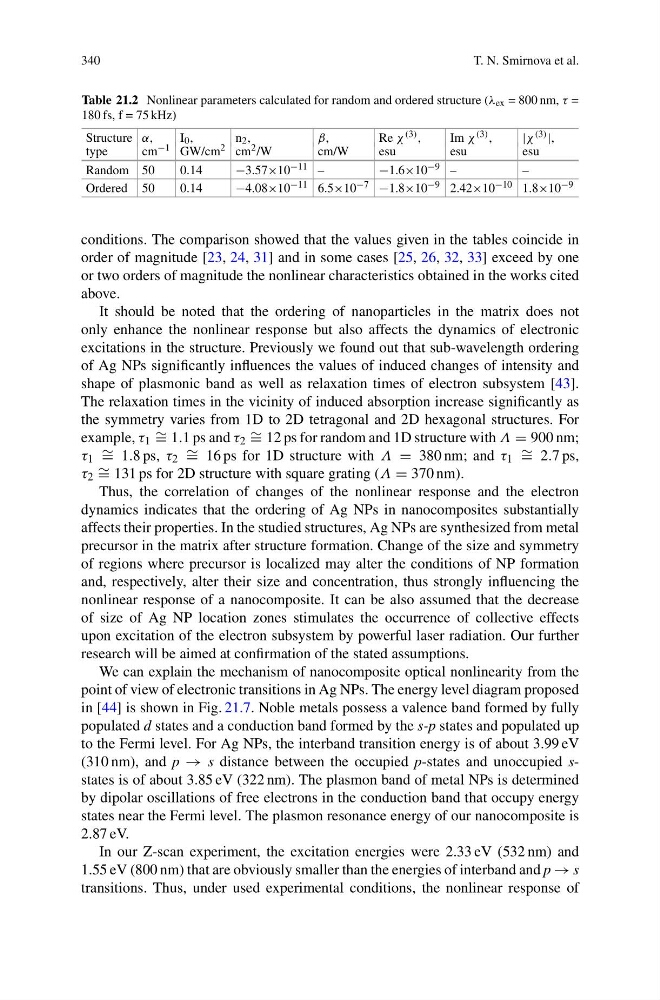
Table 21.2 Nonlinear parameters calculated for random and ordered structure (λ ex = 800 nm, τ =
180 fs, f = 75 kHz)
Structure α,
I 0 ,
n 2 ,
β,
Re χ (3) ,
Im χ (3) ,
|χ (3) |,
type
cm −1 GW/cm 2 cm 2 /W
cm/W
esu
esu
esu
Random 50
0.14
−3.57×10 −11 –
−1.6×10 −9 –
–
Ordered 50
0.14
−4.08×10 −11 6.5×10 −7 −1.8×10 −9 2.42×10 −10 1.8×10 −9
conditions. The comparison showed that the values given in the tables coincide in
order of magnitude [23, 24, 31] and in some cases [25, 26, 32, 33] exceed by one
or two orders of magnitude the nonlinear characteristics obtained in the works cited
above.
It should be noted that the ordering of nanoparticles in the matrix does not
only enhance the nonlinear response but also affects the dynamics of electronic
excitations in the structure. Previously we found out that sub-wavelength ordering
of Ag NPs significantly influences the values of induced changes of intensity and
shape of plasmonic band as well as relaxation times of electron subsystem [43].
The relaxation times in the vicinity of induced absorption increase significantly as
the symmetry varies from 1D to 2D tetragonal and 2D hexagonal structures. For
example, τ 1 ∼ = 1.1 ps and τ 2 ∼ = 12 ps for random and 1D structure with Λ = 900 nm;
τ 1 ∼ = 1.8 ps, τ 2 ∼ = 16 ps for 1D structure with Λ = 380 nm; and τ 1 ∼ = 2.7 ps,
τ 2 ∼ = 131 ps for 2D structure with square grating (Λ = 370 nm).
Thus, the correlation of changes of the nonlinear response and the electron
dynamics indicates that the ordering of Ag NPs in nanocomposites substantially
affects their properties. In the studied structures, Ag NPs are synthesized from metal
precursor in the matrix after structure formation. Change of the size and symmetry
of regions where precursor is localized may alter the conditions of NP formation
and, respectively, alter their size and concentration, thus strongly influencing the
nonlinear response of a nanocomposite. It can be also assumed that the decrease
of size of Ag NP location zones stimulates the occurrence of collective effects
upon excitation of the electron subsystem by powerful laser radiation. Our further
research will be aimed at confirmation of the stated assumptions.
We can explain the mechanism of nanocomposite optical nonlinearity from the
point of view of electronic transitions in Ag NPs. The energy level diagram proposed
in [44] is shown in Fig. 21.7. Noble metals possess a valence band formed by fully
populated d states and a conduction band formed by the s-p states and populated up
to the Fermi level. For Ag NPs, the interband transition energy is of about 3.99 eV
(310 nm), and p → s distance between the occupied p-states and unoccupied sstates is of about 3.85 eV (322 nm). The plasmon band of metal NPs is determined
by dipolar oscillations of free electrons in the conduction band that occupy energy
states near the Fermi level. The plasmon resonance energy of our nanocomposite is
2.87 eV.
In our Z-scan experiment, the excitation energies were 2.33 eV (532 nm) and
1.55 eV (800 nm) that are obviously smaller than the energies of interband and p → s
transitions. Thus, under used experimental conditions, the nonlinear response of
T. N. Smirnova et al.
Table 21.2 Nonlinear parameters calculated for random and ordered structure (λ ex = 800 nm, τ =
180 fs, f = 75 kHz)
Structure α,
I 0 ,
n 2 ,
β,
Re χ (3) ,
Im χ (3) ,
|χ (3) |,
type
cm −1 GW/cm 2 cm 2 /W
cm/W
esu
esu
esu
Random 50
0.14
−3.57×10 −11 –
−1.6×10 −9 –
–
Ordered 50
0.14
−4.08×10 −11 6.5×10 −7 −1.8×10 −9 2.42×10 −10 1.8×10 −9
conditions. The comparison showed that the values given in the tables coincide in
order of magnitude [23, 24, 31] and in some cases [25, 26, 32, 33] exceed by one
or two orders of magnitude the nonlinear characteristics obtained in the works cited
above.
It should be noted that the ordering of nanoparticles in the matrix does not
only enhance the nonlinear response but also affects the dynamics of electronic
excitations in the structure. Previously we found out that sub-wavelength ordering
of Ag NPs significantly influences the values of induced changes of intensity and
shape of plasmonic band as well as relaxation times of electron subsystem [43].
The relaxation times in the vicinity of induced absorption increase significantly as
the symmetry varies from 1D to 2D tetragonal and 2D hexagonal structures. For
example, τ 1 ∼ = 1.1 ps and τ 2 ∼ = 12 ps for random and 1D structure with Λ = 900 nm;
τ 1 ∼ = 1.8 ps, τ 2 ∼ = 16 ps for 1D structure with Λ = 380 nm; and τ 1 ∼ = 2.7 ps,
τ 2 ∼ = 131 ps for 2D structure with square grating (Λ = 370 nm).
Thus, the correlation of changes of the nonlinear response and the electron
dynamics indicates that the ordering of Ag NPs in nanocomposites substantially
affects their properties. In the studied structures, Ag NPs are synthesized from metal
precursor in the matrix after structure formation. Change of the size and symmetry
of regions where precursor is localized may alter the conditions of NP formation
and, respectively, alter their size and concentration, thus strongly influencing the
nonlinear response of a nanocomposite. It can be also assumed that the decrease
of size of Ag NP location zones stimulates the occurrence of collective effects
upon excitation of the electron subsystem by powerful laser radiation. Our further
research will be aimed at confirmation of the stated assumptions.
We can explain the mechanism of nanocomposite optical nonlinearity from the
point of view of electronic transitions in Ag NPs. The energy level diagram proposed
in [44] is shown in Fig. 21.7. Noble metals possess a valence band formed by fully
populated d states and a conduction band formed by the s-p states and populated up
to the Fermi level. For Ag NPs, the interband transition energy is of about 3.99 eV
(310 nm), and p → s distance between the occupied p-states and unoccupied sstates is of about 3.85 eV (322 nm). The plasmon band of metal NPs is determined
by dipolar oscillations of free electrons in the conduction band that occupy energy
states near the Fermi level. The plasmon resonance energy of our nanocomposite is
2.87 eV.
In our Z-scan experiment, the excitation energies were 2.33 eV (532 nm) and
1.55 eV (800 nm) that are obviously smaller than the energies of interband and p → s
transitions. Thus, under used experimental conditions, the nonlinear response of