

14
M. V. Ved’ et al.
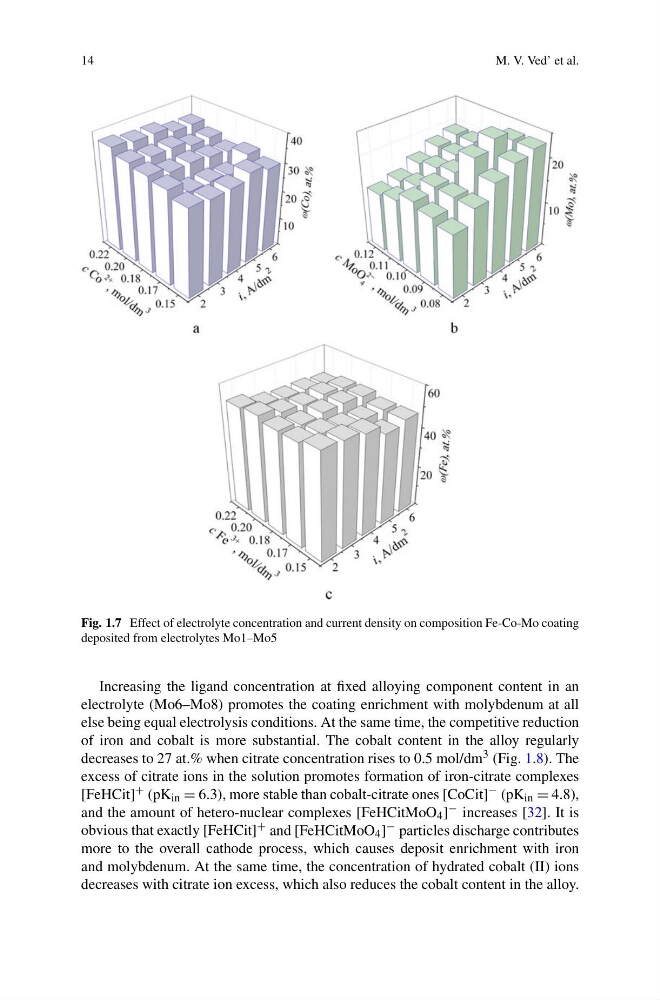
Fig. 1.7 Effect of electrolyte concentration and current density on composition Fe-Co-Mo coating
deposited from electrolytes Mo1–Mo5
Increasing the ligand concentration at fixed alloying component content in an
electrolyte (Mo6–Mo8) promotes the coating enrichment with molybdenum at all
else being equal electrolysis conditions. At the same time, the competitive reduction
of iron and cobalt is more substantial. The cobalt content in the alloy regularly
decreases to 27 at.% when citrate concentration rises to 0.5 mol/dm 3 (Fig. 1.8). The
excess of citrate ions in the solution promotes formation of iron-citrate complexes
[FeHCit] + (pK in = 6.3), more stable than cobalt-citrate ones [CoCit] − (pK in = 4.8),
and the amount of hetero-nuclear complexes [FeHCitMoO 4 ] − increases [32]. It is
obvious that exactly [FeHCit] + and [FeHCitMoO 4 ] − particles discharge contributes
more to the overall cathode process, which causes deposit enrichment with iron
and molybdenum. At the same time, the concentration of hydrated cobalt (II) ions
decreases with citrate ion excess, which also reduces the cobalt content in the alloy.
M. V. Ved’ et al.
Fig. 1.7 Effect of electrolyte concentration and current density on composition Fe-Co-Mo coating
deposited from electrolytes Mo1–Mo5
Increasing the ligand concentration at fixed alloying component content in an
electrolyte (Mo6–Mo8) promotes the coating enrichment with molybdenum at all
else being equal electrolysis conditions. At the same time, the competitive reduction
of iron and cobalt is more substantial. The cobalt content in the alloy regularly
decreases to 27 at.% when citrate concentration rises to 0.5 mol/dm 3 (Fig. 1.8). The
excess of citrate ions in the solution promotes formation of iron-citrate complexes
[FeHCit] + (pK in = 6.3), more stable than cobalt-citrate ones [CoCit] − (pK in = 4.8),
and the amount of hetero-nuclear complexes [FeHCitMoO 4 ] − increases [32]. It is
obvious that exactly [FeHCit] + and [FeHCitMoO 4 ] − particles discharge contributes
more to the overall cathode process, which causes deposit enrichment with iron
and molybdenum. At the same time, the concentration of hydrated cobalt (II) ions
decreases with citrate ion excess, which also reduces the cobalt content in the alloy.