

304
V. A. Zazhigalov et al.
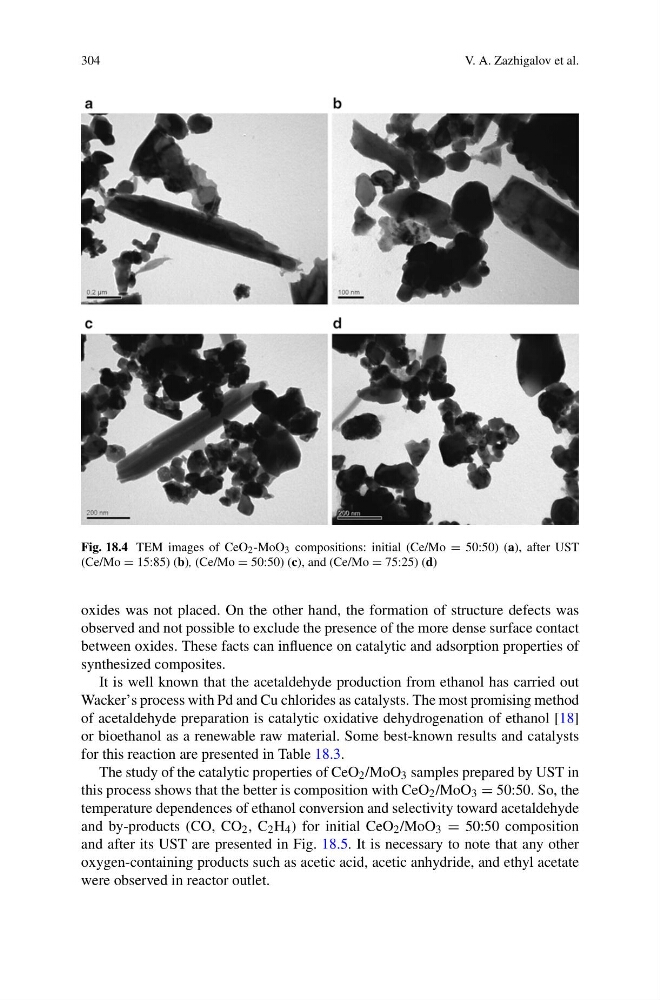
Fig. 18.4 TEM images of CeO 2 -MoO 3 compositions: initial (Ce/Mo = 50:50) (a), after UST
(Ce/Mo = 15:85) (b), (Ce/Mo = 50:50) (c), and (Ce/Mo = 75:25) (d)
oxides was not placed. On the other hand, the formation of structure defects was
observed and not possible to exclude the presence of the more dense surface contact
between oxides. These facts can influence on catalytic and adsorption properties of
synthesized composites.
It is well known that the acetaldehyde production from ethanol has carried out
Wacker’s process with Pd and Cu chlorides as catalysts. The most promising method
of acetaldehyde preparation is catalytic oxidative dehydrogenation of ethanol [18]
or bioethanol as a renewable raw material. Some best-known results and catalysts
for this reaction are presented in Table 18.3.
The study of the catalytic properties of CeO 2 /MoO 3 samples prepared by UST in
this process shows that the better is composition with CeO 2 /MoO 3 = 50:50. So, the
temperature dependences of ethanol conversion and selectivity toward acetaldehyde
and by-products (CO, CO 2 , C 2 H 4 ) for initial CeO 2 /MoO 3 = 50:50 composition
and after its UST are presented in Fig. 18.5. It is necessary to note that any other
oxygen-containing products such as acetic acid, acetic anhydride, and ethyl acetate
were observed in reactor outlet.
V. A. Zazhigalov et al.
Fig. 18.4 TEM images of CeO 2 -MoO 3 compositions: initial (Ce/Mo = 50:50) (a), after UST
(Ce/Mo = 15:85) (b), (Ce/Mo = 50:50) (c), and (Ce/Mo = 75:25) (d)
oxides was not placed. On the other hand, the formation of structure defects was
observed and not possible to exclude the presence of the more dense surface contact
between oxides. These facts can influence on catalytic and adsorption properties of
synthesized composites.
It is well known that the acetaldehyde production from ethanol has carried out
Wacker’s process with Pd and Cu chlorides as catalysts. The most promising method
of acetaldehyde preparation is catalytic oxidative dehydrogenation of ethanol [18]
or bioethanol as a renewable raw material. Some best-known results and catalysts
for this reaction are presented in Table 18.3.
The study of the catalytic properties of CeO 2 /MoO 3 samples prepared by UST in
this process shows that the better is composition with CeO 2 /MoO 3 = 50:50. So, the
temperature dependences of ethanol conversion and selectivity toward acetaldehyde
and by-products (CO, CO 2 , C 2 H 4 ) for initial CeO 2 /MoO 3 = 50:50 composition
and after its UST are presented in Fig. 18.5. It is necessary to note that any other
oxygen-containing products such as acetic acid, acetic anhydride, and ethyl acetate
were observed in reactor outlet.