

17 Percolation Threshold of 5-Cyanobiphenyl Mesogene Phases Between. . .
293
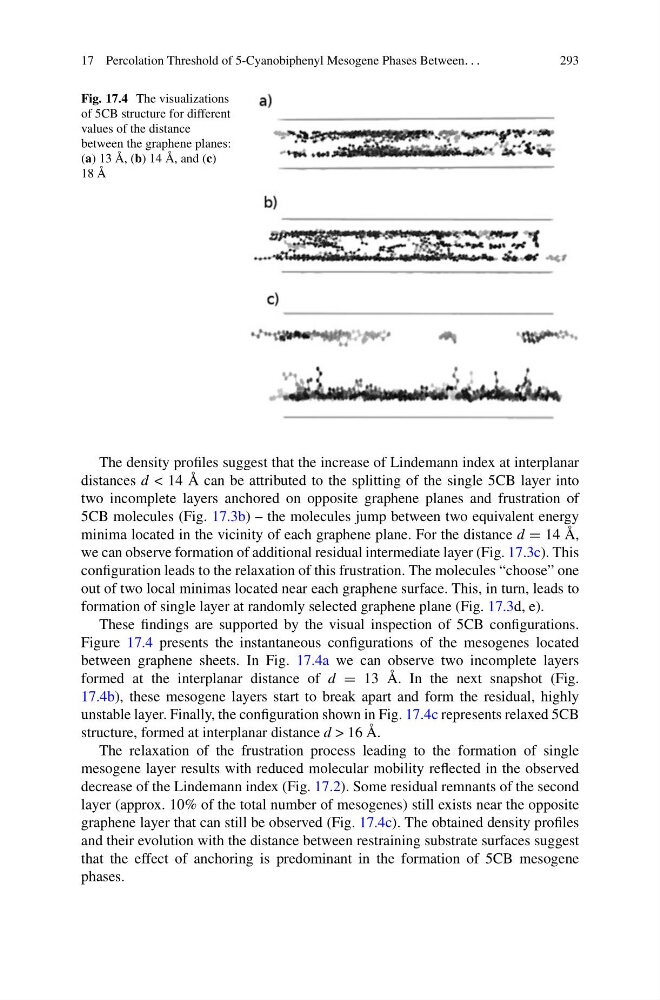
Fig. 17.4 The visualizations
of 5CB structure for different
values of the distance
between the graphene planes:
(a) 13 Å, (b) 14 Å, and (c)
18 Å
The density profiles suggest that the increase of Lindemann index at interplanar
distances d < 14 Å can be attributed to the splitting of the single 5CB layer into
two incomplete layers anchored on opposite graphene planes and frustration of
5CB molecules (Fig. 17.3b) – the molecules jump between two equivalent energy
minima located in the vicinity of each graphene plane. For the distance d = 14 Å,
we can observe formation of additional residual intermediate layer (Fig. 17.3c). This
configuration leads to the relaxation of this frustration. The molecules “choose” one
out of two local minimas located near each graphene surface. This, in turn, leads to
formation of single layer at randomly selected graphene plane (Fig. 17.3d, e).
These findings are supported by the visual inspection of 5CB configurations.
Figure 17.4 presents the instantaneous configurations of the mesogenes located
between graphene sheets. In Fig. 17.4a we can observe two incomplete layers
formed at the interplanar distance of d = 13 Å. In the next snapshot (Fig.
17.4b), these mesogene layers start to break apart and form the residual, highly
unstable layer. Finally, the configuration shown in Fig. 17.4c represents relaxed 5CB
structure, formed at interplanar distance d > 16 Å.
The relaxation of the frustration process leading to the formation of single
mesogene layer results with reduced molecular mobility reflected in the observed
decrease of the Lindemann index (Fig. 17.2). Some residual remnants of the second
layer (approx. 10% of the total number of mesogenes) still exists near the opposite
graphene layer that can still be observed (Fig. 17.4c). The obtained density profiles
and their evolution with the distance between restraining substrate surfaces suggest
that the effect of anchoring is predominant in the formation of 5CB mesogene
phases.
293
Fig. 17.4 The visualizations
of 5CB structure for different
values of the distance
between the graphene planes:
(a) 13 Å, (b) 14 Å, and (c)
18 Å
The density profiles suggest that the increase of Lindemann index at interplanar
distances d < 14 Å can be attributed to the splitting of the single 5CB layer into
two incomplete layers anchored on opposite graphene planes and frustration of
5CB molecules (Fig. 17.3b) – the molecules jump between two equivalent energy
minima located in the vicinity of each graphene plane. For the distance d = 14 Å,
we can observe formation of additional residual intermediate layer (Fig. 17.3c). This
configuration leads to the relaxation of this frustration. The molecules “choose” one
out of two local minimas located near each graphene surface. This, in turn, leads to
formation of single layer at randomly selected graphene plane (Fig. 17.3d, e).
These findings are supported by the visual inspection of 5CB configurations.
Figure 17.4 presents the instantaneous configurations of the mesogenes located
between graphene sheets. In Fig. 17.4a we can observe two incomplete layers
formed at the interplanar distance of d = 13 Å. In the next snapshot (Fig.
17.4b), these mesogene layers start to break apart and form the residual, highly
unstable layer. Finally, the configuration shown in Fig. 17.4c represents relaxed 5CB
structure, formed at interplanar distance d > 16 Å.
The relaxation of the frustration process leading to the formation of single
mesogene layer results with reduced molecular mobility reflected in the observed
decrease of the Lindemann index (Fig. 17.2). Some residual remnants of the second
layer (approx. 10% of the total number of mesogenes) still exists near the opposite
graphene layer that can still be observed (Fig. 17.4c). The obtained density profiles
and their evolution with the distance between restraining substrate surfaces suggest
that the effect of anchoring is predominant in the formation of 5CB mesogene
phases.