

15 “Polymer–Oxide” Micro-/Nanocomposites: Background and Promises
259
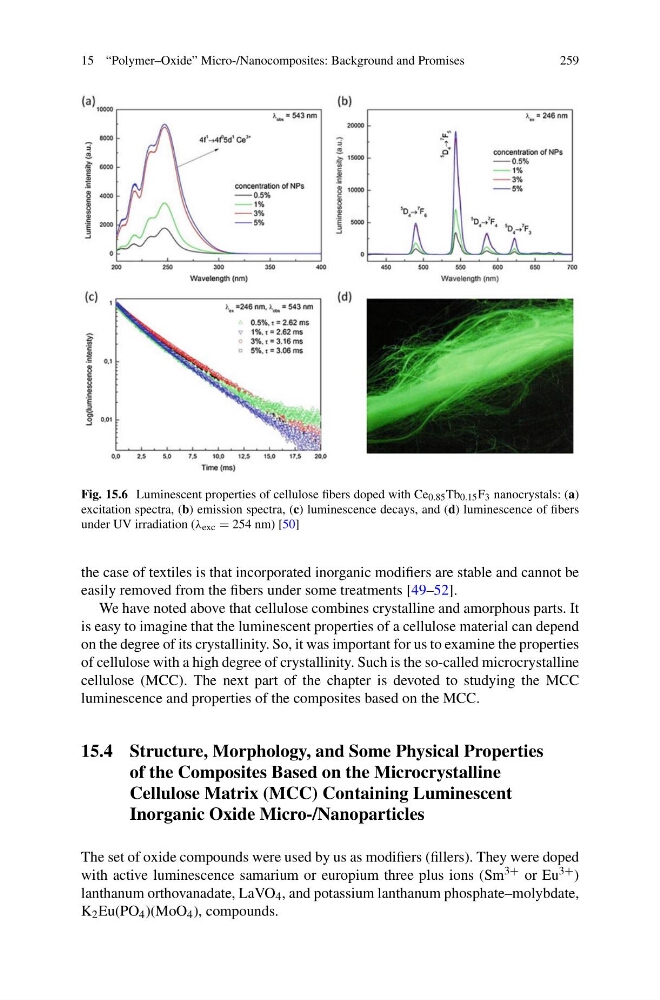
Fig. 15.6 Luminescent properties of cellulose fibers doped with Ce 0.85 Tb 0.15 F 3 nanocrystals: (a)
excitation spectra, (b) emission spectra, (c) luminescence decays, and (d) luminescence of fibers
under UV irradiation (λ exc = 254 nm) [50]
the case of textiles is that incorporated inorganic modifiers are stable and cannot be
easily removed from the fibers under some treatments [49–52].
We have noted above that cellulose combines crystalline and amorphous parts. It
is easy to imagine that the luminescent properties of a cellulose material can depend
on the degree of its crystallinity. So, it was important for us to examine the properties
of cellulose with a high degree of crystallinity. Such is the so-called microcrystalline
cellulose (MCC). The next part of the chapter is devoted to studying the MCC
luminescence and properties of the composites based on the MCC.
15.4 Structure, Morphology, and Some Physical Properties
of the Composites Based on the Microcrystalline
Cellulose Matrix (MCC) Containing Luminescent
Inorganic Oxide Micro-/Nanoparticles
The set of oxide compounds were used by us as modifiers (fillers). They were doped
with active luminescence samarium or europium three plus ions (Sm 3+ or Eu 3+ )
lanthanum orthovanadate, LaVO 4 , and potassium lanthanum phosphate–molybdate,
K 2 Eu(PO 4 )(MoO 4 ), compounds.
259
Fig. 15.6 Luminescent properties of cellulose fibers doped with Ce 0.85 Tb 0.15 F 3 nanocrystals: (a)
excitation spectra, (b) emission spectra, (c) luminescence decays, and (d) luminescence of fibers
under UV irradiation (λ exc = 254 nm) [50]
the case of textiles is that incorporated inorganic modifiers are stable and cannot be
easily removed from the fibers under some treatments [49–52].
We have noted above that cellulose combines crystalline and amorphous parts. It
is easy to imagine that the luminescent properties of a cellulose material can depend
on the degree of its crystallinity. So, it was important for us to examine the properties
of cellulose with a high degree of crystallinity. Such is the so-called microcrystalline
cellulose (MCC). The next part of the chapter is devoted to studying the MCC
luminescence and properties of the composites based on the MCC.
15.4 Structure, Morphology, and Some Physical Properties
of the Composites Based on the Microcrystalline
Cellulose Matrix (MCC) Containing Luminescent
Inorganic Oxide Micro-/Nanoparticles
The set of oxide compounds were used by us as modifiers (fillers). They were doped
with active luminescence samarium or europium three plus ions (Sm 3+ or Eu 3+ )
lanthanum orthovanadate, LaVO 4 , and potassium lanthanum phosphate–molybdate,
K 2 Eu(PO 4 )(MoO 4 ), compounds.