

258
S. G. Nedilko
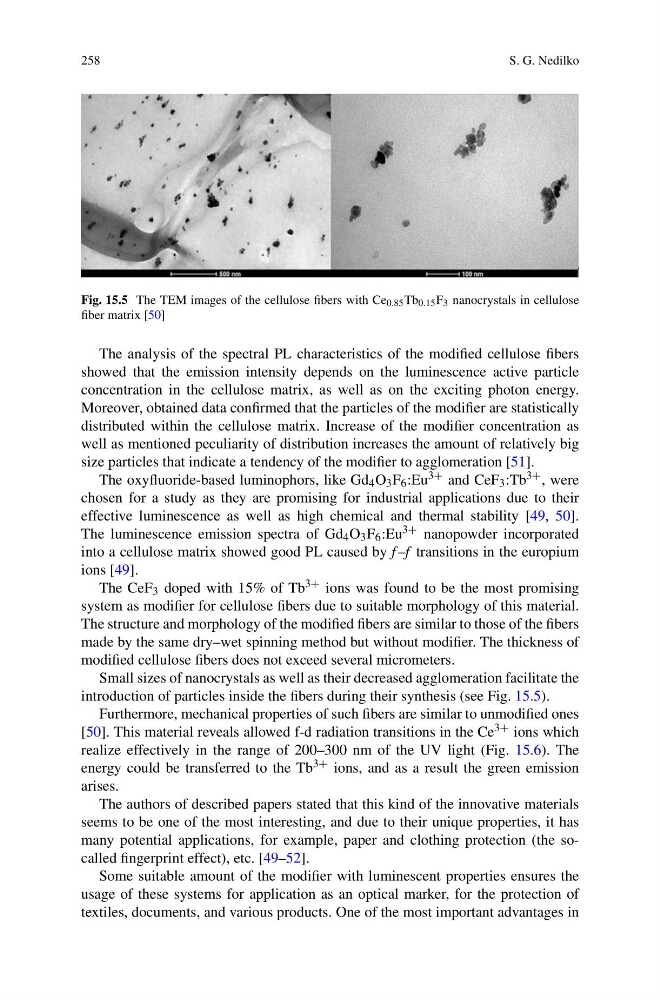
Fig. 15.5 The TEM images of the cellulose fibers with Ce 0.85 Tb 0.15 F 3 nanocrystals in cellulose
fiber matrix [50]
The analysis of the spectral PL characteristics of the modified cellulose fibers
showed that the emission intensity depends on the luminescence active particle
concentration in the cellulose matrix, as well as on the exciting photon energy.
Moreover, obtained data confirmed that the particles of the modifier are statistically
distributed within the cellulose matrix. Increase of the modifier concentration as
well as mentioned peculiarity of distribution increases the amount of relatively big
size particles that indicate a tendency of the modifier to agglomeration [51].
The oxyfluoride-based luminophors, like Gd 4 O 3 F 6 :Eu 3+ and CeF 3 :Tb 3+ , were
chosen for a study as they are promising for industrial applications due to their
effective luminescence as well as high chemical and thermal stability [49, 50].
The luminescence emission spectra of Gd 4 O 3 F 6 :Eu 3+ nanopowder incorporated
into a cellulose matrix showed good PL caused by f –f transitions in the europium
ions [49].
The CeF 3 doped with 15% of Tb 3+ ions was found to be the most promising
system as modifier for cellulose fibers due to suitable morphology of this material.
The structure and morphology of the modified fibers are similar to those of the fibers
made by the same dry–wet spinning method but without modifier. The thickness of
modified cellulose fibers does not exceed several micrometers.
Small sizes of nanocrystals as well as their decreased agglomeration facilitate the
introduction of particles inside the fibers during their synthesis (see Fig. 15.5).
Furthermore, mechanical properties of such fibers are similar to unmodified ones
[50]. This material reveals allowed f-d radiation transitions in the Ce 3+ ions which
realize effectively in the range of 200–300 nm of the UV light (Fig. 15.6). The
energy could be transferred to the Tb 3+ ions, and as a result the green emission
arises.
The authors of described papers stated that this kind of the innovative materials
seems to be one of the most interesting, and due to their unique properties, it has
many potential applications, for example, paper and clothing protection (the socalled fingerprint effect), etc. [49–52].
Some suitable amount of the modifier with luminescent properties ensures the
usage of these systems for application as an optical marker, for the protection of
textiles, documents, and various products. One of the most important advantages in
S. G. Nedilko
Fig. 15.5 The TEM images of the cellulose fibers with Ce 0.85 Tb 0.15 F 3 nanocrystals in cellulose
fiber matrix [50]
The analysis of the spectral PL characteristics of the modified cellulose fibers
showed that the emission intensity depends on the luminescence active particle
concentration in the cellulose matrix, as well as on the exciting photon energy.
Moreover, obtained data confirmed that the particles of the modifier are statistically
distributed within the cellulose matrix. Increase of the modifier concentration as
well as mentioned peculiarity of distribution increases the amount of relatively big
size particles that indicate a tendency of the modifier to agglomeration [51].
The oxyfluoride-based luminophors, like Gd 4 O 3 F 6 :Eu 3+ and CeF 3 :Tb 3+ , were
chosen for a study as they are promising for industrial applications due to their
effective luminescence as well as high chemical and thermal stability [49, 50].
The luminescence emission spectra of Gd 4 O 3 F 6 :Eu 3+ nanopowder incorporated
into a cellulose matrix showed good PL caused by f –f transitions in the europium
ions [49].
The CeF 3 doped with 15% of Tb 3+ ions was found to be the most promising
system as modifier for cellulose fibers due to suitable morphology of this material.
The structure and morphology of the modified fibers are similar to those of the fibers
made by the same dry–wet spinning method but without modifier. The thickness of
modified cellulose fibers does not exceed several micrometers.
Small sizes of nanocrystals as well as their decreased agglomeration facilitate the
introduction of particles inside the fibers during their synthesis (see Fig. 15.5).
Furthermore, mechanical properties of such fibers are similar to unmodified ones
[50]. This material reveals allowed f-d radiation transitions in the Ce 3+ ions which
realize effectively in the range of 200–300 nm of the UV light (Fig. 15.6). The
energy could be transferred to the Tb 3+ ions, and as a result the green emission
arises.
The authors of described papers stated that this kind of the innovative materials
seems to be one of the most interesting, and due to their unique properties, it has
many potential applications, for example, paper and clothing protection (the socalled fingerprint effect), etc. [49–52].
Some suitable amount of the modifier with luminescent properties ensures the
usage of these systems for application as an optical marker, for the protection of
textiles, documents, and various products. One of the most important advantages in