

14 Directional Synthesis of SnO 2 -Based Nanostructures for Use in Gas Sensors
241
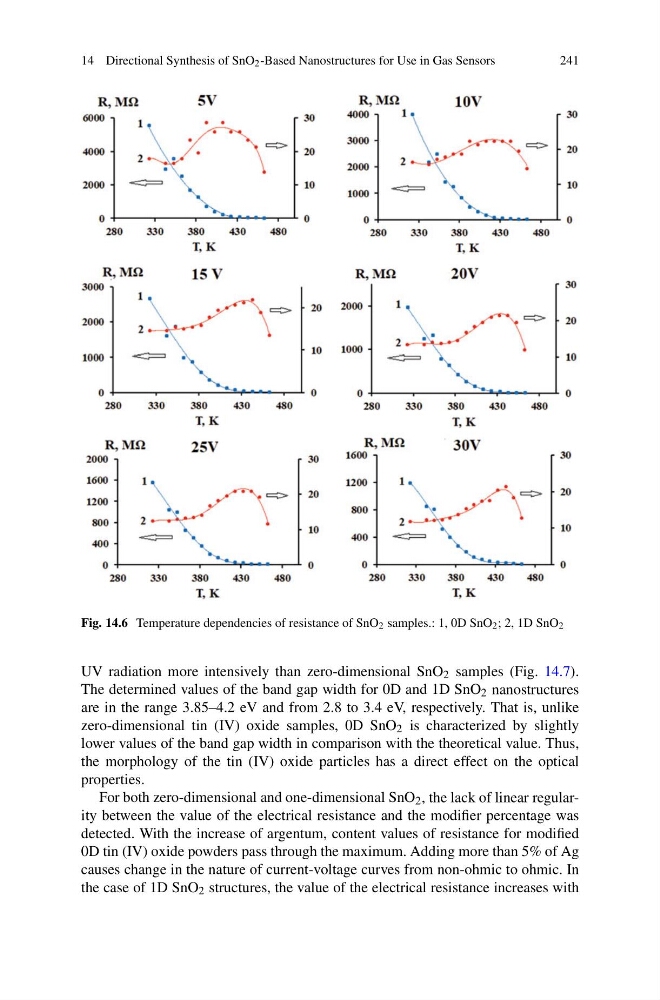
Fig. 14.6 Temperature dependencies of resistance of SnO 2 samples.: 1, 0D SnO 2 ; 2, 1D SnO 2
UV radiation more intensively than zero-dimensional SnO 2 samples (Fig. 14.7).
The determined values of the band gap width for 0D and 1D SnO 2 nanostructures
are in the range 3.85–4.2 eV and from 2.8 to 3.4 eV, respectively. That is, unlike
zero-dimensional tin (IV) oxide samples, 0D SnO 2 is characterized by slightly
lower values of the band gap width in comparison with the theoretical value. Thus,
the morphology of the tin (IV) oxide particles has a direct effect on the optical
properties.
For both zero-dimensional and one-dimensional SnO 2 , the lack of linear regularity between the value of the electrical resistance and the modifier percentage was
detected. With the increase of argentum, content values of resistance for modified
0D tin (IV) oxide powders pass through the maximum. Adding more than 5% of Ag
causes change in the nature of current-voltage curves from non-ohmic to ohmic. In
the case of 1D SnO 2 structures, the value of the electrical resistance increases with
241
Fig. 14.6 Temperature dependencies of resistance of SnO 2 samples.: 1, 0D SnO 2 ; 2, 1D SnO 2
UV radiation more intensively than zero-dimensional SnO 2 samples (Fig. 14.7).
The determined values of the band gap width for 0D and 1D SnO 2 nanostructures
are in the range 3.85–4.2 eV and from 2.8 to 3.4 eV, respectively. That is, unlike
zero-dimensional tin (IV) oxide samples, 0D SnO 2 is characterized by slightly
lower values of the band gap width in comparison with the theoretical value. Thus,
the morphology of the tin (IV) oxide particles has a direct effect on the optical
properties.
For both zero-dimensional and one-dimensional SnO 2 , the lack of linear regularity between the value of the electrical resistance and the modifier percentage was
detected. With the increase of argentum, content values of resistance for modified
0D tin (IV) oxide powders pass through the maximum. Adding more than 5% of Ag
causes change in the nature of current-voltage curves from non-ohmic to ohmic. In
the case of 1D SnO 2 structures, the value of the electrical resistance increases with