

14 Directional Synthesis of SnO 2 -Based Nanostructures for Use in Gas Sensors
235
14.2 Experimental
14.2.1 The Influence of the Synthesis Method on Structural
Characteristics of Tin (IV) Oxide Samples
As it is known, the properties of the material (in particular, the morphology, the
crystals size, the pore distribution, and microstructure development) extremely
depend on the obtaining method. In this work, the synthesis of tin (IV) oxide was
carried out by three different methods: thermal [20], sol-gel in an alcoholic medium
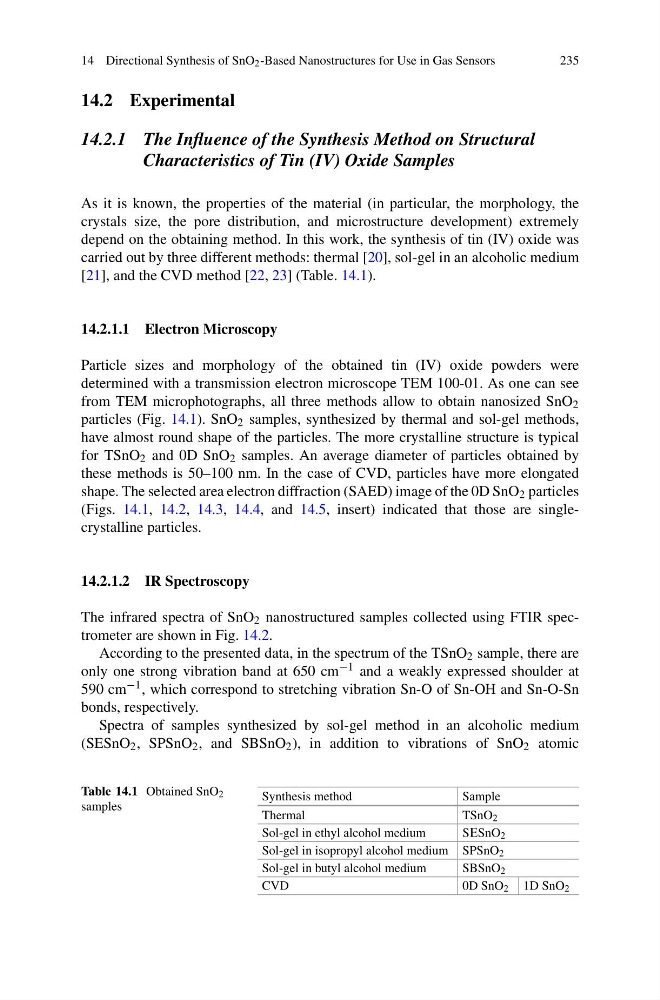
[21], and the CVD method [22, 23] (Table. 14.1).
14.2.1.1 Electron Microscopy
Particle sizes and morphology of the obtained tin (IV) oxide powders were
determined with a transmission electron microscope TEM 100-01. As one can see
from TEM microphotographs, all three methods allow to obtain nanosized SnO 2
particles (Fig. 14.1). SnO 2 samples, synthesized by thermal and sol-gel methods,
have almost round shape of the particles. The more crystalline structure is typical
for TSnO 2 and 0D SnO 2 samples. An average diameter of particles obtained by
these methods is 50–100 nm. In the case of CVD, particles have more elongated
shape. The selected area electron diffraction (SAED) image of the 0D SnO 2 particles
(Figs. 14.1, 14.2, 14.3, 14.4, and 14.5, insert) indicated that those are singlecrystalline particles.
14.2.1.2 IR Spectroscopy
The infrared spectra of SnO 2 nanostructured samples collected using FTIR spectrometer are shown in Fig. 14.2.
According to the presented data, in the spectrum of the TSnO 2 sample, there are
only one strong vibration band at 650 cm −1 and a weakly expressed shoulder at
590 cm −1 , which correspond to stretching vibration Sn-O of Sn-OH and Sn-O-Sn
bonds, respectively.
Spectra of samples synthesized by sol-gel method in an alcoholic medium
(SESnO 2 , SPSnO 2 , and SBSnO 2 ), in addition to vibrations of SnO 2 atomic
Table 14.1 Obtained SnO 2
samples
Synthesis method
Sample
Thermal
TSnO 2
Sol-gel in ethyl alcohol medium
S¨SnO 2
Sol-gel in isopropyl alcohol medium SPSnO 2
Sol-gel in butyl alcohol medium
SBSnO 2
CVD
0D SnO 2 1D SnO 2
235
14.2 Experimental
14.2.1 The Influence of the Synthesis Method on Structural
Characteristics of Tin (IV) Oxide Samples
As it is known, the properties of the material (in particular, the morphology, the
crystals size, the pore distribution, and microstructure development) extremely
depend on the obtaining method. In this work, the synthesis of tin (IV) oxide was
carried out by three different methods: thermal [20], sol-gel in an alcoholic medium
[21], and the CVD method [22, 23] (Table. 14.1).
14.2.1.1 Electron Microscopy
Particle sizes and morphology of the obtained tin (IV) oxide powders were
determined with a transmission electron microscope TEM 100-01. As one can see
from TEM microphotographs, all three methods allow to obtain nanosized SnO 2
particles (Fig. 14.1). SnO 2 samples, synthesized by thermal and sol-gel methods,
have almost round shape of the particles. The more crystalline structure is typical
for TSnO 2 and 0D SnO 2 samples. An average diameter of particles obtained by
these methods is 50–100 nm. In the case of CVD, particles have more elongated
shape. The selected area electron diffraction (SAED) image of the 0D SnO 2 particles
(Figs. 14.1, 14.2, 14.3, 14.4, and 14.5, insert) indicated that those are singlecrystalline particles.
14.2.1.2 IR Spectroscopy
The infrared spectra of SnO 2 nanostructured samples collected using FTIR spectrometer are shown in Fig. 14.2.
According to the presented data, in the spectrum of the TSnO 2 sample, there are
only one strong vibration band at 650 cm −1 and a weakly expressed shoulder at
590 cm −1 , which correspond to stretching vibration Sn-O of Sn-OH and Sn-O-Sn
bonds, respectively.
Spectra of samples synthesized by sol-gel method in an alcoholic medium
(SESnO 2 , SPSnO 2 , and SBSnO 2 ), in addition to vibrations of SnO 2 atomic
Table 14.1 Obtained SnO 2
samples
Synthesis method
Sample
Thermal
TSnO 2
Sol-gel in ethyl alcohol medium
S¨SnO 2
Sol-gel in isopropyl alcohol medium SPSnO 2
Sol-gel in butyl alcohol medium
SBSnO 2
CVD
0D SnO 2 1D SnO 2