

6
M. V. Ved’ et al.
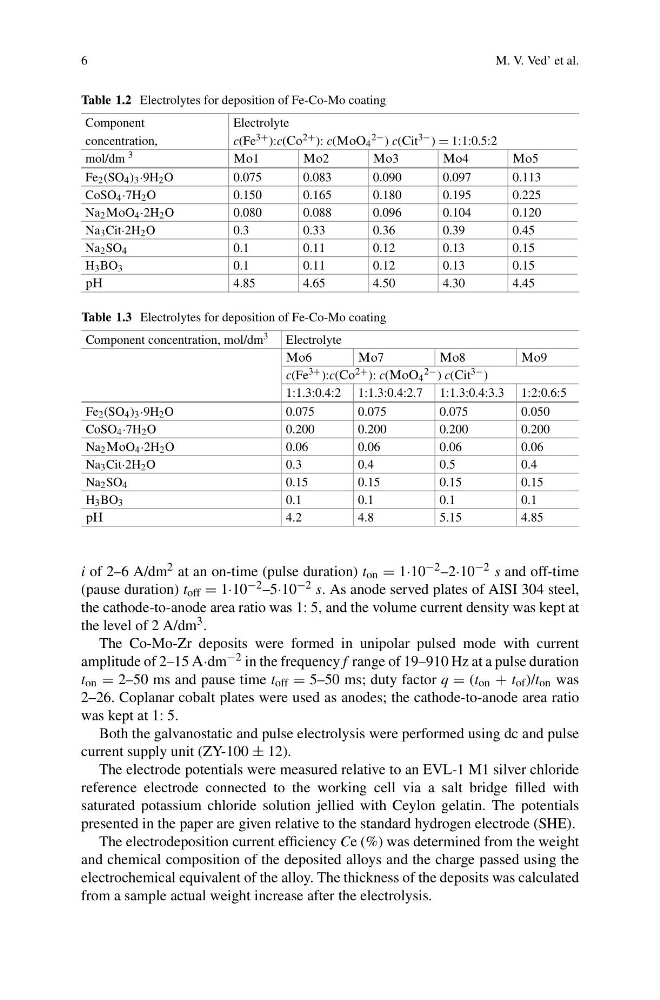
Table 1.2 Electrolytes for deposition of Fe-Co-Mo coating
Component
Electrolyte
concentration,
Ô(Fe 3+ ):Ô(´Ñ 2+ ): Ô(¯Ñ± 4
2− ) Ô(´it 3− ) = 1:1:0.5:2
mol/dm 3
¯Ñ1
¯Ñ2
¯Ñ3
¯Ñ4
¯Ñ5
Fe 2 (SO 4 ) 3 ·9H 2 O
0.075
0.083
0.090
0.097
0.113
CoSO 4 ·7H 2 O
0.150
0.165
0.180
0.195
0.225
Na 2 ¯ÑO 4 ·2H 2 O
0.080
0.088
0.096
0.104
0.120
Na 3 Cit·2H 2 O
0.3
0.33
0.36
0.39
0.45
Na 2 SO 4
0.1
0.11
0.12
0.13
0.15
H 3 BO 3
0.1
0.11
0.12
0.13
0.15
Ó°
4.85
4.65
4.50
4.30
4.45
Table 1.3 Electrolytes for deposition of Fe-Co-Mo coating
Component concentration, mol/dm 3 Electrolyte
¯Ñ6
¯Ñ7
¯Ñ8
¯Ñ9
Ô(Fe 3+ ):Ô(´Ñ 2+ ): Ô(¯Ñ± 4
2− ) Ô(´it 3− )
1:1.3:0.4:2 1:1.3:0.4:2.7 1:1.3:0.4:3.3 1:2:0.6:5
Fe 2 (SO 4 ) 3 ·9H 2 O
0.075
0.075
0.075
0.050
CoSO 4 ·7H 2 O
0.200
0.200
0.200
0.200
Na 2 ¯ÑO 4 ·2H 2 O
0.06
0.06
0.06
0.06
Na 3 Cit·2H 2 O
0.3
0.4
0.5
0.4
Na 2 SO 4
0.15
0.15
0.15
0.15
H 3 BO 3
0.1
0.1
0.1
0.1
Ó°
4.2
4.8
5.15
4.85
i of 2–6 A/dm 2 at an on-time (pulse duration) t on = 1·10 −2 –2·10 −2 s and off-time
(pause duration) t off = 1·10 −2 –5·10 −2 s. As anode served plates of AISI 304 steel,
the cathode-to-anode area ratio was 1: 5, and the volume current density was kept at
the level of 2 A/dm 3 .
The Co-Mo-Zr deposits were formed in unipolar pulsed mode with current
amplitude of 2–15 £·dm −2 in the frequency f range of 19–910 Hz at a pulse duration
t on = 2–50 ms and pause time t off = 5–50 ms; duty factor q = (t on + t of )/t on was
2–26. Coplanar cobalt plates were used as anodes; the cathode-to-anode area ratio
was kept at 1: 5.
Both the galvanostatic and pulse electrolysis were performed using dc and pulse
current supply unit (ZY-100 ± 12).
The electrode potentials were measured relative to an EVL-1 M1 silver chloride
reference electrode connected to the working cell via a salt bridge filled with
saturated potassium chloride solution jellied with Ceylon gelatin. The potentials
presented in the paper are given relative to the standard hydrogen electrode (SHE).
The electrodeposition current efficiency Ce (%) was determined from the weight
and chemical composition of the deposited alloys and the charge passed using the
electrochemical equivalent of the alloy. The thickness of the deposits was calculated
from a sample actual weight increase after the electrolysis.
M. V. Ved’ et al.
Table 1.2 Electrolytes for deposition of Fe-Co-Mo coating
Component
Electrolyte
concentration,
Ô(Fe 3+ ):Ô(´Ñ 2+ ): Ô(¯Ñ± 4
2− ) Ô(´it 3− ) = 1:1:0.5:2
mol/dm 3
¯Ñ1
¯Ñ2
¯Ñ3
¯Ñ4
¯Ñ5
Fe 2 (SO 4 ) 3 ·9H 2 O
0.075
0.083
0.090
0.097
0.113
CoSO 4 ·7H 2 O
0.150
0.165
0.180
0.195
0.225
Na 2 ¯ÑO 4 ·2H 2 O
0.080
0.088
0.096
0.104
0.120
Na 3 Cit·2H 2 O
0.3
0.33
0.36
0.39
0.45
Na 2 SO 4
0.1
0.11
0.12
0.13
0.15
H 3 BO 3
0.1
0.11
0.12
0.13
0.15
Ó°
4.85
4.65
4.50
4.30
4.45
Table 1.3 Electrolytes for deposition of Fe-Co-Mo coating
Component concentration, mol/dm 3 Electrolyte
¯Ñ6
¯Ñ7
¯Ñ8
¯Ñ9
Ô(Fe 3+ ):Ô(´Ñ 2+ ): Ô(¯Ñ± 4
2− ) Ô(´it 3− )
1:1.3:0.4:2 1:1.3:0.4:2.7 1:1.3:0.4:3.3 1:2:0.6:5
Fe 2 (SO 4 ) 3 ·9H 2 O
0.075
0.075
0.075
0.050
CoSO 4 ·7H 2 O
0.200
0.200
0.200
0.200
Na 2 ¯ÑO 4 ·2H 2 O
0.06
0.06
0.06
0.06
Na 3 Cit·2H 2 O
0.3
0.4
0.5
0.4
Na 2 SO 4
0.15
0.15
0.15
0.15
H 3 BO 3
0.1
0.1
0.1
0.1
Ó°
4.2
4.8
5.15
4.85
i of 2–6 A/dm 2 at an on-time (pulse duration) t on = 1·10 −2 –2·10 −2 s and off-time
(pause duration) t off = 1·10 −2 –5·10 −2 s. As anode served plates of AISI 304 steel,
the cathode-to-anode area ratio was 1: 5, and the volume current density was kept at
the level of 2 A/dm 3 .
The Co-Mo-Zr deposits were formed in unipolar pulsed mode with current
amplitude of 2–15 £·dm −2 in the frequency f range of 19–910 Hz at a pulse duration
t on = 2–50 ms and pause time t off = 5–50 ms; duty factor q = (t on + t of )/t on was
2–26. Coplanar cobalt plates were used as anodes; the cathode-to-anode area ratio
was kept at 1: 5.
Both the galvanostatic and pulse electrolysis were performed using dc and pulse
current supply unit (ZY-100 ± 12).
The electrode potentials were measured relative to an EVL-1 M1 silver chloride
reference electrode connected to the working cell via a salt bridge filled with
saturated potassium chloride solution jellied with Ceylon gelatin. The potentials
presented in the paper are given relative to the standard hydrogen electrode (SHE).
The electrodeposition current efficiency Ce (%) was determined from the weight
and chemical composition of the deposited alloys and the charge passed using the
electrochemical equivalent of the alloy. The thickness of the deposits was calculated
from a sample actual weight increase after the electrolysis.