

1 Nanostructured Functional Coatings of Iron Family Metals with Refractory. . .
5
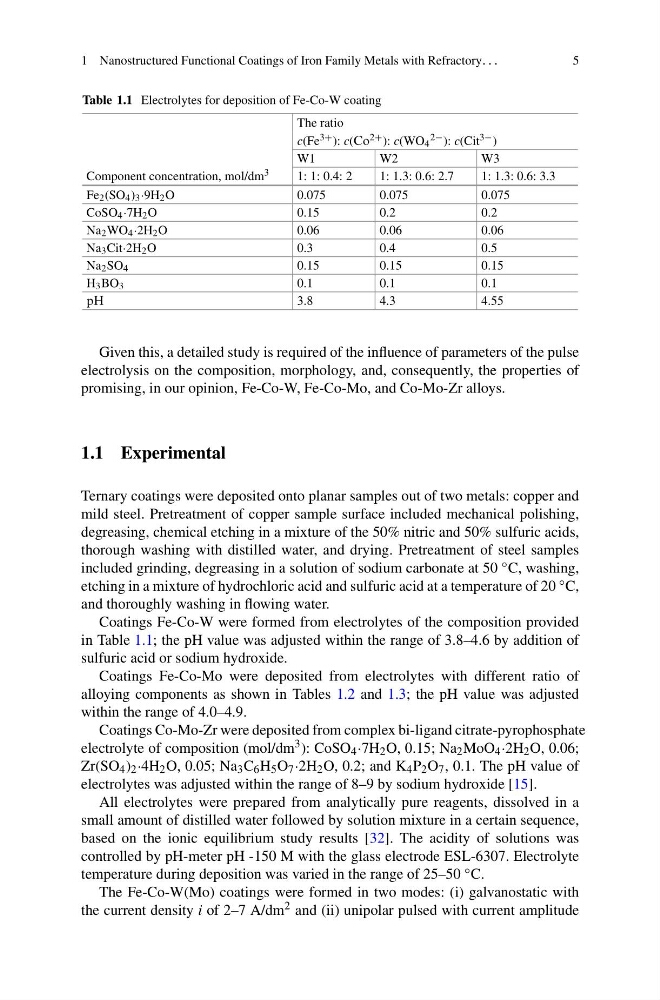
Table 1.1 Electrolytes for deposition of Fe-Co-W coating
The ratio
Ô(Fe 3+ ): Ô(´Ñ 2+ ): Ô(WO 4
2− ): Ô(Cit 3− )
W1
W2
W3
Component concentration, mol/dm 3
1: 1: 0.4: 2
1: 1.3: 0.6: 2.7
1: 1.3: 0.6: 3.3
Fe 2 (SO 4 ) 3 ·9H 2 O
0.075
0.075
0.075
CoSO 4 ·7H 2 O
0.15
0.2
0.2
Na 2 WO 4 ·2H 2 O
0.06
0.06
0.06
Na 3 Cit·2H 2 O
0.3
0.4
0.5
Na 2 SO 4
0.15
0.15
0.15
H 3 BO 3
0.1
0.1
0.1
Ó°
3.8
4.3
4.55
Given this, a detailed study is required of the influence of parameters of the pulse
electrolysis on the composition, morphology, and, consequently, the properties of
promising, in our opinion, Fe-Co-W, Fe-Co-Mo, and Co-Mo-Zr alloys.
1.1 Experimental
Ternary coatings were deposited onto planar samples out of two metals: copper and
mild steel. Pretreatment of copper sample surface included mechanical polishing,
degreasing, chemical etching in a mixture of the 50% nitric and 50% sulfuric acids,
thorough washing with distilled water, and drying. Pretreatment of steel samples
included grinding, degreasing in a solution of sodium carbonate at 50 ◦ C, washing,
etching in a mixture of hydrochloric acid and sulfuric acid at a temperature of 20 ◦ C,
and thoroughly washing in flowing water.
Coatings Fe-Co-W were formed from electrolytes of the composition provided
in Table 1.1; the pH value was adjusted within the range of 3.8–4.6 by addition of
sulfuric acid or sodium hydroxide.
Coatings Fe-Co-Mo were deposited from electrolytes with different ratio of
alloying components as shown in Tables 1.2 and 1.3; the pH value was adjusted
within the range of 4.0–4.9.
Coatings Co-Mo-Zr were deposited from complex bi-ligand citrate-pyrophosphate
electrolyte of composition (mol/dm 3 ): CoSO 4 ·7H 2 O, 0.15; Na 2 MoO 4 ·2H 2 O, 0.06;
Zr(SO 4 ) 2 ·4H 2 O, 0.05; Na 3 C 6 H 5 O 7 ·2H 2 O, 0.2; and K 4 P 2 O 7 , 0.1. The pH value of
electrolytes was adjusted within the range of 8–9 by sodium hydroxide [15].
All electrolytes were prepared from analytically pure reagents, dissolved in a
small amount of distilled water followed by solution mixture in a certain sequence,
based on the ionic equilibrium study results [32]. The acidity of solutions was
controlled by pH-meter pH -150 M with the glass electrode ESL-6307. Electrolyte
temperature during deposition was varied in the range of 25–50 ◦ C.
The Fe-Co-W(Mo) coatings were formed in two modes: (i) galvanostatic with
the current density i of 2–7 A/dm 2 and (ii) unipolar pulsed with current amplitude
5
Table 1.1 Electrolytes for deposition of Fe-Co-W coating
The ratio
Ô(Fe 3+ ): Ô(´Ñ 2+ ): Ô(WO 4
2− ): Ô(Cit 3− )
W1
W2
W3
Component concentration, mol/dm 3
1: 1: 0.4: 2
1: 1.3: 0.6: 2.7
1: 1.3: 0.6: 3.3
Fe 2 (SO 4 ) 3 ·9H 2 O
0.075
0.075
0.075
CoSO 4 ·7H 2 O
0.15
0.2
0.2
Na 2 WO 4 ·2H 2 O
0.06
0.06
0.06
Na 3 Cit·2H 2 O
0.3
0.4
0.5
Na 2 SO 4
0.15
0.15
0.15
H 3 BO 3
0.1
0.1
0.1
Ó°
3.8
4.3
4.55
Given this, a detailed study is required of the influence of parameters of the pulse
electrolysis on the composition, morphology, and, consequently, the properties of
promising, in our opinion, Fe-Co-W, Fe-Co-Mo, and Co-Mo-Zr alloys.
1.1 Experimental
Ternary coatings were deposited onto planar samples out of two metals: copper and
mild steel. Pretreatment of copper sample surface included mechanical polishing,
degreasing, chemical etching in a mixture of the 50% nitric and 50% sulfuric acids,
thorough washing with distilled water, and drying. Pretreatment of steel samples
included grinding, degreasing in a solution of sodium carbonate at 50 ◦ C, washing,
etching in a mixture of hydrochloric acid and sulfuric acid at a temperature of 20 ◦ C,
and thoroughly washing in flowing water.
Coatings Fe-Co-W were formed from electrolytes of the composition provided
in Table 1.1; the pH value was adjusted within the range of 3.8–4.6 by addition of
sulfuric acid or sodium hydroxide.
Coatings Fe-Co-Mo were deposited from electrolytes with different ratio of
alloying components as shown in Tables 1.2 and 1.3; the pH value was adjusted
within the range of 4.0–4.9.
Coatings Co-Mo-Zr were deposited from complex bi-ligand citrate-pyrophosphate
electrolyte of composition (mol/dm 3 ): CoSO 4 ·7H 2 O, 0.15; Na 2 MoO 4 ·2H 2 O, 0.06;
Zr(SO 4 ) 2 ·4H 2 O, 0.05; Na 3 C 6 H 5 O 7 ·2H 2 O, 0.2; and K 4 P 2 O 7 , 0.1. The pH value of
electrolytes was adjusted within the range of 8–9 by sodium hydroxide [15].
All electrolytes were prepared from analytically pure reagents, dissolved in a
small amount of distilled water followed by solution mixture in a certain sequence,
based on the ionic equilibrium study results [32]. The acidity of solutions was
controlled by pH-meter pH -150 M with the glass electrode ESL-6307. Electrolyte
temperature during deposition was varied in the range of 25–50 ◦ C.
The Fe-Co-W(Mo) coatings were formed in two modes: (i) galvanostatic with
the current density i of 2–7 A/dm 2 and (ii) unipolar pulsed with current amplitude