

220
A. V. Panko et al.
solutions with air, then obtaining of pure GR(SO 4
2− ) structures is a hard task.
The latter can accordingly influence results of kinetic investigations of GR(SO 4
2− )
formation in sulfate solutions due to uncontrollable CO 2 from air migration into
solution. It also complicates unmistakable modeling of GR formation processes of
some types of microorganisms whose vital activity product is CO 2 .
Thus, analysis of literature data indicates that GR formation in natural conditions
at oxygen deficit (deep-water processes in seawater, in groundwater) is conditioned by the microorganism vital activity, iron-reducing ones being foremost. In
most cases there are low concentrations of SO 4
2− ions then Fe 2+ -Fe 3+ LDX of
GR(CO 3
2− ) type forms mostly. The latter are unstable substances and so they are
active reductants. Their chemical activity increases also because GR particle sizes
lie within the range of typical nanosized ones (10–100 nm). It is quite possible that
all aforesaid in specific conditions provokes some not yet studied nanochemical
reactions both in IOHSS and in PS along with ferrioxide minerals with other
ferrioxide minerals where metabolism is the prime mover. Thus the drawback of
the investigations made so far could be the lack of proper attention paid to colloid–
chemical mechanisms of transformation processes and their role in formation of
more complex mineral and polymineral iron-oxide-silicate systems and pelagic
sediments.
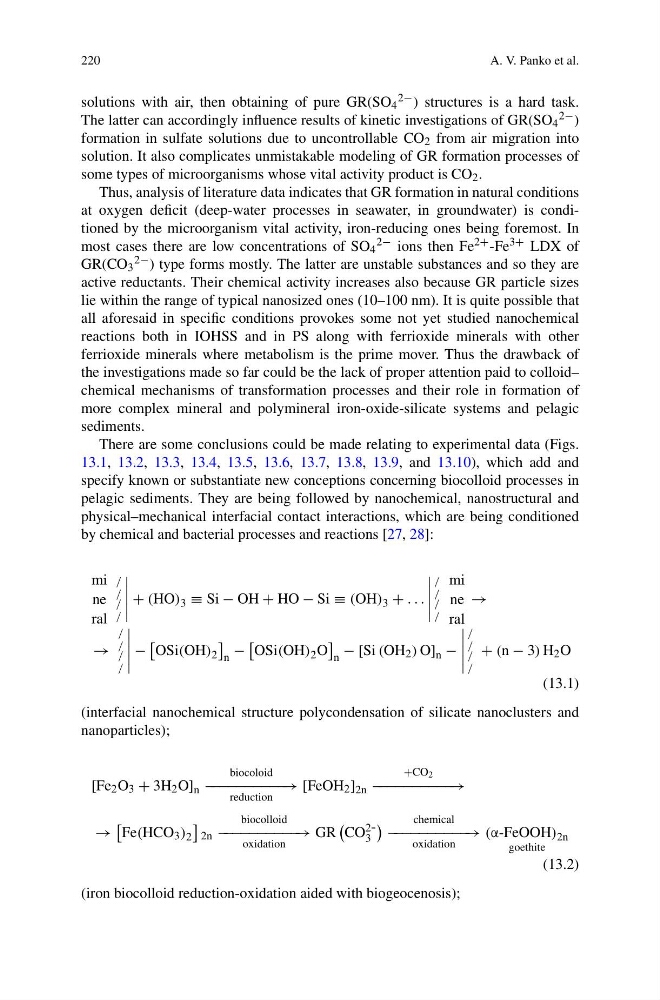
There are some conclusions could be made relating to experimental data (Figs.
13.1, 13.2, 13.3, 13.4, 13.5, 13.6, 13.7, 13.8, 13.9, and 13.10), which add and
specify known or substantiate new conceptions concerning biocolloid processes in
pelagic sediments. They are being followed by nanochemical, nanostructural and
physical–mechanical interfacial contact interactions, which are being conditioned
by chemical and bacterial processes and reactions [27, 28]:
mi
ne
ral
/
/
/
/
+ (HO) 3 ≡ Si − OH + HO − Si ≡ (OH) 3 + . . .
/
/
/
/
mi
ne
ral
→
→
/
/
/
/
−
OSi(OH) 2
n
−
OSi(OH) 2 O
n
− [Si (OH 2 ) O] n −
/
/
/
/
+ (n − 3) H 2 O
(13.1)
(interfacial nanochemical structure polycondensation of silicate nanoclusters and
nanoparticles);
[Fe 2 O 3 + 3H 2 O] n
biocoloid
− −−−−−−−−− →
reduction
[FeOH 2 ] 2n
+CO 2
− −−−−−−−−− →
→
Fe(HCO 3 ) 2
2n
biocolloid
− −−−−−−−−− →
oxidation
GR
CO
23
chemical
− −−−−−−−−− →
oxidation
(α-FeOOH) 2n
goethite
(13.2)
(iron biocolloid reduction-oxidation aided with biogeocenosis);
A. V. Panko et al.
solutions with air, then obtaining of pure GR(SO 4
2− ) structures is a hard task.
The latter can accordingly influence results of kinetic investigations of GR(SO 4
2− )
formation in sulfate solutions due to uncontrollable CO 2 from air migration into
solution. It also complicates unmistakable modeling of GR formation processes of
some types of microorganisms whose vital activity product is CO 2 .
Thus, analysis of literature data indicates that GR formation in natural conditions
at oxygen deficit (deep-water processes in seawater, in groundwater) is conditioned by the microorganism vital activity, iron-reducing ones being foremost. In
most cases there are low concentrations of SO 4
2− ions then Fe 2+ -Fe 3+ LDX of
GR(CO 3
2− ) type forms mostly. The latter are unstable substances and so they are
active reductants. Their chemical activity increases also because GR particle sizes
lie within the range of typical nanosized ones (10–100 nm). It is quite possible that
all aforesaid in specific conditions provokes some not yet studied nanochemical
reactions both in IOHSS and in PS along with ferrioxide minerals with other
ferrioxide minerals where metabolism is the prime mover. Thus the drawback of
the investigations made so far could be the lack of proper attention paid to colloid–
chemical mechanisms of transformation processes and their role in formation of
more complex mineral and polymineral iron-oxide-silicate systems and pelagic
sediments.
There are some conclusions could be made relating to experimental data (Figs.
13.1, 13.2, 13.3, 13.4, 13.5, 13.6, 13.7, 13.8, 13.9, and 13.10), which add and
specify known or substantiate new conceptions concerning biocolloid processes in
pelagic sediments. They are being followed by nanochemical, nanostructural and
physical–mechanical interfacial contact interactions, which are being conditioned
by chemical and bacterial processes and reactions [27, 28]:
mi
ne
ral
/
/
/
/
+ (HO) 3 ≡ Si − OH + HO − Si ≡ (OH) 3 + . . .
/
/
/
/
mi
ne
ral
→
→
/
/
/
/
−
OSi(OH) 2
n
−
OSi(OH) 2 O
n
− [Si (OH 2 ) O] n −
/
/
/
/
+ (n − 3) H 2 O
(13.1)
(interfacial nanochemical structure polycondensation of silicate nanoclusters and
nanoparticles);
[Fe 2 O 3 + 3H 2 O] n
biocoloid
− −−−−−−−−− →
reduction
[FeOH 2 ] 2n
+CO 2
− −−−−−−−−− →
→
Fe(HCO 3 ) 2
2n
biocolloid
− −−−−−−−−− →
oxidation
GR
CO
23
chemical
− −−−−−−−−− →
oxidation
(α-FeOOH) 2n
goethite
(13.2)
(iron biocolloid reduction-oxidation aided with biogeocenosis);