

218
A. V. Panko et al.
16
14
12
10
8
6
4
2
0
16
14
12
10
8
6
4
2
0
0,2
0,016
0,012
0,008
0,004
0,000
1
2
3 45
1 0
Pore Radius, nm
20
30
0,00
0,01
0,02
0,03
0,04
0,016
0,012
0,008
0,004
0,000
1
2
3 45
1 0
2 0
3 0
0,00
0,01
0,02
0,03
0,04
Pore Radius, nm
dV(log r)
dV(log r)
Cumulative Pore Volume
Cumulative Pore Volume
0,4
0,6
0,8
1,0
0,2
0,4
0,6
0,8
1,0
p/p 0
p/p 0
a, cm 3
/g
a, cm 3
/g
V, cm 3
/g
V, cm 3
/g
dV(log r), cm 3
/g
dV(log r), cm 3
/g
adsorption
desorption
adsorption
desorption
a
b
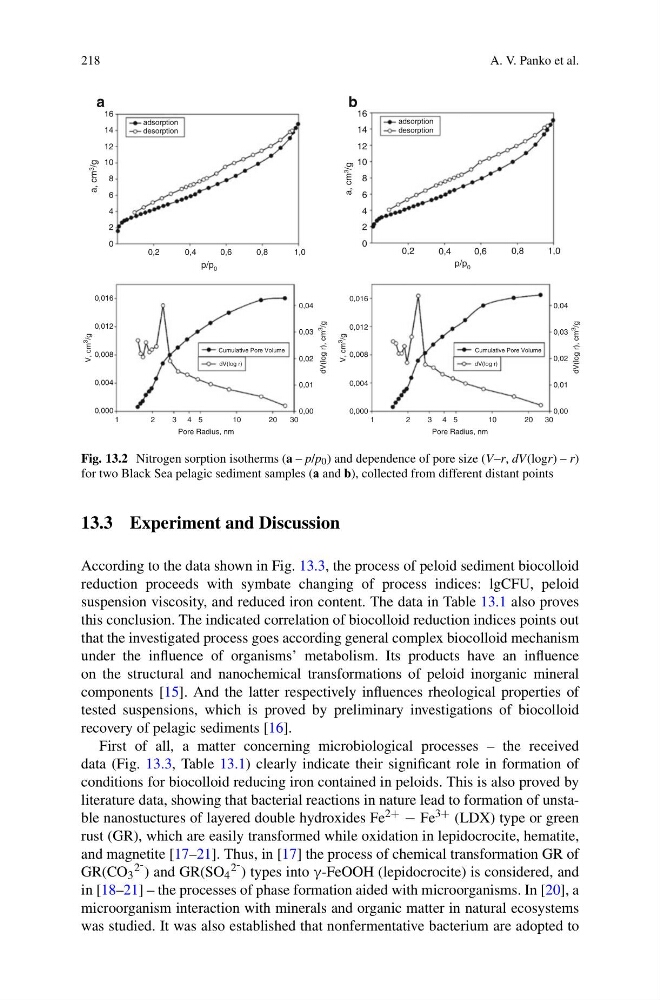
Fig. 13.2 Nitrogen sorption isotherms (a – p/p 0 ) and dependence of pore size (V–r, dV(logr) – r)
for two Black Sea pelagic sediment samples (Ã and b), collected from different distant points
13.3 Experiment and Discussion
According to the data shown in Fig. 13.3, the process of peloid sediment biocolloid
reduction proceeds with symbate changing of process indices: lgCFU, peloid
suspension viscosity, and reduced iron content. The data in Table 13.1 also proves
this conclusion. The indicated correlation of biocolloid reduction indices points out
that the investigated process goes according general complex biocolloid mechanism
under the influence of organisms’ metabolism. Its products have an influence
on the structural and nanochemical transformations of peloid inorganic mineral
components [15]. And the latter respectively influences rheological properties of
tested suspensions, which is proved by preliminary investigations of biocolloid
recovery of pelagic sediments [16].
First of all, a matter concerning microbiological processes – the received
data (Fig. 13.3, Table 13.1) clearly indicate their significant role in formation of
conditions for biocolloid reducing iron contained in peloids. This is also proved by
literature data, showing that bacterial reactions in nature lead to formation of unstable nanostuctures of layered double hydroxides Fe 2+ − Fe 3+ (LDX) type or green
rust (GR), which are easily transformed while oxidation in lepidocrocite, hematite,
and magnetite [17–21]. Thus, in [17] the process of chemical transformation GR of
GR(CO 3
2 - ) and GR(SO 4
2 - ) types into γ-FeOOH (lepidocrocite) is considered, and
in [18–21] – the processes of phase formation aided with microorganisms. In [20], a
microorganism interaction with minerals and organic matter in natural ecosystems
was studied. It was also established that nonfermentative bacterium are adopted to
A. V. Panko et al.
16
14
12
10
8
6
4
2
0
16
14
12
10
8
6
4
2
0
0,2
0,016
0,012
0,008
0,004
0,000
1
2
3 45
1 0
Pore Radius, nm
20
30
0,00
0,01
0,02
0,03
0,04
0,016
0,012
0,008
0,004
0,000
1
2
3 45
1 0
2 0
3 0
0,00
0,01
0,02
0,03
0,04
Pore Radius, nm
dV(log r)
dV(log r)
Cumulative Pore Volume
Cumulative Pore Volume
0,4
0,6
0,8
1,0
0,2
0,4
0,6
0,8
1,0
p/p 0
p/p 0
a, cm 3
/g
a, cm 3
/g
V, cm 3
/g
V, cm 3
/g
dV(log r), cm 3
/g
dV(log r), cm 3
/g
adsorption
desorption
adsorption
desorption
a
b
Fig. 13.2 Nitrogen sorption isotherms (a – p/p 0 ) and dependence of pore size (V–r, dV(logr) – r)
for two Black Sea pelagic sediment samples (Ã and b), collected from different distant points
13.3 Experiment and Discussion
According to the data shown in Fig. 13.3, the process of peloid sediment biocolloid
reduction proceeds with symbate changing of process indices: lgCFU, peloid
suspension viscosity, and reduced iron content. The data in Table 13.1 also proves
this conclusion. The indicated correlation of biocolloid reduction indices points out
that the investigated process goes according general complex biocolloid mechanism
under the influence of organisms’ metabolism. Its products have an influence
on the structural and nanochemical transformations of peloid inorganic mineral
components [15]. And the latter respectively influences rheological properties of
tested suspensions, which is proved by preliminary investigations of biocolloid
recovery of pelagic sediments [16].
First of all, a matter concerning microbiological processes – the received
data (Fig. 13.3, Table 13.1) clearly indicate their significant role in formation of
conditions for biocolloid reducing iron contained in peloids. This is also proved by
literature data, showing that bacterial reactions in nature lead to formation of unstable nanostuctures of layered double hydroxides Fe 2+ − Fe 3+ (LDX) type or green
rust (GR), which are easily transformed while oxidation in lepidocrocite, hematite,
and magnetite [17–21]. Thus, in [17] the process of chemical transformation GR of
GR(CO 3
2 - ) and GR(SO 4
2 - ) types into γ-FeOOH (lepidocrocite) is considered, and
in [18–21] – the processes of phase formation aided with microorganisms. In [20], a
microorganism interaction with minerals and organic matter in natural ecosystems
was studied. It was also established that nonfermentative bacterium are adopted to