

12 Mechanical and Thermal Characteristics of Irradiation Cross-linked Hydrogels
213
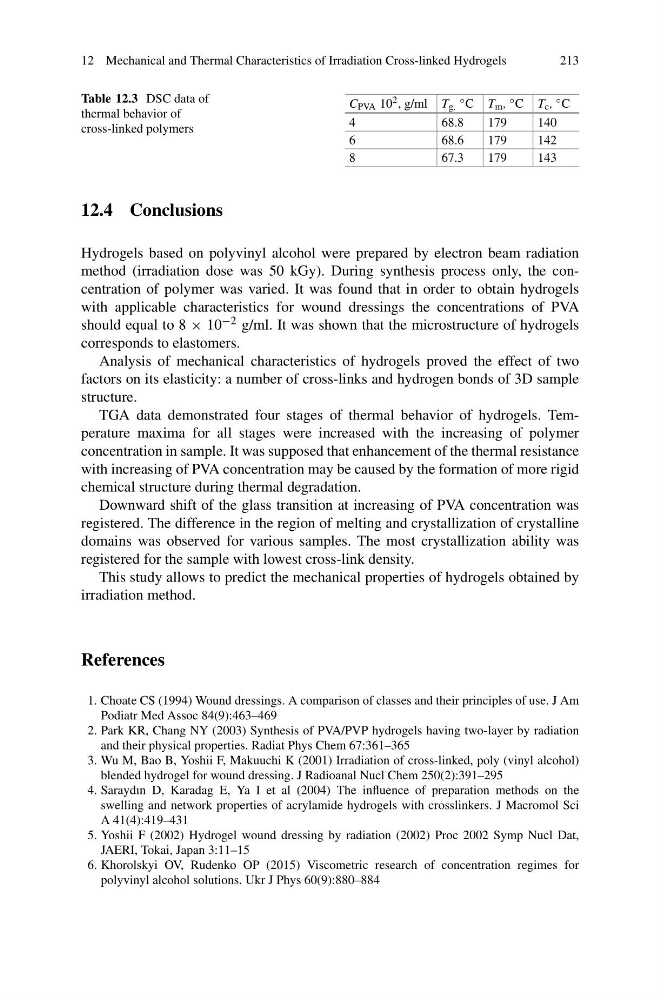
Table 12.3 DSC data of
thermal behavior of
cross-linked polymers
C PVA 10 2 , g/ml T g,
◦ C T m , ◦ C T c , ◦ C
4
68.8
179
140
6
68.6
179
142
8
67.3
179
143
12.4 Conclusions
Hydrogels based on polyvinyl alcohol were prepared by electron beam radiation
method (irradiation dose was 50 kGy). During synthesis process only, the concentration of polymer was varied. It was found that in order to obtain hydrogels
with applicable characteristics for wound dressings the concentrations of PVA
should equal to 8 × 10 −2 g/ml. It was shown that the microstructure of hydrogels
corresponds to elastomers.
Analysis of mechanical characteristics of hydrogels proved the effect of two
factors on its elasticity: a number of cross-links and hydrogen bonds of 3D sample
structure.
TGA data demonstrated four stages of thermal behavior of hydrogels. Temperature maxima for all stages were increased with the increasing of polymer
concentration in sample. It was supposed that enhancement of the thermal resistance
with increasing of PVA concentration may be caused by the formation of more rigid
chemical structure during thermal degradation.
Downward shift of the glass transition at increasing of PVA concentration was
registered. The difference in the region of melting and crystallization of crystalline
domains was observed for various samples. The most crystallization ability was
registered for the sample with lowest cross-link density.
This study allows to predict the mechanical properties of hydrogels obtained by
irradiation method.
References
1. Choate CS (1994) Wound dressings. A comparison of classes and their principles of use. J Am
Podiatr Med Assoc 84(9):463–469
2. Park KR, Chang NY (2003) Synthesis of PVA/PVP hydrogels having two-layer by radiation
and their physical properties. Radiat Phys Chem 67:361–365
3. Wu M, Bao B, Yoshii F, Makuuchi K (2001) Irradiation of cross-linked, poly (vinyl alcohol)
blended hydrogel for wound dressing. J Radioanal Nucl Chem 250(2):391–295
4. Saraydın D, Karadag E, Ya I et al (2004) The influence of preparation methods on the
swelling and network properties of acrylamide hydrogels with crosslinkers. J Macromol Sci
A 41(4):419–431
5. Yoshii F (2002) Hydrogel wound dressing by radiation (2002) Proc 2002 Symp Nucl Dat,
JAERI, Tokai, Japan 3:11–15
6. Khorolskyi OV, Rudenko OP (2015) Viscometric research of concentration regimes for
polyvinyl alcohol solutions. Ukr J Phys 60(9):880–884
213
Table 12.3 DSC data of
thermal behavior of
cross-linked polymers
C PVA 10 2 , g/ml T g,
◦ C T m , ◦ C T c , ◦ C
4
68.8
179
140
6
68.6
179
142
8
67.3
179
143
12.4 Conclusions
Hydrogels based on polyvinyl alcohol were prepared by electron beam radiation
method (irradiation dose was 50 kGy). During synthesis process only, the concentration of polymer was varied. It was found that in order to obtain hydrogels
with applicable characteristics for wound dressings the concentrations of PVA
should equal to 8 × 10 −2 g/ml. It was shown that the microstructure of hydrogels
corresponds to elastomers.
Analysis of mechanical characteristics of hydrogels proved the effect of two
factors on its elasticity: a number of cross-links and hydrogen bonds of 3D sample
structure.
TGA data demonstrated four stages of thermal behavior of hydrogels. Temperature maxima for all stages were increased with the increasing of polymer
concentration in sample. It was supposed that enhancement of the thermal resistance
with increasing of PVA concentration may be caused by the formation of more rigid
chemical structure during thermal degradation.
Downward shift of the glass transition at increasing of PVA concentration was
registered. The difference in the region of melting and crystallization of crystalline
domains was observed for various samples. The most crystallization ability was
registered for the sample with lowest cross-link density.
This study allows to predict the mechanical properties of hydrogels obtained by
irradiation method.
References
1. Choate CS (1994) Wound dressings. A comparison of classes and their principles of use. J Am
Podiatr Med Assoc 84(9):463–469
2. Park KR, Chang NY (2003) Synthesis of PVA/PVP hydrogels having two-layer by radiation
and their physical properties. Radiat Phys Chem 67:361–365
3. Wu M, Bao B, Yoshii F, Makuuchi K (2001) Irradiation of cross-linked, poly (vinyl alcohol)
blended hydrogel for wound dressing. J Radioanal Nucl Chem 250(2):391–295
4. Saraydın D, Karadag E, Ya I et al (2004) The influence of preparation methods on the
swelling and network properties of acrylamide hydrogels with crosslinkers. J Macromol Sci
A 41(4):419–431
5. Yoshii F (2002) Hydrogel wound dressing by radiation (2002) Proc 2002 Symp Nucl Dat,
JAERI, Tokai, Japan 3:11–15
6. Khorolskyi OV, Rudenko OP (2015) Viscometric research of concentration regimes for
polyvinyl alcohol solutions. Ukr J Phys 60(9):880–884