

190
L. K. Matkovska et al.
a
b
4000 3500 3000 2500 2000 1500 1000
Absorbance
Wavenumber (cm
-1 )
Wavenumber (cm
-1 )
4000 3500 3000 2500 2000 1500 1000
Absorbance
c
Wavenumber (cm
-1 )
4000 3500 3000 2500 2000 1500 1000
Absorbance
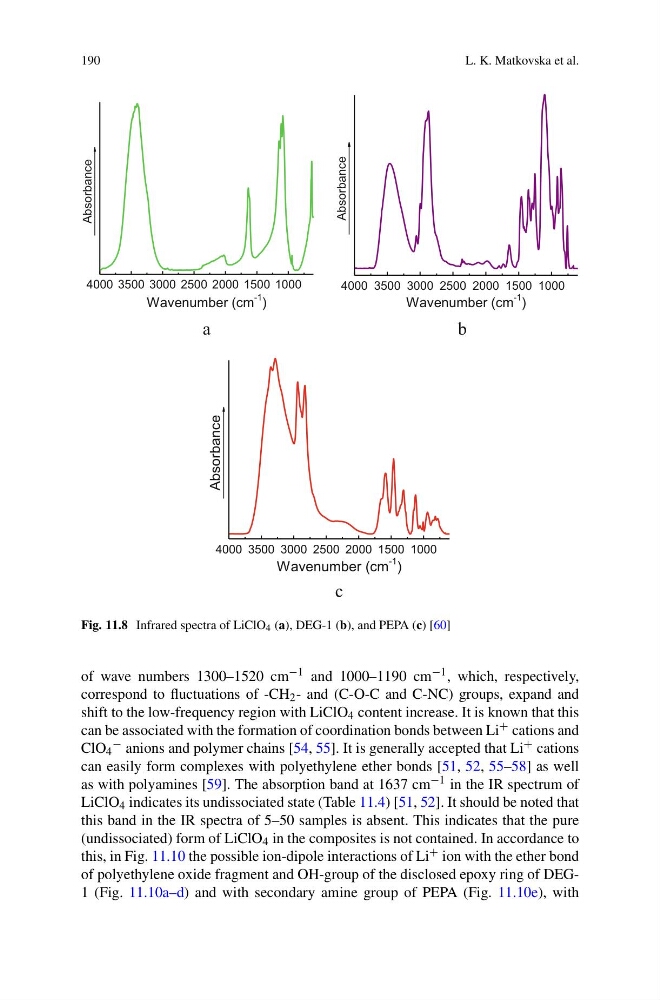
Fig. 11.8 Infrared spectra of LiClO 4 (a), DEG-1 (b), and PEPA (c) [60]
of wave numbers 1300–1520 cm −1 and 1000–1190 cm −1 , which, respectively,
correspond to fluctuations of -CH 2 - and (C-O-C and C-NC) groups, expand and
shift to the low-frequency region with LiClO 4 content increase. It is known that this
can be associated with the formation of coordination bonds between Li + cations and
ClO 4
− anions and polymer chains [54, 55]. It is generally accepted that Li + cations
can easily form complexes with polyethylene ether bonds [51, 52, 55–58] as well
as with polyamines [59]. The absorption band at 1637 cm −1 in the IR spectrum of
LiClO 4 indicates its undissociated state (Table 11.4) [51, 52]. It should be noted that
this band in the IR spectra of 5–50 samples is absent. This indicates that the pure
(undissociated) form of LiClO 4 in the composites is not contained. In accordance to
this, in Fig. 11.10 the possible ion-dipole interactions of Li + ion with the ether bond
of polyethylene oxide fragment and OH-group of the disclosed epoxy ring of DEG1 (Fig. 11.10a–d) and with secondary amine group of PEPA (Fig. 11.10e), with
L. K. Matkovska et al.
a
b
4000 3500 3000 2500 2000 1500 1000
Absorbance
Wavenumber (cm
-1 )
Wavenumber (cm
-1 )
4000 3500 3000 2500 2000 1500 1000
Absorbance
c
Wavenumber (cm
-1 )
4000 3500 3000 2500 2000 1500 1000
Absorbance
Fig. 11.8 Infrared spectra of LiClO 4 (a), DEG-1 (b), and PEPA (c) [60]
of wave numbers 1300–1520 cm −1 and 1000–1190 cm −1 , which, respectively,
correspond to fluctuations of -CH 2 - and (C-O-C and C-NC) groups, expand and
shift to the low-frequency region with LiClO 4 content increase. It is known that this
can be associated with the formation of coordination bonds between Li + cations and
ClO 4
− anions and polymer chains [54, 55]. It is generally accepted that Li + cations
can easily form complexes with polyethylene ether bonds [51, 52, 55–58] as well
as with polyamines [59]. The absorption band at 1637 cm −1 in the IR spectrum of
LiClO 4 indicates its undissociated state (Table 11.4) [51, 52]. It should be noted that
this band in the IR spectra of 5–50 samples is absent. This indicates that the pure
(undissociated) form of LiClO 4 in the composites is not contained. In accordance to
this, in Fig. 11.10 the possible ion-dipole interactions of Li + ion with the ether bond
of polyethylene oxide fragment and OH-group of the disclosed epoxy ring of DEG1 (Fig. 11.10a–d) and with secondary amine group of PEPA (Fig. 11.10e), with