

10 High-Temperature Electrochemical Synthesis of Nanostructured Coatings. . .
175
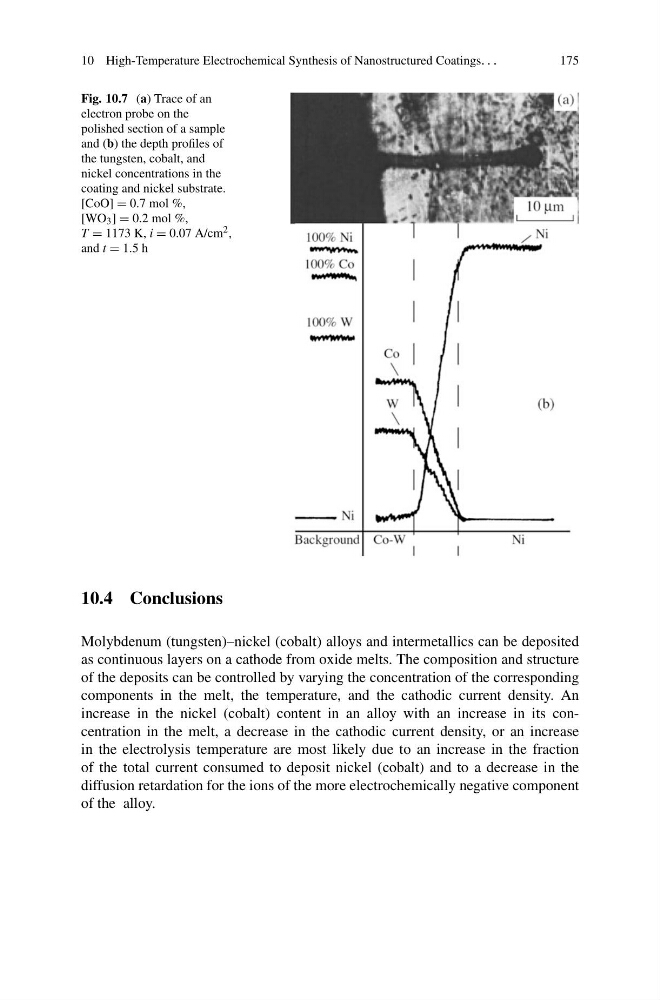
Fig. 10.7 (a) Trace of an
electron probe on the
polished section of a sample
and (b) the depth profiles of
the tungsten, cobalt, and
nickel concentrations in the
coating and nickel substrate.
[CoO] = 0.7 mol %,
[WO 3 ] = 0.2 mol %,
T = 1173 K, i = 0.07 A/cm 2 ,
and t = 1.5 h
10.4 Conclusions
Molybdenum (tungsten)–nickel (cobalt) alloys and intermetallics can be deposited
as continuous layers on a cathode from oxide melts. The composition and structure
of the deposits can be controlled by varying the concentration of the corresponding
components in the melt, the temperature, and the cathodic current density. An
increase in the nickel (cobalt) content in an alloy with an increase in its concentration in the melt, a decrease in the cathodic current density, or an increase
in the electrolysis temperature are most likely due to an increase in the fraction
of the total current consumed to deposit nickel (cobalt) and to a decrease in the
diffusion retardation for the ions of the more electrochemically negative component
of the alloy.
175
Fig. 10.7 (a) Trace of an
electron probe on the
polished section of a sample
and (b) the depth profiles of
the tungsten, cobalt, and
nickel concentrations in the
coating and nickel substrate.
[CoO] = 0.7 mol %,
[WO 3 ] = 0.2 mol %,
T = 1173 K, i = 0.07 A/cm 2 ,
and t = 1.5 h
10.4 Conclusions
Molybdenum (tungsten)–nickel (cobalt) alloys and intermetallics can be deposited
as continuous layers on a cathode from oxide melts. The composition and structure
of the deposits can be controlled by varying the concentration of the corresponding
components in the melt, the temperature, and the cathodic current density. An
increase in the nickel (cobalt) content in an alloy with an increase in its concentration in the melt, a decrease in the cathodic current density, or an increase
in the electrolysis temperature are most likely due to an increase in the fraction
of the total current consumed to deposit nickel (cobalt) and to a decrease in the
diffusion retardation for the ions of the more electrochemically negative component
of the alloy.