

8 Nanocomposites Based on Thermosetting Polyurethane Matrix. . .
133
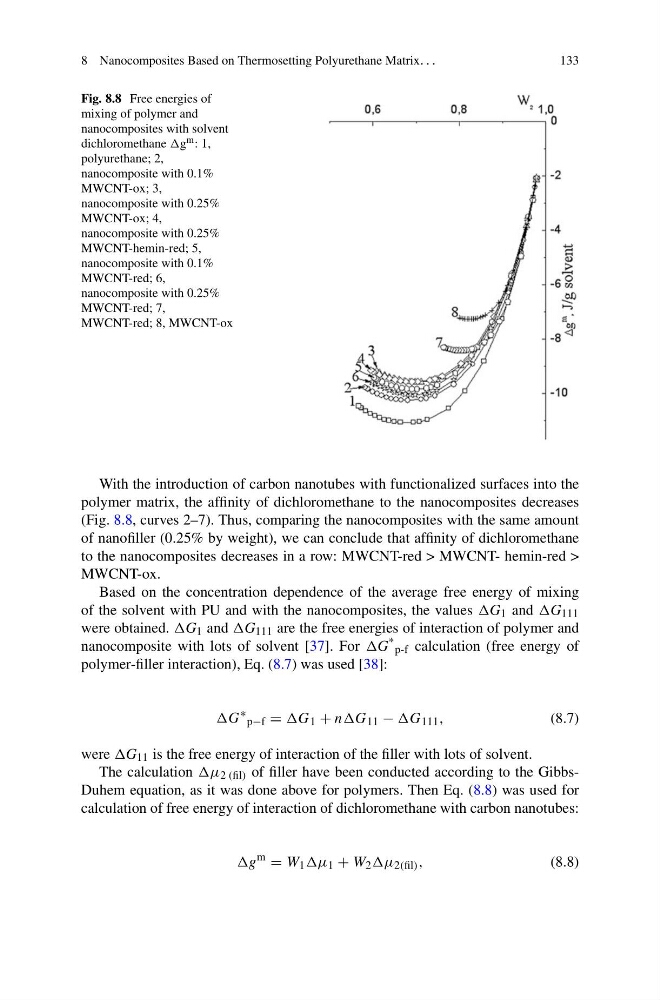
Fig. 8.8 Free energies of
mixing of polymer and
nanocomposites with solvent
dichloromethane g m : 1,
polyurethane; 2,
nanocomposite with 0.1%
MWCNT-ox; 3,
nanocomposite with 0.25%
MWCNT-ox; 4,
nanocomposite with 0.25%
MWCNT-hemin-red; 5,
nanocomposite with 0.1%
MWCNT-red; 6,
nanocomposite with 0.25%
MWCNT-red; 7,
MWCNT-red; 8, MWCNT-ox
With the introduction of carbon nanotubes with functionalized surfaces into the
polymer matrix, the affinity of dichloromethane to the nanocomposites decreases
(Fig. 8.8, curves 2–7). Thus, comparing the nanocomposites with the same amount
of nanofiller (0.25% by weight), we can conclude that affinity of dichloromethane
to the nanocomposites decreases in a row: MWCNT-red > MWCNT- hemin-red >
MWCNT-ox.
Based on the concentration dependence of the average free energy of mixing
of the solvent with PU and with the nanocomposites, the values 1 and 111
were obtained. 1 and 111 are the free energies of interaction of polymer and
nanocomposite with lots of solvent [37]. For * p-f calculation (free energy of
polymer-filler interaction), Eq. (8.7) was used [38]:
∗
p−f = 1 + nnG 11 − G 111 ,
(8.7)
were 11 is the free energy of interaction of the filler with lots of solvent.
The calculation 2 (fil) of filler have been conducted according to the GibbsDuhem equation, as it was done above for polymers. Then Eq. (8.8) was used for
calculation of free energy of interaction of dichloromethane with carbon nanotubes:
m
= W 1 1 + W 2 2(fil) ,
(8.8)
133
Fig. 8.8 Free energies of
mixing of polymer and
nanocomposites with solvent
dichloromethane g m : 1,
polyurethane; 2,
nanocomposite with 0.1%
MWCNT-ox; 3,
nanocomposite with 0.25%
MWCNT-ox; 4,
nanocomposite with 0.25%
MWCNT-hemin-red; 5,
nanocomposite with 0.1%
MWCNT-red; 6,
nanocomposite with 0.25%
MWCNT-red; 7,
MWCNT-red; 8, MWCNT-ox
With the introduction of carbon nanotubes with functionalized surfaces into the
polymer matrix, the affinity of dichloromethane to the nanocomposites decreases
(Fig. 8.8, curves 2–7). Thus, comparing the nanocomposites with the same amount
of nanofiller (0.25% by weight), we can conclude that affinity of dichloromethane
to the nanocomposites decreases in a row: MWCNT-red > MWCNT- hemin-red >
MWCNT-ox.
Based on the concentration dependence of the average free energy of mixing
of the solvent with PU and with the nanocomposites, the values 1 and 111
were obtained. 1 and 111 are the free energies of interaction of polymer and
nanocomposite with lots of solvent [37]. For * p-f calculation (free energy of
polymer-filler interaction), Eq. (8.7) was used [38]:
∗
p−f = 1 + nnG 11 − G 111 ,
(8.7)
were 11 is the free energy of interaction of the filler with lots of solvent.
The calculation 2 (fil) of filler have been conducted according to the GibbsDuhem equation, as it was done above for polymers. Then Eq. (8.8) was used for
calculation of free energy of interaction of dichloromethane with carbon nanotubes:
m
= W 1 1 + W 2 2(fil) ,
(8.8)