

Torque (Nm)
4
2
0
–2
–4
–6
τ 2d Dynamically-coupled driving torque of joint 2
t t = 0.50
t m = 0.74
t f = 1.16
Backswing
Do
sw
wning
Follow-through
0
0.2
0.4
0.6
0.8
1
1.2
Time (s)
(e)
77
Human-Inspired Hyper Dynamic Manipulation
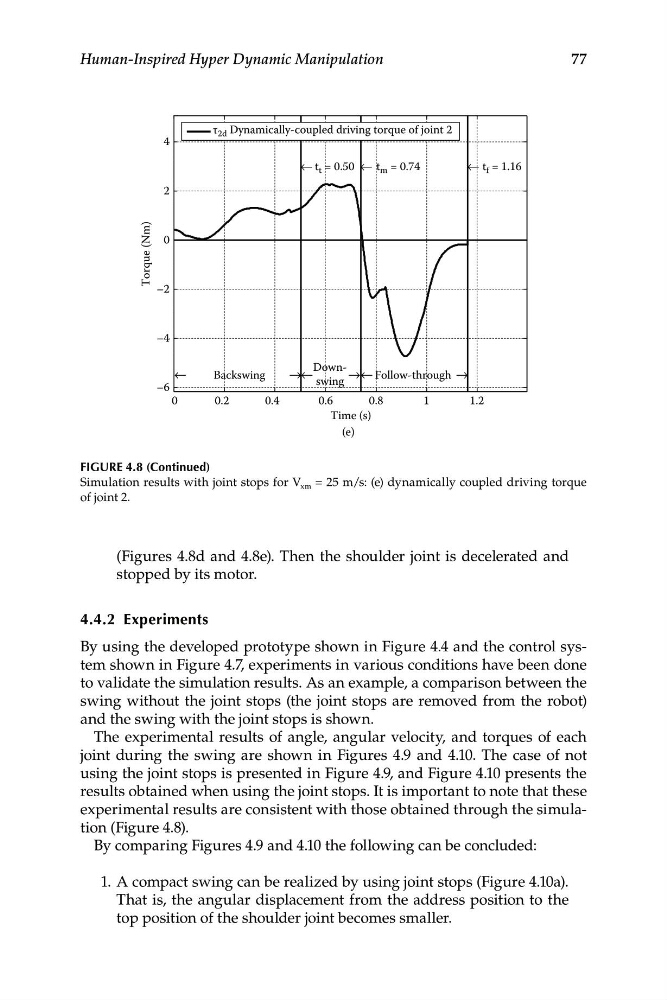
FIGURE 4.8 (Continued)
Simulation results with joint stops for V xm = 25 m/s: (e) dynamically coupled driving torque
of joint 2.
(Figures 4.8d and 4.8e). Then the shoulder joint is decelerated and
stopped by its motor.
4.4.2 Experiments
By using the developed prototype shown in Figure 4.4 and the control system shown in Figure 4.7, experiments in various conditions have been done
to validate the simulation results. As an example, a comparison between the
swing without the joint stops (the joint stops are removed from the robot)
and the swing with the joint stops is shown.
The experimental results of angle, angular velocity, and torques of each
joint during the swing are shown in Figures 4.9 and 4.10. The case of not
using the joint stops is presented in Figure 4.9, and Figure 4.10 presents the
results obtained when using the joint stops. It is important to note that these
experimental results are consistent with those obtained through the simulation (Figure 4.8).
By comparing Figures 4.9 and 4.10 the following can be concluded:
1. A compact swing can be realized by using joint stops (Figure 4.10a).
That is, the angular displacement from the address position to the
top position of the shoulder joint becomes smaller.