

Human-Inspired Hyper Dynamic Manipulation
69
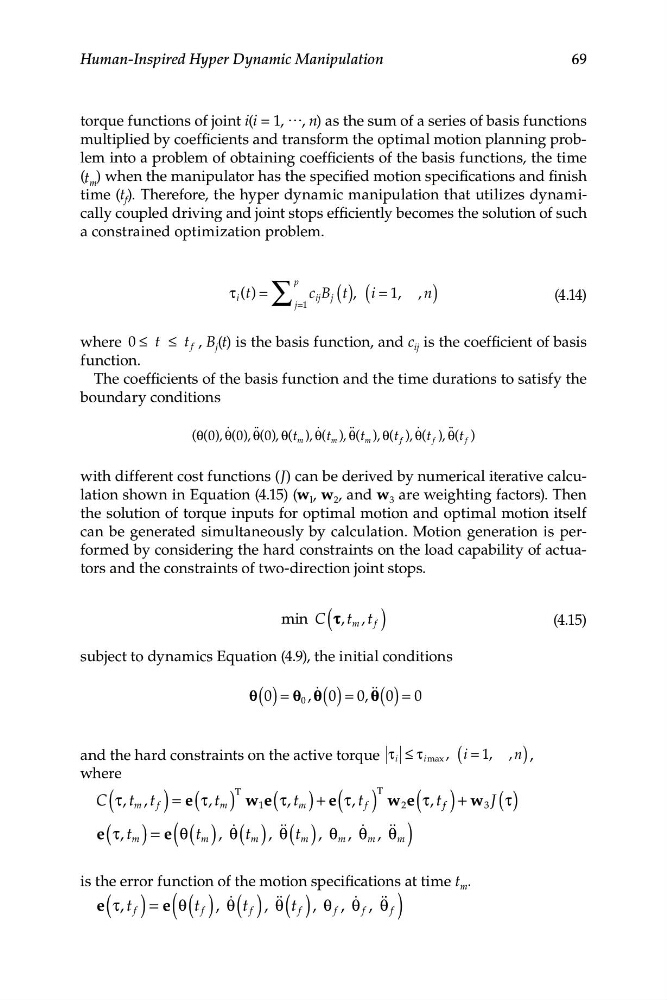
torque functions of joint i(i = 1, … , n) as the sum of a series of basis functions
multiplied by coefficients and transform the optimal motion planning problem into a problem of obtaining coefficients of the basis functions, the time
(t m ) when the manipulator has the specified motion specifications and finish
time (t f ). Therefore, the hyper dynamic manipulation that utilizes dynamically coupled driving and joint stops efficiently becomes the solution of such
a constrained optimization problem.
p
τ i ( )
t =
c ij B j ( )
t , (i = 1, �, n)
(4.14)
∑ j=1
where 0 ≤ t ≤ t f , B j (t) is the basis function, and c ij is the coefficient of basis
function.
The coefficients of the basis function and the time durations to satisfy the
boundary conditions
(θ
q
θ qq
(0 ), θ(0 ), (0 ), θ( t ), θ q (t ), θ qq t ), θ(t q t qq
m
m
( m
f f ), θ( f ), θ(t f )
with different cost functions (J) can be derived by numerical iterative calculation shown in Equation (4.15) (w l , w 2 , and w 3 are weighting factors). Then
the solution of torque inputs for optimal motion and optimal motion itself
can be generated simultaneously by calculation. Motion generation is performed by considering the hard constraints on the load capability of actuators and the constraints of two-direction joint stops.
min C
, t
( τ τ, t m f )
(4.15)
subject to dynamics Equation (4.9), the initial conditions
θ θ( )
0 = θ θ θ
, θ q ( )
0 = 0, θ q θ q
0
( )
0 = 0
and the hard constraints on the active torque τ i ≤ τ i max , (i = 1, �, n) ,
where
C (
Τ
τ , ,
Τ
t m t ) = e (τ, t )
f
m
w 1 e (τ, t m ) + e ( τ, t f ) w 2 e ( τ, t f f ) + w 3 J ( )
τ
H ( τ, t = H ( θ ( )
t
)
, θ q ( )
t , θ q q ( )
t , θ , θ q , θ qq q
m
m
m
m
m
m
m )
is the error function of the motion specifications at time t m .
H ( τ, t f ) = H ( θ ( )
t , θ q ( )
t , θ q q ( )
t , θ , θ q , θ qq q
f
f
f
f
f
f )
69
torque functions of joint i(i = 1, … , n) as the sum of a series of basis functions
multiplied by coefficients and transform the optimal motion planning problem into a problem of obtaining coefficients of the basis functions, the time
(t m ) when the manipulator has the specified motion specifications and finish
time (t f ). Therefore, the hyper dynamic manipulation that utilizes dynamically coupled driving and joint stops efficiently becomes the solution of such
a constrained optimization problem.
p
τ i ( )
t =
c ij B j ( )
t , (i = 1, �, n)
(4.14)
∑ j=1
where 0 ≤ t ≤ t f , B j (t) is the basis function, and c ij is the coefficient of basis
function.
The coefficients of the basis function and the time durations to satisfy the
boundary conditions
(θ
q
θ qq
(0 ), θ(0 ), (0 ), θ( t ), θ q (t ), θ qq t ), θ(t q t qq
m
m
( m
f f ), θ( f ), θ(t f )
with different cost functions (J) can be derived by numerical iterative calculation shown in Equation (4.15) (w l , w 2 , and w 3 are weighting factors). Then
the solution of torque inputs for optimal motion and optimal motion itself
can be generated simultaneously by calculation. Motion generation is performed by considering the hard constraints on the load capability of actuators and the constraints of two-direction joint stops.
min C
, t
( τ τ, t m f )
(4.15)
subject to dynamics Equation (4.9), the initial conditions
θ θ( )
0 = θ θ θ
, θ q ( )
0 = 0, θ q θ q
0
( )
0 = 0
and the hard constraints on the active torque τ i ≤ τ i max , (i = 1, �, n) ,
where
C (
Τ
τ , ,
Τ
t m t ) = e (τ, t )
f
m
w 1 e (τ, t m ) + e ( τ, t f ) w 2 e ( τ, t f f ) + w 3 J ( )
τ
H ( τ, t = H ( θ ( )
t
)
, θ q ( )
t , θ q q ( )
t , θ , θ q , θ qq q
m
m
m
m
m
m
m )
is the error function of the motion specifications at time t m .
H ( τ, t f ) = H ( θ ( )
t , θ q ( )
t , θ q q ( )
t , θ , θ q , θ qq q
f
f
f
f
f
f )