

62
Biologically Inspired Robotics
τ 1dv
τ 1da
β 21
β 21
III: +
IV: +
I: −
II: −
II: if 2 ≥ 0 –
¨
if 2 ≤ 0 +
¨
I: if 2 ≥ 0 +
¨
if 2 ≤ 0 –
¨
III: if 2 ≥ 0 –
¨
if 2 ≤ 0 +
¨
IV: if 2 ≥ 0 +
¨
if 2 ≤ 0 –
¨
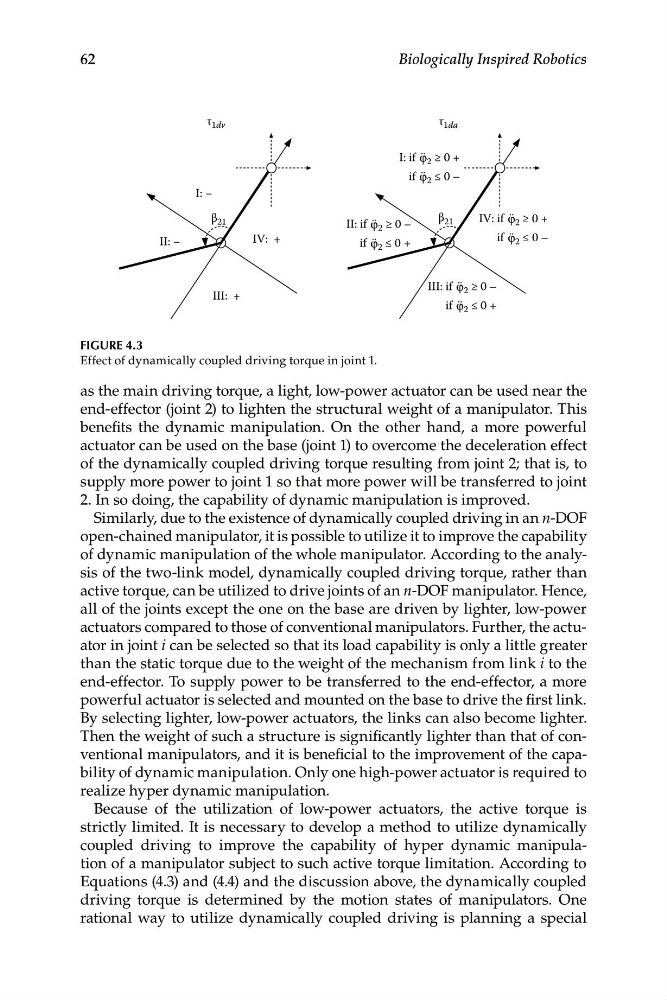
FIGURE 4.3
Effect of dynamically coupled driving torque in joint 1.
as the main driving torque, a light, low-power actuator can be used near the
end-effector (joint 2) to lighten the structural weight of a manipulator. This
benefits the dynamic manipulation. On the other hand, a more powerful
actuator can be used on the base (joint 1) to overcome the deceleration effect
of the dynamically coupled driving torque resulting from joint 2; that is, to
supply more power to joint 1 so that more power will be transferred to joint
2. In so doing, the capability of dynamic manipulation is improved.
Similarly, due to the existence of dynamically coupled driving in an n-DOF
open-chained manipulator, it is possible to utilize it to improve the capability
of dynamic manipulation of the whole manipulator. According to the analysis of the two-link model, dynamically coupled driving torque, rather than
active torque, can be utilized to drive joints of an n-DOF manipulator. Hence,
all of the joints except the one on the base are driven by lighter, low-power
actuators compared to those of conventional manipulators. Further, the actuator in joint i can be selected so that its load capability is only a little greater
than the static torque due to the weight of the mechanism from link i to the
end-effector. To supply power to be transferred to the end-effector, a more
powerful actuator is selected and mounted on the base to drive the first link.
By selecting lighter, low-power actuators, the links can also become lighter.
Then the weight of such a structure is significantly lighter than that of conventional manipulators, and it is beneficial to the improvement of the capability of dynamic manipulation. Only one high-power actuator is required to
realize hyper dynamic manipulation.
Because of the utilization of low-power actuators, the active torque is
strictly limited. It is necessary to develop a method to utilize dynamically
coupled driving to improve the capability of hyper dynamic manipulation of a manipulator subject to such active torque limitation. According to
Equations (4.3) and (4.4) and the discussion above, the dynamically coupled
driving torque is determined by the motion states of manipulators. One
rational way to utilize dynamically coupled driving is planning a special
Biologically Inspired Robotics
τ 1dv
τ 1da
β 21
β 21
III: +
IV: +
I: −
II: −
II: if 2 ≥ 0 –
¨
if 2 ≤ 0 +
¨
I: if 2 ≥ 0 +
¨
if 2 ≤ 0 –
¨
III: if 2 ≥ 0 –
¨
if 2 ≤ 0 +
¨
IV: if 2 ≥ 0 +
¨
if 2 ≤ 0 –
¨
FIGURE 4.3
Effect of dynamically coupled driving torque in joint 1.
as the main driving torque, a light, low-power actuator can be used near the
end-effector (joint 2) to lighten the structural weight of a manipulator. This
benefits the dynamic manipulation. On the other hand, a more powerful
actuator can be used on the base (joint 1) to overcome the deceleration effect
of the dynamically coupled driving torque resulting from joint 2; that is, to
supply more power to joint 1 so that more power will be transferred to joint
2. In so doing, the capability of dynamic manipulation is improved.
Similarly, due to the existence of dynamically coupled driving in an n-DOF
open-chained manipulator, it is possible to utilize it to improve the capability
of dynamic manipulation of the whole manipulator. According to the analysis of the two-link model, dynamically coupled driving torque, rather than
active torque, can be utilized to drive joints of an n-DOF manipulator. Hence,
all of the joints except the one on the base are driven by lighter, low-power
actuators compared to those of conventional manipulators. Further, the actuator in joint i can be selected so that its load capability is only a little greater
than the static torque due to the weight of the mechanism from link i to the
end-effector. To supply power to be transferred to the end-effector, a more
powerful actuator is selected and mounted on the base to drive the first link.
By selecting lighter, low-power actuators, the links can also become lighter.
Then the weight of such a structure is significantly lighter than that of conventional manipulators, and it is beneficial to the improvement of the capability of dynamic manipulation. Only one high-power actuator is required to
realize hyper dynamic manipulation.
Because of the utilization of low-power actuators, the active torque is
strictly limited. It is necessary to develop a method to utilize dynamically
coupled driving to improve the capability of hyper dynamic manipulation of a manipulator subject to such active torque limitation. According to
Equations (4.3) and (4.4) and the discussion above, the dynamically coupled
driving torque is determined by the motion states of manipulators. One
rational way to utilize dynamically coupled driving is planning a special