

46
Biologically Inspired Robotics
from one riding mode to another, the balance between resistance and former
driving force will be broken. This will cause the user an uncomfortable feeling and the phenomenon of no-load running.
3.4.2 Principle of the Compound Resistance System
In order to adapt the driving characteristics, three kinds of resistance methods are considered in the system. The compound resistance system includes
the following:
• Basic resistance refers to the exercise intensity, the level of which can
be selected by the user.
• Position resistance R p is normally used when using the bionic riding mode to counteract the cyclical fluctuation, and a designed cam
mechanism is used to adjust the position resistance automatically.
• Speed resistance R s is an adjustment parameter to avoid driving fluctuation, which always occurs when speeding up.
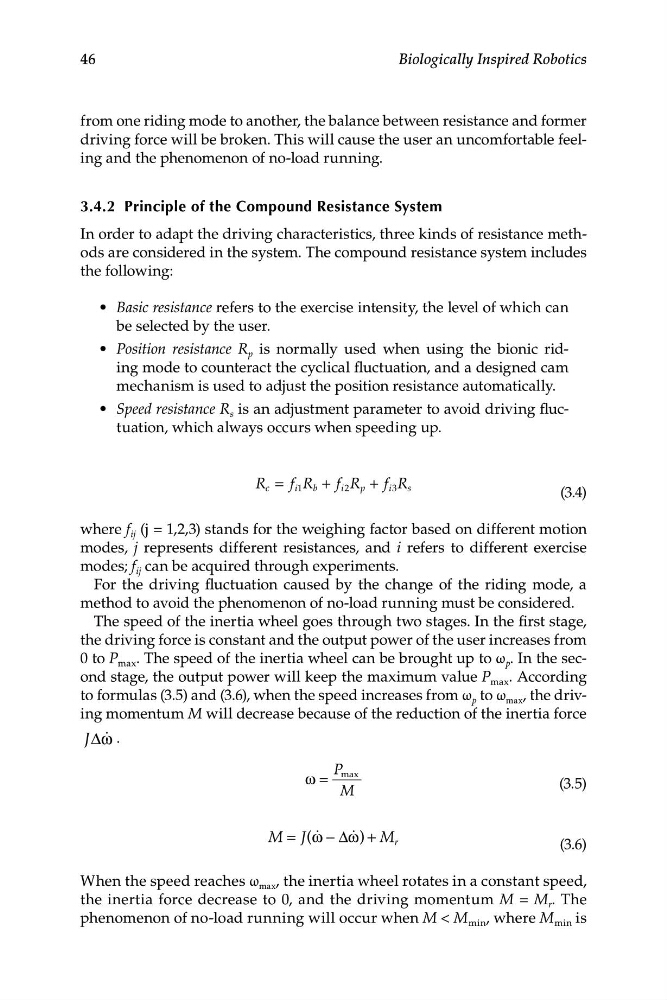
R c = f 1 R + f
i
b
i 2 R p + f i3 R s
(3.4)
where f ij (j = 1,2,3) stands for the weighing factor based on different motion
modes, j represents different resistances, and i refers to different exercise
modes; f ij can be acquired through experiments.
For the driving fluctuation caused by the change of the riding mode, a
method to avoid the phenomenon of no-load running must be considered.
The speed of the inertia wheel goes through two stages. In the first stage,
the driving force is constant and the output power of the user increases from
0 to P max . The speed of the inertia wheel can be brought up to ω p . In the second stage, the output power will keep the maximum value P max . According
to formulas (3.5) and (3.6), when the speed increases from ω p to ω max , the driving momentum M will decrease because of the reduction of the inertia force
-Δω q .
P
ω =
max
(3.5)
M
M J
= (ω q − Δω q ) + M r
(3.6)
When the speed reaches ω max , the inertia wheel rotates in a constant speed,
the inertia force decrease to 0, and the driving momentum M = M r . The
phenomenon of no-load running will occur when M < M min , where M min is
Biologically Inspired Robotics
from one riding mode to another, the balance between resistance and former
driving force will be broken. This will cause the user an uncomfortable feeling and the phenomenon of no-load running.
3.4.2 Principle of the Compound Resistance System
In order to adapt the driving characteristics, three kinds of resistance methods are considered in the system. The compound resistance system includes
the following:
• Basic resistance refers to the exercise intensity, the level of which can
be selected by the user.
• Position resistance R p is normally used when using the bionic riding mode to counteract the cyclical fluctuation, and a designed cam
mechanism is used to adjust the position resistance automatically.
• Speed resistance R s is an adjustment parameter to avoid driving fluctuation, which always occurs when speeding up.
R c = f 1 R + f
i
b
i 2 R p + f i3 R s
(3.4)
where f ij (j = 1,2,3) stands for the weighing factor based on different motion
modes, j represents different resistances, and i refers to different exercise
modes; f ij can be acquired through experiments.
For the driving fluctuation caused by the change of the riding mode, a
method to avoid the phenomenon of no-load running must be considered.
The speed of the inertia wheel goes through two stages. In the first stage,
the driving force is constant and the output power of the user increases from
0 to P max . The speed of the inertia wheel can be brought up to ω p . In the second stage, the output power will keep the maximum value P max . According
to formulas (3.5) and (3.6), when the speed increases from ω p to ω max , the driving momentum M will decrease because of the reduction of the inertia force
-Δω q .
P
ω =
max
(3.5)
M
M J
= (ω q − Δω q ) + M r
(3.6)
When the speed reaches ω max , the inertia wheel rotates in a constant speed,
the inertia force decrease to 0, and the driving momentum M = M r . The
phenomenon of no-load running will occur when M < M min , where M min is