

Seat
pole
Thigh
Pedal
crank
α
Thigh
Shank
Shank
β
Pedal
crank
Seat
pole
β
α = 90°
(a)
(b)
42
Biologically Inspired Robotics
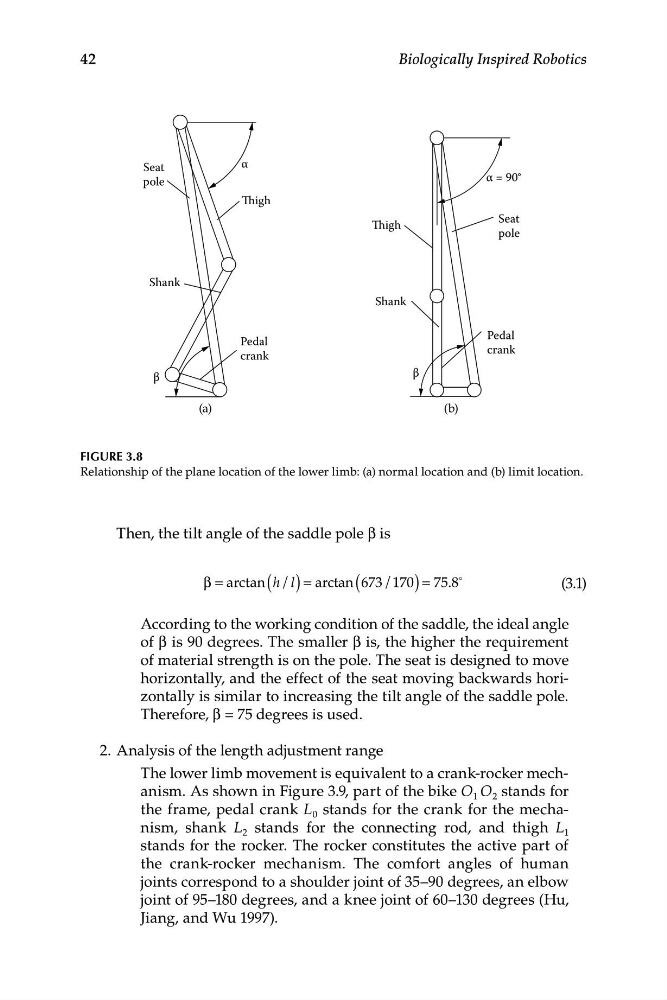
FIGURE 3.8
Relationship of the plane location of the lower limb: (a) normal location and (b) limit location.
Then, the tilt angle of the saddle pole β is
β = arctan ( / ) = arctan (673/170) = .
K
(3.1)
h l
75 8
According to the working condition of the saddle, the ideal angle
of β is 90 degrees. The smaller β is, the higher the requirement
of material strength is on the pole. The seat is designed to move
horizontally, and the effect of the seat moving backwards horizontally is similar to increasing the tilt angle of the saddle pole.
Therefore, β = 75 degrees is used.
2. Analysis of the length adjustment range
The lower limb movement is equivalent to a crank-rocker mechanism. As shown in Figure 3.9, part of the bike O 1 O 2 stands for
the frame, pedal crank L 0 stands for the crank for the mechanism, shank L 2 stands for the connecting rod, and thigh L 1
stands for the rocker. The rocker constitutes the active part of
the crank-rocker mechanism. The comfort angles of human
joints correspond to a shoulder joint of 35–90 degrees, an elbow
joint of 95–180 degrees, and a knee joint of 60–130 degrees (Hu,
Jiang, and Wu 1997).
pole
Thigh
Pedal
crank
α
Thigh
Shank
Shank
β
Pedal
crank
Seat
pole
β
α = 90°
(a)
(b)
42
Biologically Inspired Robotics
FIGURE 3.8
Relationship of the plane location of the lower limb: (a) normal location and (b) limit location.
Then, the tilt angle of the saddle pole β is
β = arctan ( / ) = arctan (673/170) = .
K
(3.1)
h l
75 8
According to the working condition of the saddle, the ideal angle
of β is 90 degrees. The smaller β is, the higher the requirement
of material strength is on the pole. The seat is designed to move
horizontally, and the effect of the seat moving backwards horizontally is similar to increasing the tilt angle of the saddle pole.
Therefore, β = 75 degrees is used.
2. Analysis of the length adjustment range
The lower limb movement is equivalent to a crank-rocker mechanism. As shown in Figure 3.9, part of the bike O 1 O 2 stands for
the frame, pedal crank L 0 stands for the crank for the mechanism, shank L 2 stands for the connecting rod, and thigh L 1
stands for the rocker. The rocker constitutes the active part of
the crank-rocker mechanism. The comfort angles of human
joints correspond to a shoulder joint of 35–90 degrees, an elbow
joint of 95–180 degrees, and a knee joint of 60–130 degrees (Hu,
Jiang, and Wu 1997).