

40
Biologically Inspired Robotics
Gear 1
Gear 3
Spindle
Gear 4
Spline
shaft
Gear 2
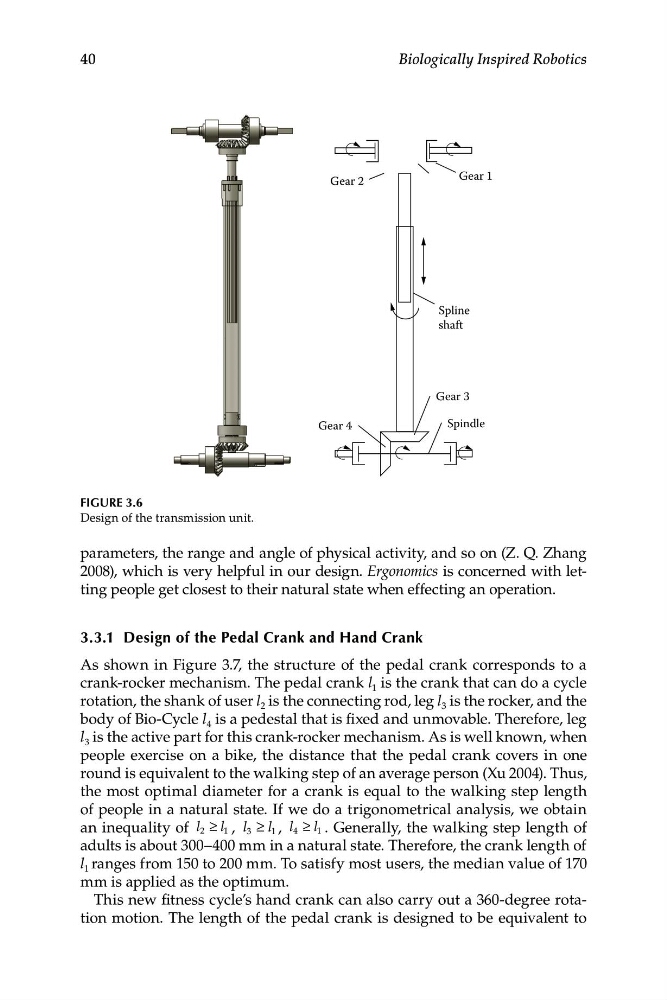
FIGURE 3.6
Design of the transmission unit.
parameters, the range and angle of physical activity, and so on (Z. Q. Zhang
2008), which is very helpful in our design. Ergonomics is concerned with letting people get closest to their natural state when effecting an operation.
3.3.1 Design of the Pedal Crank and Hand Crank
As shown in Figure 3.7, the structure of the pedal crank corresponds to a
crank-rocker mechanism. The pedal crank l 1 is the crank that can do a cycle
rotation, the shank of user l 2 is the connecting rod, leg l 3 is the rocker, and the
body of Bio-Cycle l 4 is a pedestal that is fixed and unmovable. Therefore, leg
l 3 is the active part for this crank-rocker mechanism. As is well known, when
people exercise on a bike, the distance that the pedal crank covers in one
round is equivalent to the walking step of an average person (Xu 2004). Thus,
the most optimal diameter for a crank is equal to the walking step length
of people in a natural state. If we do a trigonometrical analysis, we obtain
an inequality of O 2 ≥ O 1 , O 3 ≥ O 1 , O 4 ≥ O 1 . Generally, the walking step length of
adults is about 300–400 mm in a natural state. Therefore, the crank length of
l 1 ranges from 150 to 200 mm. To satisfy most users, the median value of 170
mm is applied as the optimum.
This new fitness cycle’s hand crank can also carry out a 360-degree rotation motion. The length of the pedal crank is designed to be equivalent to
Biologically Inspired Robotics
Gear 1
Gear 3
Spindle
Gear 4
Spline
shaft
Gear 2
FIGURE 3.6
Design of the transmission unit.
parameters, the range and angle of physical activity, and so on (Z. Q. Zhang
2008), which is very helpful in our design. Ergonomics is concerned with letting people get closest to their natural state when effecting an operation.
3.3.1 Design of the Pedal Crank and Hand Crank
As shown in Figure 3.7, the structure of the pedal crank corresponds to a
crank-rocker mechanism. The pedal crank l 1 is the crank that can do a cycle
rotation, the shank of user l 2 is the connecting rod, leg l 3 is the rocker, and the
body of Bio-Cycle l 4 is a pedestal that is fixed and unmovable. Therefore, leg
l 3 is the active part for this crank-rocker mechanism. As is well known, when
people exercise on a bike, the distance that the pedal crank covers in one
round is equivalent to the walking step of an average person (Xu 2004). Thus,
the most optimal diameter for a crank is equal to the walking step length
of people in a natural state. If we do a trigonometrical analysis, we obtain
an inequality of O 2 ≥ O 1 , O 3 ≥ O 1 , O 4 ≥ O 1 . Generally, the walking step length of
adults is about 300–400 mm in a natural state. Therefore, the crank length of
l 1 ranges from 150 to 200 mm. To satisfy most users, the median value of 170
mm is applied as the optimum.
This new fitness cycle’s hand crank can also carry out a 360-degree rotation motion. The length of the pedal crank is designed to be equivalent to