

16
Biologically Inspired Robotics
u
v
_ 1
_ 2
u 0
_ y j
_
y
y out
+
-
y out +
-
y 1
y 2
y 1
y 2
y 3
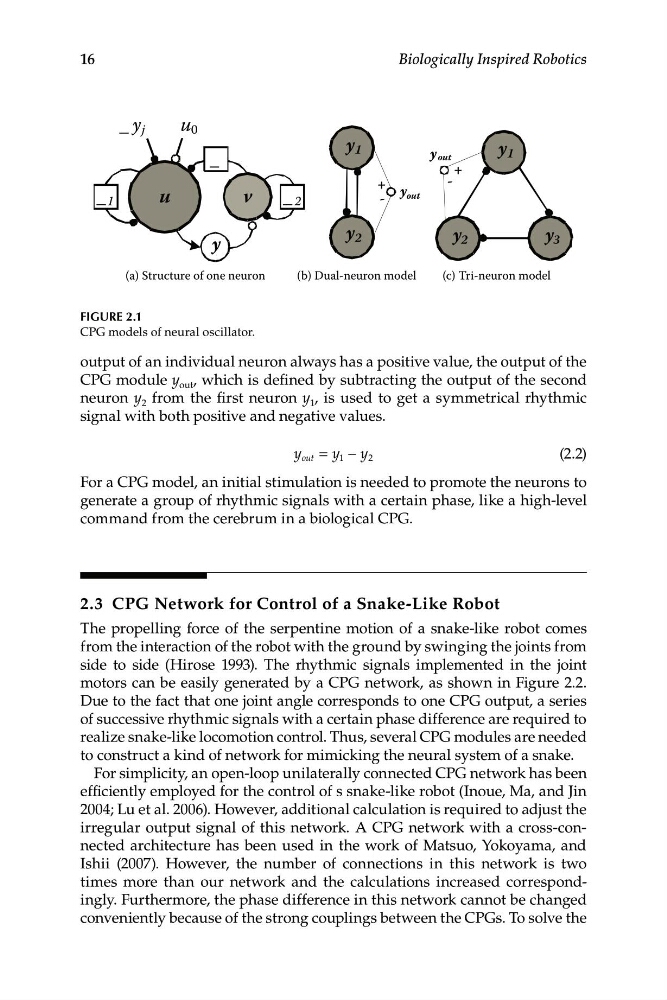
(a) Structure of one neuron
(b) Dual-neuron model
(c) Tri-neuron model
FIGURE 2.1
CPG models of neural oscillator.
output of an individual neuron always has a positive value, the output of the
CPG module y out , which is defined by subtracting the output of the second
neuron y 2 from the first neuron y 1 , is used to get a symmetrical rhythmic
signal with both positive and negative values.
y out = y 1 − y 2
(2.2)
For a CPG model, an initial stimulation is needed to promote the neurons to
generate a group of rhythmic signals with a certain phase, like a high-level
command from the cerebrum in a biological CPG.
2.3 CPG Network for Control of a Snake-Like Robot
The propelling force of the serpentine motion of a snake-like robot comes
from the interaction of the robot with the ground by swinging the joints from
side to side (Hirose 1993). The rhythmic signals implemented in the joint
motors can be easily generated by a CPG network, as shown in Figure 2.2.
Due to the fact that one joint angle corresponds to one CPG output, a series
of successive rhythmic signals with a certain phase difference are required to
realize snake-like locomotion control. Thus, several CPG modules are needed
to construct a kind of network for mimicking the neural system of a snake.
For simplicity, an open-loop unilaterally connected CPG network has been
efficiently employed for the control of s snake-like robot (Inoue, Ma, and Jin
2004; Lu et al. 2006). However, additional calculation is required to adjust the
irregular output signal of this network. A CPG network with a cross-connected architecture has been used in the work of Matsuo, Yokoyama, and
Ishii (2007). However, the number of connections in this network is two
times more than our network and the calculations increased correspondingly. Furthermore, the phase difference in this network cannot be changed
conveniently because of the strong couplings between the CPGs. To solve the